
The Role of CRM in Sales: Your 2026 Revenue Guide
TL;DR:
- A sales CRM is a system of action that transforms customer data into executable sales workflows, not just a contact database. It enhances pipeline management, forecasting accuracy, and team performance by centralizing data, automating tasks, and fostering disciplined usage. Successful implementation relies on embedding structured sales processes, AI-driven recommendations, and behavioral discipline into daily workflows rather than solely focusing on technical deployment.
A sales CRM is defined as a system of action that converts customer data and pipeline activity into executable next steps, not a passive contact database. The role of CRM in sales has shifted from record keeping to revenue execution. Sales CRMs center on four core objects: Contacts, Accounts, Opportunities, and Activities. Each object drives a workflow, not just a data entry. When you treat your CRM as the operational backbone of your sales motion, quota attainment and revenue per rep climb measurably. Mobile-enabled CRM users report 65% quota attainment compared to 22% for those without mobile access, and a 41% increase in revenue per salesperson. That gap is not a coincidence. It reflects what happens when your team lives inside the CRM rather than logging data after the fact.
Pipeline management is where the importance of CRM in sales becomes impossible to ignore. A CRM centralizes customer and prospect data, tracks every pipeline stage, and automates repetitive tasks that otherwise eat your reps’ selling time. Without that centralization, you’re managing your pipeline through spreadsheets, memory, and gut feel. That’s not a pipeline. That’s a guess.
Here’s what a well-configured CRM does for pipeline visibility:
The forecasting benefit alone justifies CRM investment for most sales leaders. When your pipeline data is current and accurate, your weekly forecast call becomes a decision meeting instead of a reconstruction exercise.
Pro Tip: Map specific exit criteria to each pipeline stage inside your CRM. If a rep can’t check a box confirming the criteria are met, the deal doesn’t advance. This one discipline eliminates the “happy ears” problem that inflates pipelines and destroys forecast accuracy.

The impact of CRM on sales execution shows up in three places: speed, consistency, and alignment. Here’s how each plays out in practice.
Elimination of administrative drag. CRM automation reduces repetitive data entry, task logging, and follow-up scheduling. Reps spend more time selling and less time updating spreadsheets. In high-velocity sales environments, this difference compounds fast.
Faster, more consistent follow-up. The average B2B deal requires multiple touchpoints before a decision. A CRM with automated follow-up sequences means no prospect falls through the cracks because a rep got busy. Consistency in follow-up shortens sales cycles because buyers get timely responses at every stage.
Unified customer view across teams. Modern CRM systems unify sales, marketing, and support data through integrated components: sales force automation, marketing automation, and service automation. When your AE can see that a prospect opened three marketing emails and submitted a support ticket last week, they walk into the next call with context that closes deals.
Coaching and pipeline review quality. When your CRM data is reliable, your pipeline reviews shift from “what’s actually in here?” to “here’s what we’re doing about it.” Managers can coach on specific deals with specific data rather than relying on rep self-reporting.
Revenue per rep growth. The 41% revenue increase per salesperson tied to mobile CRM adoption reflects a broader truth: when reps have full pipeline access anywhere, they respond faster, follow up more consistently, and close more deals.
Real talk: most teams underuse their CRM by 40% or more. They log calls but skip stage updates. They create contacts but don’t attach activities. The CRM benefits for sales only materialize when the system reflects reality. Structure beats heroics every time.
Not all CRM usage is equal. This is the nuance most sales leaders miss. A 2026 ScienceDirect study found a curvilinear relationship between CRM infusion intensity and sales performance. Translation: light users see minimal benefit, heavy users see strong gains, but there’s a middle zone where reps experience technostress without yet realizing the payoff.
Here’s a comparison of what low, medium, and high CRM infusion looks like in practice:
| Infusion level | Typical behavior | Sales outcome |
|---|---|---|
| Low | Logs calls occasionally, skips stage updates | Poor pipeline visibility, weak forecasting |
| Medium | Uses CRM daily but inconsistently | Technostress, partial data, unreliable reports |
| High | CRM is the single source of truth for all activity | Accurate forecasts, faster coaching, higher quota attainment |
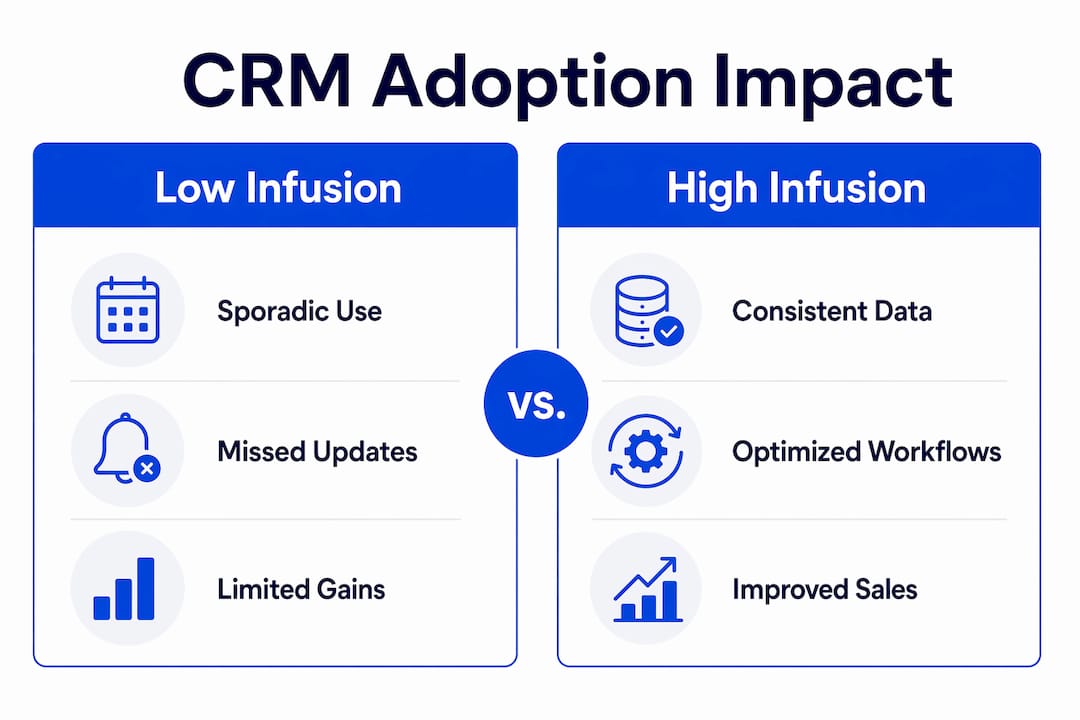
The AI layer changes this equation significantly. A Gartner survey of 227 chief sales officers found that organizations using AI-enabled next best actions inside their CRM workflows are 2.6 times more likely to achieve commercial growth. That’s not AI as a feature. That’s AI operationalized into the daily selling motion. The biggest ROI from AI in CRM comes from embedding recommendations directly into the rep’s workflow, not from dashboards they have to go find.
The managerial implication is direct: stop measuring CRM adoption by seat licenses or login frequency. Measure CRM infusion behaviors. Are reps updating stages after every call? Are they logging activities in real time? Are they acting on AI-generated prompts? Those behaviors predict performance. Seat count does not. For a deeper look at how AI features are reshaping sales tools, the AI impact on sales tech breakdown from Saleslabelconsulting covers the practical tradeoffs.
Pro Tip: During onboarding, pair new CRM users with a “CRM buddy” who is already at high infusion. Peer modeling reduces technostress faster than documentation or training videos. The goal is to get reps past the painful middle zone quickly.
The most common CRM failure is not technical. It’s behavioral. Teams treat the CRM as a system of record rather than a system of action, and the consequences are predictable. Treating CRM as only a data repository results in poor pipeline visibility and degraded coaching effectiveness. Forecasting becomes guesswork. Pipeline reviews become reconstruction work.
Here are the pitfalls that kill CRM value and how to fix each one:
Inconsistent data entry. When reps skip stage updates or log activities days after the fact, your pipeline data is fiction. Fix this by building CRM updates into your sales plays as non-negotiable exit criteria, not optional admin.
No workflow triggers. If reps have to manually decide what to do next after every interaction, they’ll default to whatever feels comfortable. Embedding workflow triggers and next-step automation removes that decision entirely. The CRM tells them what to do next.
Poor data quality limiting AI. Poor data quality is the primary failure point of CRM systems. It causes revenue leakage and limits AI effectiveness. If your CRM data is incomplete, your AI recommendations are wrong. Garbage in, garbage out.
Pipeline reviews without CRM trust. 65% of sales leaders spend over 8 hours weekly trying to understand pipeline status because they don’t trust their CRM data. That’s a full workday lost every week to reconstruction work that disciplined CRM use eliminates.
Measuring adoption instead of infusion. Knowing that 90% of your team logs into the CRM tells you nothing about whether they’re using it to drive decisions. Measure stage update frequency, activity logging rates, and forecast accuracy instead.
The fix is not a new CRM. It’s a disciplined approach to sales pipeline optimization that maps every sales play to specific CRM fields, exit criteria, and automated next steps. When the system reflects reality, it becomes the most powerful coaching and forecasting tool you have.
A CRM functions as a revenue execution platform only when reps treat it as the single source of truth for every deal, activity, and next step in the pipeline.
| Point | Details |
|---|---|
| CRM as system of action | CRM drives workflows through Contacts, Accounts, Opportunities, and Activities, not just data storage. |
| Pipeline visibility requires discipline | Consistent stage updates and activity logging are what make forecasting accurate and coaching effective. |
| AI multiplies CRM value | Organizations with AI-enabled next best actions in CRM are 2.6x more likely to achieve commercial growth. |
| Measure infusion, not adoption | Track how deeply reps use CRM daily, not just login rates, to predict performance impact. |
| Automation removes decision fatigue | Workflow triggers and next-step automation keep reps focused on selling instead of tracking. |
Real talk: I’ve worked with dozens of sales teams that had Salesforce, HubSpot, or Pipedrive fully licensed and barely functional as revenue tools. The CRM was there. The data wasn’t. And without reliable data, the whole system collapses.
The shift I’ve seen work consistently is treating CRM implementation as a sales process design project, not a software rollout. You don’t configure fields and call it done. You map your actual sales plays to specific CRM stages, define exit criteria for each stage, and build automation that tells reps exactly what to do next. When that structure is in place, the CRM stops feeling like overhead and starts feeling like a co-pilot.
The AI piece is real, but it’s not magic. The teams getting 2.6x commercial growth from AI-enabled next best actions didn’t just turn on a feature. They operationalized AI into their daily workflow. That means reps see AI recommendations inside the tools they already use, not in a separate dashboard they have to remember to check. If you’re exploring AI-enhanced CRM workflows, start with one use case: AI-suggested follow-up timing. It’s low friction, immediately measurable, and builds rep trust in the system.
One more thing worth saying directly: the teams that struggle most with CRM adoption are usually the ones where leadership treats CRM compliance as an IT issue. It’s not. It’s a revenue issue. When your VP of Sales opens every pipeline review from the CRM and refuses to discuss deals that aren’t updated, adoption follows. Structure beats heroics. Every time.
— Antony
If you recognize your team in any of the pitfalls above, you’re not alone. Most sales organizations have the tools. What they’re missing is the process architecture that makes those tools produce predictable results.
Saleslabelconsulting works directly with RevOps leaders, Heads of Sales, and VPs of Sales to build the workflow discipline, data governance, and sales play structure that makes CRM investment pay off. From sales enablement step by step to full sales audits that identify where your pipeline is leaking revenue, the work is always grounded in your actual sales motion, not generic best practices. If you want predictable revenue instead of pipeline theater, that’s exactly what we’re built for.
A sales CRM serves as the operational system that tracks every prospect interaction, manages pipeline stages, and automates next steps for sales reps. Its core function is to convert customer data into executable workflows that drive revenue, not just store contact information.
CRM improves forecasting by centralizing real-time pipeline data with defined stage criteria and activity logs, giving managers an accurate view of deal health. When data entry is consistent, forecast accuracy reflects actual pipeline reality rather than rep self-reporting.
Salesforce, HubSpot, and Pipedrive are among the most widely used CRM tools for sales management, each offering pipeline tracking, automation, and AI-assisted features. The right choice depends on team size, sales complexity, and integration requirements.
Organizations that embed AI-enabled next best actions directly into CRM workflows are 2.6 times more likely to achieve commercial growth than those that don’t. The key is operationalizing AI into the rep’s daily workflow, not offering it as a standalone feature.
CRM implementations fail most often because of poor data quality, inconsistent usage, and treating the system as a record keeper rather than a workflow driver. Measuring CRM infusion behaviors rather than login rates is the most reliable way to identify and fix adoption gaps.
Subscribe to our Insights: Expert productivity tips in your inbox
You'll receive 1-3 emails per month. Your data stays private, always.

CRO & Co-Founder with Sales Label Consulting

Watch our Sales Mates Podcast
October 19, 2026 - 10 min read
Read article Read articleOctober 18, 2026 - 10 min read
Read article Read articleOctober 17, 2026 - 7 min read
Read article Read articleOctober 16, 2026 - 8 min read
Read article Read article