
Why Sales Alignment Matters for Revenue Growth
TL;DR:
- Sales and marketing misalignment primarily results from operating-model disagreements, not missing technology.
- Consistent definitions, shared SLAs, weekly pipeline reviews, and RevOps support are essential for enduring alignment.
Misaligned sales teams are quietly draining your pipeline. Companies lose an estimated $1 trillion annually due to sales and marketing misalignment, and yet most organizations keep throwing new tools at the problem and wondering why nothing changes. Why sales alignment matters isn’t just a theoretical question. It’s the difference between a sales org that scales predictably and one that burns through leads, budget, and reps without hitting targets. This article gives you the real operational and cultural picture, with frameworks you can actually put to work.
| Point | Details |
|---|---|
| Alignment is not a tool problem | Most misalignment stems from operating-model disagreements, not missing software. |
| The revenue cost is real | Misaligned organizations close fewer deals and pay up to 36% more to acquire customers. |
| Lead definitions come first | Without a shared definition of a qualified lead, every other process breaks down. |
| Rhythm beats one-time fixes | Weekly joint pipeline reviews sustain alignment better than quarterly resets or audits. |
| RevOps is the enforcer | A functioning RevOps layer keeps shared goals, dashboards, and SLAs accountable over time. |
Sales alignment means your sales and marketing teams share the same goals, use the same definitions, and hold each other accountable to the same metrics. That sounds straightforward. In practice, it almost never is.
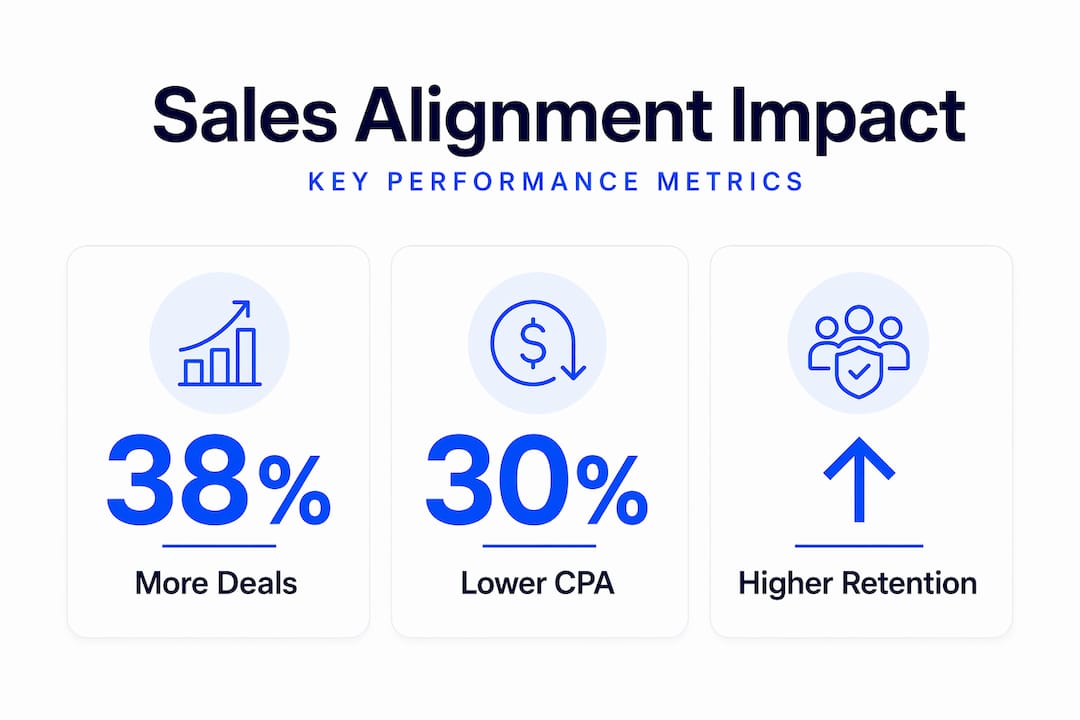
Here’s what the data says about the impact of sales alignment. Aligned organizations close 38% more deals and see 36% higher customer retention. When alignment breaks down, customer acquisition costs spike by 36% and pipeline quality collapses. That’s not a marginal difference. That’s the gap between hitting ARR targets and missing them by a mile.
The environment in 2026 makes this even harder to ignore. The average B2B purchase now involves 11 to 13 stakeholders, which means you can’t afford to send mixed messages across a buying committee. Every touchpoint needs to carry the same narrative, or you lose credibility at exactly the wrong moment.
Real talk: Sales alignment isn’t a feel-good initiative. It’s a revenue protection strategy. When your teams are pulling in opposite directions, your buyers feel it before your dashboards do.
The misalignment shows up in familiar ways:
Every one of those situations costs you money. And you can’t fix any of them with a new CRM.
The uncomfortable truth is that most alignment failures stem from operating-model disagreements, not missing technology. You can connect every tool in your stack and still have teams fighting over lead quality, blaming each other for missed targets, and making strategy decisions based on incomplete data.
The single biggest culprit? Lead definitions. When marketing defines an MQL differently than sales defines a sales-ready opportunity, operational tooling enforces conflicting definitions and accelerates the divide. Up to 80% of marketing-generated leads never receive any sales follow-up, largely because of this definitional gap. That’s not a volume problem. That’s a coordination failure.
Here are the operational breakdowns that show up most often across organizations:
Cultural friction compounds all of this. When the norm is “quarterly blame” sessions where sales says marketing sends garbage and marketing says sales doesn’t follow up, there’s no structural change that fixes the underlying dynamic. The tools are just scorecards for the argument.
Pro Tip: Before any tech conversation, get both teams in the same room to agree on three things: what a qualified lead looks like, what the follow-up SLA is, and what “winning” means for both teams together. That 90-minute meeting is worth more than any platform integration.
You don’t need a perfect org structure to align your teams. You need repeatable practices that keep teams synchronized across the entire revenue cycle. Here’s what actually works, broken down into a sequence that builds on itself.
Define your lead taxonomy together. Marketing and sales must agree on MQL, SQL, and opportunity definitions before anything else. Write it down. Attach behavioral criteria. Make it measurable, not subjective.
Create bilateral SLAs. Shared SLAs transform vague expectations into measurable commitments. Marketing commits to volume and quality thresholds. Sales commits to follow-up timing. Both sides are accountable.
Run weekly joint pipeline reviews. Weekly 30-minute joint pipeline meetings create real-time feedback loops that quarterly reviews simply can’t replicate. You catch problems in the current cycle, not two months after the damage is done.
Build shared dashboards. Both teams should look at the same funnel data in the same place. Separate reporting creates separate realities. Unified data creates shared ownership.
Align incentives to revenue outcomes. If marketing is rewarded for lead volume and sales is rewarded for closed-won, you’ve built a misalignment engine. Tie at least part of both teams’ compensation to shared pipeline quality and revenue metrics.
Install RevOps as the operating layer. RevOps doesn’t just manage tools. It supports alignment and seamless handoffs between sales and marketing and holds the entire operating model accountable.
Pro Tip: If your RevOps team spends most of its time on data hygiene and report-building instead of facilitating alignment reviews and process decisions, you’re underutilizing it. Reframe the role from “data plumber” to “alignment enforcer.”
Here’s a quick comparison of misaligned versus aligned sales operations so you can see the delta clearly:
| Area | Misaligned state | Aligned state |
|---|---|---|
| Lead definitions | Each team uses its own criteria | Shared, documented MQL and SQL definitions |
| Pipeline reviews | Quarterly, focused on blame | Weekly, focused on improvement |
| Data visibility | Siloed dashboards per team | Unified CRM view accessible to both |
| Incentives | Activity-based, team-specific | Revenue-based, shared across teams |
| SLAs | Informal or nonexistent | Documented, tracked, and reviewed regularly |
The impact of sales alignment on day-to-day performance is concrete, not abstract. Aligned sales strategies increase deal velocity, win rates, and average deal sizes while reducing acquisition costs. Let’s get specific about where that shows up.

Tighter messaging closes more deals. When sales reps carry the same narrative that marketing built into the market, buyers experience consistency. That consistency builds trust. Trust accelerates decisions. Coordinated outreach across email, ads, and direct sales conversations signals that your company knows what it’s doing. Buyers notice.
Better targeting lowers cost per acquisition. With cost per lead up 30 to 40% since 2023, you can’t afford to waste a single lead on a rep who doesn’t know what to do with it, or on a campaign chasing the wrong profile. When both teams agree on the ICP and work from the same data, spend goes to the right places.
Forecast accuracy actually improves. When pipeline stages mean the same thing to everyone, forecasts reflect reality. When they don’t, every forecast is a guess dressed up in spreadsheet formatting. Sales leaders making headcount and budget decisions need a pipeline they can trust.
Here’s a summary of the performance outcomes tied to each alignment practice:
| Alignment practice | Performance outcome |
|---|---|
| Shared ICP and messaging | Higher win rates and faster close cycles |
| Joint lead definitions and SLAs | Fewer wasted leads, lower CAC |
| Unified dashboards | More accurate forecasting |
| Weekly pipeline reviews | Earlier risk identification, higher pipeline quality |
| Aligned incentives | Better cross-team cooperation, stronger revenue outcomes |
The customer experience benefit is often underestimated. When a prospect moves from a marketing email to a sales conversation and the messaging is consistent, they feel like they’re dealing with a company that has its act together. That perception matters at every stage of the buying cycle, especially in complex B2B deals involving large buying committees.
I’ve worked with sales leaders who were convinced that buying a new platform would fix the misalignment in their org. In almost every case, the platform made the existing disagreements more visible, not smaller.
What I’ve learned is that true revenue operations alignment is about shared operating cadence and agreements, not technology stacks. I’ve seen alignment collapse within a single quarter when the weekly joint reviews stopped happening. Not because the tools broke. Because the rhythm broke.
The other thing I’d push back on is the idea that alignment is a project with a finish line. It isn’t. The sales alignment for growth that sustainable organizations build is a permanent operating rhythm, one that requires ongoing facilitation, not a one-time workshop.
The shift from blame culture to collaboration culture is where most leaders get stuck. It’s not comfortable. It means marketing has to hear that their leads aren’t converting and actually do something with that feedback. It means sales has to stop treating marketing as a service function and start treating it as a co-owner of revenue. That shift is harder than any technology decision you’ll make.
My advice? Start with the conversation, not the dashboard. Get the right people in the room, agree on definitions, and build the operating rhythm before you buy anything new. Structure beats heroics every time.
— Antony
Understanding why alignment matters is one thing. Building the operating model that sustains it is where most sales leaders need a guide. Saleslabelconsulting works directly with RevOps leaders, Heads of Sales, and VPs of Sales to identify where misalignment is costing them pipeline and revenue, then builds the frameworks to fix it.
Whether your challenge is a broken lead handoff process, disconnected incentive structures, or a forecasting model that no one trusts, our sales enablement for predictable revenue practice gives you a repeatable system that doesn’t depend on heroics from any single rep or manager. We also publish in-depth thinking on sales enablement best practices for teams scaling in competitive environments. If your teams are ready to stop running in parallel and start pulling together, let’s talk.
Aligned organizations close 38% more deals and retain customers at higher rates. Misalignment inflates acquisition costs and wastes a significant portion of the leads your marketing budget generates.
Most misalignment comes from disagreements on lead definitions and operating processes, not missing tools. When marketing and sales define qualified leads differently, every downstream process suffers.
Weekly 30-minute joint pipeline reviews are more effective than quarterly sessions. Short, frequent meetings create real-time feedback loops that catch problems before they compound.
RevOps functions as the operating layer that enforces shared definitions, tracks SLA compliance, and keeps dashboards unified. Without it, alignment agreements tend to erode within one quarter.
No. Tools enforce whatever definitions and processes already exist. If those definitions are contested or unclear, technology accelerates the misalignment rather than fixing it.
Subscribe to our Insights: Expert productivity tips in your inbox
You'll receive 1-3 emails per month. Your data stays private, always.

CRO & Co-Founder with Sales Label Consulting

Watch our Sales Mates Podcast
September 15, 2026 - 10 min read
Read article Read articleSeptember 14, 2026 - 10 min read
Read article Read articleSeptember 13, 2026 - 8 min read
Read article Read articleSeptember 12, 2026 - 10 min read
Read article Read article