
Lead Scoring Guide for B2B Sales and Marketing Leaders
TL;DR:
- Effective lead scoring distinguishes between fit and intent, improving routing and outreach precision.
- Maintaining clean data, operational discipline, and continuous model calibration are crucial for long-term success.
Your sales team is busy. But busy doesn’t mean productive. Without a clear lead scoring guide, reps spend hours chasing mid-funnel contacts who will never buy, while genuinely ready prospects go cold waiting for a call. This guide cuts through the noise and gives you the frameworks, models, and operational habits needed to build lead scoring that actually moves pipeline. Whether you’re starting from scratch or fixing a broken system, you’ll find concrete steps from data prep to AI-powered execution to scaling across your entire buying committee.
| Point | Details |
|---|---|
| Scoring separates fit from intent | Keep fit and intent as distinct scores to enable smarter routing and more targeted outreach. |
| Data quality comes before modeling | Scrubbing historical win/loss data is non-negotiable before activating any scoring model. |
| Temporal signals outperform static data | Recency and engagement velocity predict conversion better than firmographics alone. |
| Operational discipline beats platform hype | Weekly audits and feedback loops sustain scoring performance far better than quarterly reviews. |
| Measure what changes pipeline | Track win rates, pipeline velocity, and customer acquisition cost to prove and improve scoring ROI. |
Lead scoring is the practice of assigning numerical values to leads based on how likely they are to become customers. But here’s where most teams get it wrong. They treat scoring as one number on a contact record, when it really needs to be two separate signals: fit and intent.
Fit answers whether a lead matches your ideal customer profile. Think firmographics like company size, industry, and technology stack. Intent answers whether they’re in-market right now, based on behavioral signals like page visits, content downloads, and pricing page views. Separating these into a 2×2 matrix enables targeted routing. High-fit, high-intent leads go straight to a sales rep. High-fit, low-intent leads enter a nurture sequence. Treating both signals as one number collapses that logic entirely.
The four primary lead scoring models you’ll encounter:
The business case is not subtle. Mature scoring systems improve win rates by 30 to 50% and cut customer acquisition cost by 50% for top-performing teams. And yet, fewer than 10% of leads ever reach a genuinely sales-ready score threshold. That gap is where your revenue is hiding.
No model saves you from bad inputs. Before you build anything, you need to audit your data. Pull your last 12 to 24 months of closed-won and closed-lost deals. Look for patterns: which industries converted fastest, which company sizes churned within 90 days, which job titles actually signed contracts. Using unaudited historical data to train a model bakes legacy bias directly into your scoring. That’s not a minor issue. It’s how you end up routing the wrong leads to your best reps.
Here’s a practical setup sequence:
Pro Tip: Before running any alignment session, pull five real examples of leads that were scored highly but went nowhere, and five that were scored low but converted. Those examples will do more to calibrate your team’s thinking than any slide deck.
With clean data and team alignment locked in, you’re ready to build. Your first decision is choosing the right approach for your current data maturity.
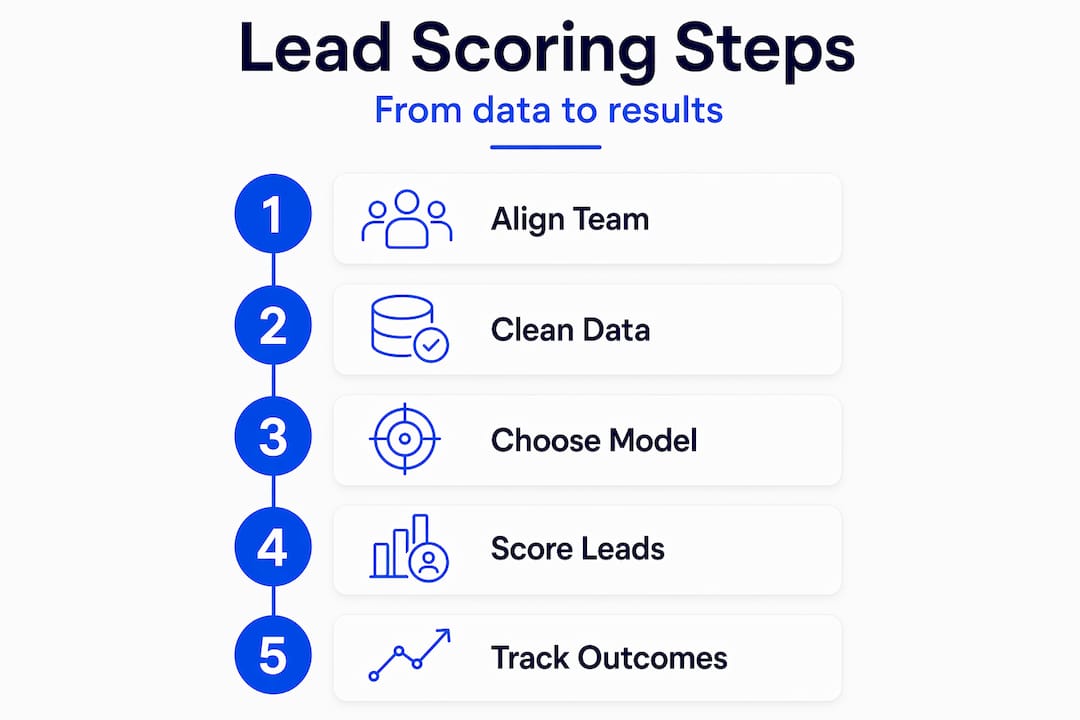
If you have fewer than 500 historical deals to train on, start with a fit-intent matrix. It’s manual, it’s transparent, and it gives your SDRs something they can actually explain to a prospect. If you have 1,000-plus deals and a connected tech stack, predictive AI is worth the investment. AI scoring takes four to eight weeks to ship an initial version, with meaningful optimization happening over the first quarter.
Static data like job title or company size doesn’t change often. Engagement signals do. Velocity and recency are significantly more predictive than static firmographics. A lead who visited your pricing page three times this week is fundamentally different from one who did so six months ago. Build score decay into your model from day one. A lead that was scored at 80 points and has shown zero engagement for 30 days should automatically drop. Stale high scores clog your pipeline and destroy rep trust.
The most effective approach uses what’s called the AAA framework: fit multiplied by intent multiplied by engagement. The AAA framework surfaces in-market prospects with a precision that single-dimension models can’t match. Here’s what that looks like in practice:

| Score dimension | Example signals | Weight |
|---|---|---|
| Fit | Company size, industry, tech stack match | 40% |
| Intent | Third-party intent data, pricing page visits | 35% |
| Engagement | Email opens, webinar attendance, demo requests | 25% |
Account-level scoring adds another layer. If three contacts at the same company all cross the 60-point threshold within two weeks, that’s a buying committee signal worth more than any single contact score. Relational ML models detect exactly this, using what researchers call “colleague signals” to amplify scores when multiple contacts at an account show buying behavior simultaneously.
Pro Tip: Pilot your scoring model in one segment first, not across your entire database. Track meeting acceptance rates, conversion from MQL to opportunity, and time-to-close for that segment over 60 days before rolling out broadly.
Most teams build a scoring model, celebrate the launch, and then slowly watch it degrade. Many teams fail by treating lead scoring as a project rather than an ongoing operational process. That’s the number one mistake. Here’s where things tend to fall apart:
Real talk: The team that reviews scoring performance every week and adjusts in real time will outperform the team with the fancier AI model that checks in once a quarter. Structure beats heroics every time.
You’ve launched. You’ve piloted. Now it’s time to prove the ROI and grow the program. The metrics that matter most:
Scaling beyond individual leads means building toward a lead qualification guide for your entire buying committee. That means scoring accounts and individual contacts simultaneously, then surfacing accounts where multiple contacts show buying signals at the same time.
For ongoing accuracy, use cohort-aware retraining. Segment your historical data by time period and rebuild your model with recent cohorts weighted more heavily. Scoring systems must adjust for market shifts by retraining on current buyer behavior, not static legacy patterns. Plan a recalibration schedule: monthly for fast-moving markets, quarterly as a minimum for everyone else.
One final move that most teams overlook: align compensation incentives to scoring accuracy. When SDRs are partly measured on how well they use and refine scoring data, you get a feedback loop instead of a one-way report.
I’ve seen teams spend months selecting the perfect AI scoring platform and then fail because nobody agreed on what a sales-ready lead actually means. And I’ve seen scrappy teams with a simple spreadsheet-based fit-intent matrix outperform their tool-heavy competitors because they ran weekly reviews and actually talked to each other.
The technology matters less than the operational discipline. What I’ve consistently found is that the biggest blind spot isn’t the model. It’s the data behind it. Teams underestimate how much time it takes to clean historical CRM data properly, and they underestimate how badly dirty data corrupts even sophisticated predictive models.
Separating fit and intent scores transformed every engagement I’ve had where we implemented it. Sales suddenly stopped complaining that marketing was sending junk leads. Marketing stopped feeling like their MQLs were being ignored. They were looking at two dimensions instead of one, and routing decisions became defensible.
The frontier I’m watching now is real-time orchestration: using live behavioral signals to trigger personalized outreach at the exact moment a prospect crosses an intent threshold. Pair that with relational models that pick up on buying committee signals across connected contacts and you’re not just scoring leads. You’re predicting the precise moment to show up. That’s where effective lead scoring is heading, and the teams building toward it now will have a serious competitive edge.
— Antony
A sharp scoring model without sales enablement behind it is like a great GPS in a car with no fuel. You know where to go. You just can’t get there.
At Saleslabelconsulting, we work with RevOps leaders, Heads of Sales, and VPs of Sales to make scoring systems stick by building the enablement infrastructure around them. That means playbooks, rep training, CRM workflows, and feedback loops that turn a model into a machine. If you’re ready to move from theory to execution, our step-by-step sales enablement program is built exactly for that. And if you want to see what best-in-class looks like at scale, explore our sales enablement best practices for growing B2B teams.
Lead scoring is the process of assigning numerical values to leads based on fit, intent, and behavioral signals to help sales teams prioritize the most likely buyers. Mature systems improve win rates by 30 to 50% and reduce customer acquisition cost significantly.
Combining fit and intent into a single score collapses the routing logic you need to act on each signal differently. High-fit, high-intent leads need immediate sales contact, while high-fit, low-intent leads belong in a nurture sequence.
A basic fit-intent matrix can be set up in one to two weeks. AI-driven predictive scoring models typically take four to eight weeks to ship an initial version, with optimization continuing over the first quarter.
Score decay automatically reduces a lead’s score after a period of inactivity. Without decay, your pipeline fills with stale high-scored leads that reps waste time on, undermining trust in the entire scoring system.
Lead scoring and qualifying B2B leads work together: scoring surfaces who is ready, while qualification confirms fit through direct rep conversation. The best teams use scoring to triage and qualification to verify before committing full sales cycles.
Subscribe to our Insights: Expert productivity tips in your inbox
You'll receive 1-3 emails per month. Your data stays private, always.

CRO & Co-Founder with Sales Label Consulting

Watch our Sales Mates Podcast
September 30, 2026 - 10 min read
Read article Read articleSeptember 29, 2026 - 13 min read
Read article Read articleSeptember 28, 2026 - 12 min read
Read article Read articleSeptember 27, 2026 - 11 min read
Read article Read article