
What Is a Sales Funnel? A Guide for Marketers
TL;DR:
- Most marketers can draw a sales funnel but struggle to understand why deals fall out of it.
- A sales funnel tracks the buyer’s psychological journey through measurable stages, not just a linear path.
Most marketers can draw a funnel on a whiteboard. Far fewer can tell you why deals fall out of it. Understanding what is a sales funnel goes beyond knowing the shape. It means grasping the buyer’s psychology at every stage, knowing which signals indicate forward momentum, and having the discipline to measure drop-offs without making excuses for them. The funnel is not a rigid pipeline you push deals through. It’s a living map of buyer behavior that you design, instrument, and continuously fix. This guide breaks all of that down.
| Point | Details |
|---|---|
| Funnel vs. pipeline distinction | A funnel tracks buyer conversion behavior; a pipeline tracks seller deal activity. Confusing the two misaligns teams. |
| Stages are flexible, not fixed | Buyers skip, regress, and loop through stages, so your funnel design must account for non-linear movement. |
| Build with measurable criteria | Every stage entry and exit needs a verifiable condition to compute conversion rates and find leaks reliably. |
| Optimization starts with data | Drop-off analysis and conversion rate tracking turn guesswork into targeted fixes at specific funnel points. |
| Alignment is non-negotiable | Marketing and sales must share funnel ownership, stage definitions, and performance data to close revenue gaps. |
The sales funnel definition that most people learn first is deceptively simple: a wide top where many prospects enter, a narrowing middle where interest grows, and a narrow bottom where buyers convert. That image is useful. It is also incomplete.
A more accurate framing is this. A sales funnel tracks the buyer’s journey from the moment they become aware of a problem through to the moment they make a purchase decision. The funnel’s job is to help sellers understand where buyers are mentally and what they need next. Every stage represents a shift in the buyer’s intent, not just a step in a sales sequence.
Here’s the distinction that changes how teams operate. The funnel is buyer-focused. Marketing funnels draw in audiences, while sales funnels guide them from awareness to purchase, and that requires different strategic priorities at each stage. A sales pipeline, by contrast, is seller-focused. It tracks deal status, tasks, and rep activity. Conflating the funnel with the pipeline can misalign team responsibilities and cause you to optimize the wrong thing entirely.
What the funnel gives you practically:
The real talk here? Most teams have a funnel diagram on a slide deck but no actual funnel instrumented in their CRM. That’s the gap this guide is here to close.
The most commonly referenced model runs six stages: Awareness, Interest, Consideration, Intent, Evaluation, and Purchase. The US Chamber model condenses this into four steps. Neither is wrong. What matters is that your stage model reflects how your specific buyers actually behave.
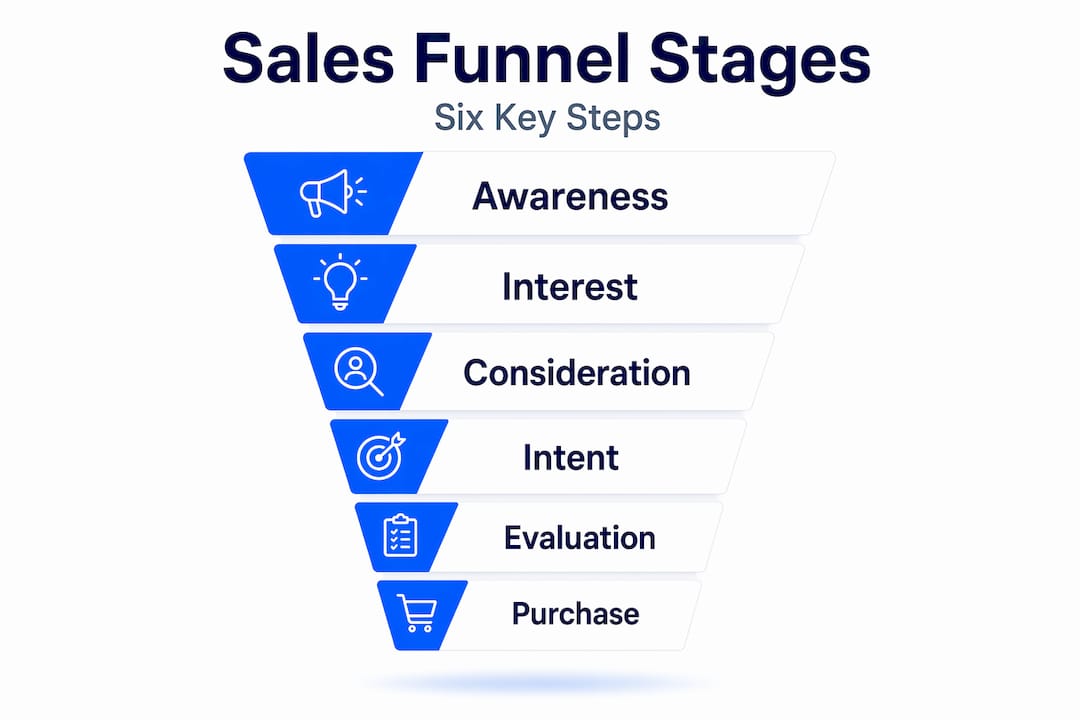
Here’s how the six-stage Salesforce model maps against a simplified four-step version:
| Stage | Salesforce 6-Stage Model | US Chamber 4-Step Model | Buyer Action |
|---|---|---|---|
| 1 | Awareness | Awareness | Discovers the problem or solution |
| 2 | Interest | Interest | Seeks more information, engages content |
| 3 | Consideration | Consideration | Compares options, requests demos |
| 4 | Intent | Consideration (continued) | Shows buying signals, requests pricing |
| 5 | Evaluation | Decision | Reviews proposals, involves stakeholders |
| 6 | Purchase | Purchase | Closes and signs |
The major misconception most sales teams carry is that buyers move cleanly from stage one to stage six. They don’t. Prospects do not always follow a linear path. They may jump stages after reading a strong case study, regress from Evaluation back to Consideration after a budget conversation, or go completely dark after showing strong Intent. This flexibility requires agile funnel design and active intervention from your team.
What makes stage management actually work is not the stage names. It’s the criteria. Stage-to-stage conversion tracking requires verifiable criteria to compute accurate metrics and diagnose funnel leaks effectively. “They seem interested” is not an exit criterion for the Interest stage. “Prospect has attended a demo and submitted a follow-up question” is.
Pro Tip: Define a single measurable exit condition for every funnel stage before you start tracking. One condition per stage is enough to get started. Vague stage definitions are the number one reason funnel metrics lie to you.
Building a funnel that actually generates revenue is a sequential process, not a creative exercise. Here’s the framework that works in practice:
Define your ICP and map the buyer journey. Before you build anything, you need to know who enters the funnel and what questions they ask at each stage. Interview your best customers. Pull your closed-won data. Document the real path from problem awareness to purchase decision.
Generate leads with intent-targeted content. The top of the funnel lives or dies by the quality of attention it attracts. Useful content, paid search, social campaigns, and referral programs are all entry points. For practical lead generation tactics, the guide on generating MQLs from data research covers this in depth.
Nurture with purpose, not volume. Lead generation, nurturing, and conversion are the three macro stages of any funnel. Nurturing is where most teams lose the plot. Sending five generic emails is not nurturing. Delivering a targeted case study to a prospect who just visited your pricing page is. Map your messaging to stage, not just to persona.
Build your lead nurturing workflow. A structured lead nurturing workflow uses triggers, not timers. When a prospect takes a specific action, the next communication fires. That keeps outreach relevant and reduces drop-off at mid-funnel.
Instrument every stage in your CRM. Enter your stage criteria into your CRM as required fields or validation rules. This is non-negotiable. Without it, your funnel reports are based on rep judgment, which is inconsistent at best.
Identify and act on buying signals. At the Intent and Evaluation stages, sales funnel software provides visualization, automation, and analytics to help reps see who’s hot and what’s blocking the deal. Use those signals to time outreach precisely.
Align marketing and sales on stage ownership. Which team owns which stage? Who hands off the lead and when? If you can’t answer both questions in one sentence, your funnel has a structural gap.
Pro Tip: Don’t design your funnel around your sales process. Design it around your buyer’s decision process, then fit your sales motions to match. The difference sounds subtle but it changes everything from your content calendar to your SDR call scripts.
Building a funnel is table stakes. Analyzing it is where the real performance gains live.

Sales funnels are optimized using conversion and drop-off rate analysis to identify where prospects abandon or slow down. This is a distinct discipline from pipeline management. Pipeline management asks “what deals do we have and when do they close?” Funnel analysis asks “at which stage are we losing the most buyers, and why?”
The key metrics that tell the real story:
| Metric | What it tells you | Where to act |
|---|---|---|
| Stage conversion rate | Where buyers disengage most | Improve content or qualification at that stage |
| Funnel velocity | Where deals stall | Investigate friction: pricing, stakeholders, competition |
| Drop-off volume | Where revenue leakage is largest | Prioritize fixes at highest-volume loss stages |
| Lead source conversion | Which channels produce real buyers | Reallocate budget from volume sources to quality sources |
The analysis only works if your tracking is unified. Multi-channel funnel instrumentation is key to accurately attributing prospect touchpoints. Without it, you see activity but can’t connect that activity to conversion behavior. A prospect who reads three blog posts, attends a webinar, and then responds to a cold email converted because of all three touchpoints, not just the last one. Single-channel attribution hides this.
For teams that have done the basics and want a more advanced view, sales funnel optimization steps that drive measurable conversion lifts go well beyond these fundamentals.
I’ve watched sales teams spend weeks debating stage names while doing zero stage instrumentation. And I’ve worked with marketers who could draw a beautiful funnel diagram but had no idea what their stage three conversion rate was.
Here’s what I’ve actually learned from working through funnel audits with RevOps and Head of Sales teams: the funnel is only as useful as the discipline behind it. You can copy a six-stage model from any playbook. What you can’t copy is the culture of measuring it honestly and acting on what the data says, even when the data says your top-of-funnel content is attracting the wrong buyers.
The most common mistake I see is treating funnel stages as labels rather than states. A prospect is not “in Consideration” because a rep moved them there on Friday. They are in Consideration because they have demonstrated specific behavior that meets your defined criteria. That distinction alone transforms how teams manage their funnels.
My other strong opinion: stop copying generic funnel models wholesale. A self-serve SaaS product has a fundamentally different buyer journey than a six-figure enterprise deal. Build your funnel around your buyer’s actual decision process. Then instrument it, measure it relentlessly, and fix the biggest leak first. Structure beats heroics every single time.
— Antony
If reading this article surfaced gaps in how your team currently tracks, stages, or converts pipeline, that’s a productive realization. The next question is: what do you do about it?
Saleslabelconsulting works directly with RevOps leaders, Heads of Sales, and VPs of Sales to build and fix sales funnels that produce predictable revenue. That means stage definitions grounded in real buyer behavior, instrumentation that gives you honest conversion data, and sales enablement frameworks that align your marketing and sales motions. Whether you need a full sales enablement program built from the ground up or a targeted audit of where your funnel is leaking, the team at Saleslabelconsulting brings the experience to do it without the guesswork. Real talk: most funnel problems are fixable. You just need the right diagnostic framework to find them.
A sales funnel is a model that maps the buyer’s journey from first awareness of a product or problem through to a purchase decision. It helps sales and marketing teams understand buyer intent at each stage and take the right action to move prospects forward.
Stage counts vary by company and model. The Salesforce model uses six stages (Awareness, Interest, Consideration, Intent, Evaluation, Purchase) while the US Chamber model uses four. What matters is that your stages reflect your actual buyer journey and have measurable entry and exit criteria.
A sales funnel focuses on the buyer’s conversion behavior and psychological journey. A sales pipeline tracks the seller’s deal status and activities. Mixing up the two creates accountability gaps and causes teams to optimize seller tasks instead of buyer experience.
Track the conversion rate between each consecutive stage. The stage with the largest drop-off percentage or the highest volume of exits is your primary leak point. From there, analyze the common characteristics of prospects who dropped off to diagnose the root cause.
A well-instrumented funnel gives revenue teams a shared, objective view of where buyers are, what’s blocking conversion, and which activities actually produce closed revenue. Without it, sales and marketing operate on gut feel, which rarely scales.
Subscribe to our Insights: Expert productivity tips in your inbox
You'll receive 1-3 emails per month. Your data stays private, always.

CRO & Co-Founder with Sales Label Consulting

Watch our Sales Mates Podcast
October 22, 2026 - 9 min read
Read article Read articleOctober 21, 2026 - 9 min read
Read article Read articleOctober 20, 2026 - 9 min read
Read article Read articleOctober 19, 2026 - 10 min read
Read article Read article