
Sales pipeline health explained: boost predictability fast
Most sales leaders we talk to are proud of a full pipeline. Lots of deals, lots of activity, lots of optimism. But here’s the real talk: a bloated pipeline with the wrong deals at the wrong stages is not an asset. It’s a liability. Healthy pipelines are more predictive of revenue than simply having a large number of deals. If you’re leading sales at an IT company in Europe and you want predictable growth, you need to stop counting deals and start measuring pipeline health. This guide covers exactly how to do that.
| Point | Details |
|---|---|
| Pipeline health over volume | A healthy sales pipeline is about quality and balance, not just having more deals. |
| Track the right metrics | Metrics like conversion rates and pipeline velocity give an accurate picture of pipeline health. |
| Regular reviews matter | Consistent pipeline reviews help catch problems early and boost sales predictability. |
| Expert intervention helps | Consulting and structured frameworks fix common sales pipeline pitfalls for lasting impact. |
Sales pipeline health is not about volume. It’s about whether your pipeline is balanced, moving, and filled with deals that are actually likely to close. Think of it like a river. A healthy river flows steadily. A clogged one floods in some places and runs dry in others.
Sales pipeline health is a critical driver of forecast accuracy and win rates. When your pipeline is healthy, your forecasts are reliable, your team knows where to focus, and your revenue becomes predictable. When it’s not, you’re guessing.
For IT sales teams, poor pipeline health often shows up in specific, recognizable patterns. Here are the warning signs to watch for:
Understanding the difference between a lead vs prospect is foundational here. Mixing unqualified leads with real opportunities distorts your entire pipeline picture.
Understanding pipeline health means measuring the right things. Let’s look at the most critical metrics and what they reveal.

Tracking key pipeline metrics leads to improved win rates and sales efficiency. Teams that track pipeline velocity see 22% higher accuracy in forecasting. That’s not a small edge. That’s the difference between hitting your number and missing it by a mile.
Here are the five metrics every IT sales leader should track:
| Metric | What it measures | How to calculate | Why it matters |
|---|---|---|---|
| Conversion rate | Stage-to-stage deal progression | Deals advanced / deals entered | Spots bottlenecks fast |
| Deal velocity | Speed of pipeline movement | (Deals x Win rate x Deal size) / Sales cycle length | Predicts revenue timing |
| Average deal size | Typical deal value | Total revenue / number of deals closed | Validates pipeline value |
| Pipeline coverage | Buffer against missed targets | Total pipeline value / revenue target | Ensures enough runway |
| Stage duration | Time spent per stage | Average days in each stage | Identifies stagnation |
These pipeline stages definitions matter because without clear stage criteria, your metrics become noise. Define your stages tightly, then measure consistently.
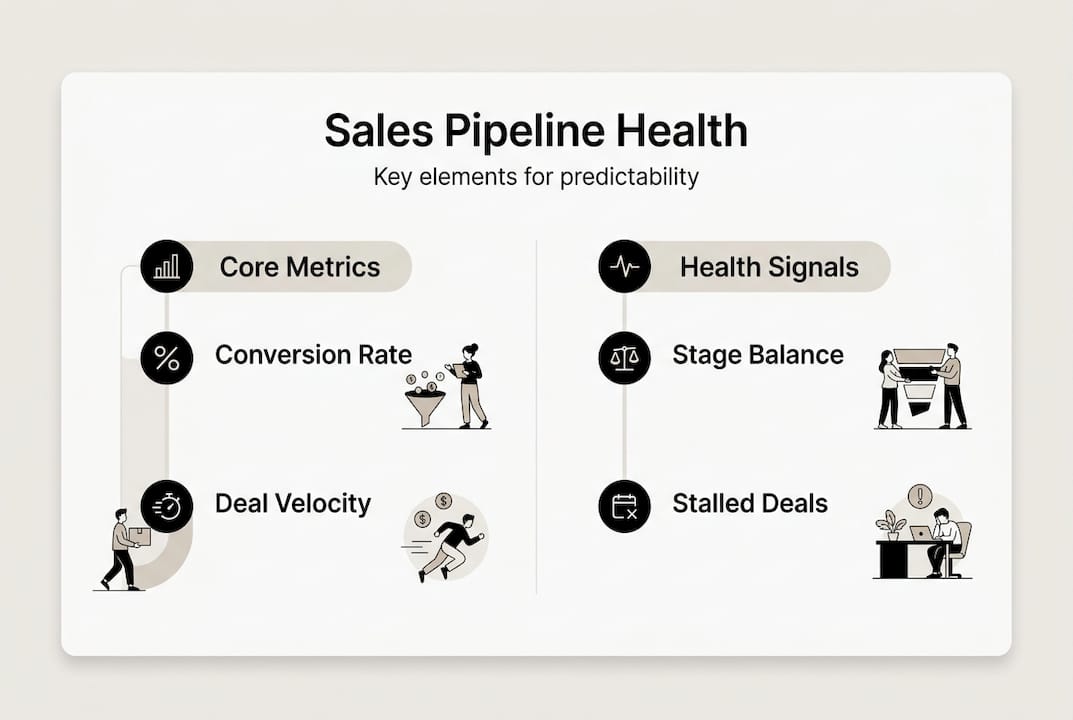
After understanding what to measure, it’s critical to diagnose your actual pipeline’s health using practical tools and frameworks.
Systematic pipeline reviews help uncover bottlenecks and enable timely intervention. Here’s a step-by-step diagnostic you can run with your team right now:
“Deals that sit in the same stage for more than twice the average stage duration have a significantly higher probability of being lost. Don’t wait for them to close on their own.”
Pro Tip: Review deal age at every stage during your weekly pipeline meetings. Set a threshold, say 30 days without movement, and flag those deals for immediate action or removal.
For complex IT deals with long cycles, you need specific strategies to maintain momentum. Long B2B sales cycle strategies can help you keep deals alive without burning out your team.
Even with strong metrics and diagnostics, common pitfalls can undermine pipeline health. Here are the issues and solutions most IT sales leaders encounter.
Ignoring pipeline imbalances can undermine overall sales efforts, regardless of team size or performance. Here’s what we see most often:
These mistakes compound over time. A pipeline full of zombie deals destroys forecast accuracy and demoralizes your team.
The fix? Start with structure. Map your sales funnel optimization process to buyer intent, not just internal sales activities. Each stage should reflect a real buyer action or commitment, not just a rep’s optimism.
Pro Tip: Map your pipeline stages to buyer intent signals. For example, a deal should only move to “proposal” when the buyer has confirmed budget and timeline, not just because a demo went well.
Working with a sales consulting role partner can accelerate this process significantly. An outside perspective cuts through internal blind spots and gets your pipeline structure right faster than iterating alone.
Once you’ve fixed the fundamentals, the next challenge is maintaining lasting pipeline health and driving continuous improvement.
Using structured frameworks and regular training sustains pipeline health gains over time. The difference between teams that maintain healthy pipelines and those that don’t usually comes down to one thing: structure beats heroics.
Here’s a comparison of ad-hoc versus structured pipeline management:
| Approach | Pipeline reviews | Qualification | CRM hygiene | Forecasting accuracy |
|---|---|---|---|---|
| Ad-hoc | Irregular, deal-by-deal | Inconsistent | Low, data gaps | Unreliable |
| Structured | Weekly cadence | Defined criteria | High, enforced | Predictable |
The structured approach wins every time. Here’s how to build it:
If you want to see what this looks like in practice, the pipeline transformation case study from one of our tech clients shows a 30% pipeline boost through structured sales transformation. Real results, real process.
You now have the framework. You know what pipeline health means, how to measure it, how to diagnose it, and how to fix it. But knowing and doing are two different things. Execution is where most teams stall.
At Sales Label Consulting, we work directly with RevOps leaders, Heads of Sales, and VPs of Sales at IT companies across Europe to build pipelines that perform consistently. Whether you need step-by-step sales enablement, a full sales audit, or demand generation support, we bring the structure and experience to make it stick. Explore our enablement best practices and start tracking the essential sales metrics that actually move the needle. Let’s build something predictable together.
Pipeline health measures quality, balance, and deal progression through your stages. Size only counts the number of deals present, which tells you very little about whether those deals will actually close.
Pipeline coverage is the ratio of your total pipeline value to your revenue target, and it shows whether you have enough potential deals to realistically hit your goals. Most B2B IT teams aim for a 3x to 4x coverage ratio to maintain a healthy buffer.
Weekly reviews keep your team accountable and catch stalled deals early, while routine pipeline reviews at a monthly level support trend analysis and strategic adjustments. Both cadences serve different purposes and work best together.
Stalled deals, inconsistent conversion rates, and a lack of late-stage opportunities are the clearest signals. Consistent deal aging and stage progression tracking are the fastest ways to catch these issues before they cost you revenue.
Absolutely. External consulting identifies root causes that internal teams often miss because they’re too close to the day-to-day. The result is faster fixes, better structure, and sustained revenue growth.
Subscribe to our Insights: Expert productivity tips in your inbox
You'll receive 1-3 emails per month. Your data stays private, always.

CRO & Co-Founder with Sales Label Consulting

Watch our Sales Mates Podcast
September 14, 2026 - 10 min read
Read article Read articleSeptember 13, 2026 - 8 min read
Read article Read articleSeptember 12, 2026 - 10 min read
Read article Read articleSeptember 11, 2026 - 11 min read
Read article Read article