
Lead qualification process: Boost tech sales by 40%
Many IT sales leaders watch their teams chase unqualified leads while genuine opportunities slip through the cracks. This inefficiency drains resources, frustrates sales reps, and directly impacts revenue growth. Poor lead qualification creates a cycle where marketing generates volume but sales struggles with conversion, leaving both teams pointing fingers. This guide cuts through the confusion with a clear, actionable framework to transform your lead qualification process. You’ll discover proven strategies that EU IT companies use to focus efforts on high-value prospects, align sales and marketing teams, and build predictable revenue pipelines that scale.
| Point | Details |
|---|---|
| Structured lead framework | A four stage process standardizes steps from capture to sales ready handoff, improving consistency and prioritization. |
| Sales and Marketing Alignment | Clear feedback and shared definitions reduce handoff chaos and boost conversion rates. |
| Data driven scoring | Firmographics and engagement signals are translated into numeric scores to identify ready to buy prospects. |
| Continuous process optimization | Regular review of criteria and results ensures the framework adapts to market and product changes. |
Lead qualification is the systematic evaluation of potential customers to determine their readiness to buy and fit with your solution. For IT companies selling complex services or enterprise software, this process separates curious browsers from serious buyers who have budget, authority, need, and timeline. Without clear qualification, sales teams waste countless hours on prospects who will never convert, while genuine opportunities grow cold waiting for attention.
The stakes are particularly high in EU IT markets where longer sales cycles and committee-based buying decisions demand precision. Implementing a structured lead qualification process can significantly increase sales conversion rates in professional services and IT firms. Yet many organizations struggle with vague criteria that leave reps guessing whether a lead deserves immediate follow-up or nurturing.
Common pitfalls plague even experienced teams:
Effective qualification directly impacts pipeline health and forecast accuracy. When you know which leads match your ideal customer profile and show genuine buying signals, you can predict revenue with confidence. Sales leaders gain visibility into conversion rates at each stage, identifying where prospects stall and why. Marketing teams receive clear feedback on lead quality, enabling them to refine targeting and messaging. This alignment transforms lead qualification from a bottleneck into a competitive advantage that accelerates growth.
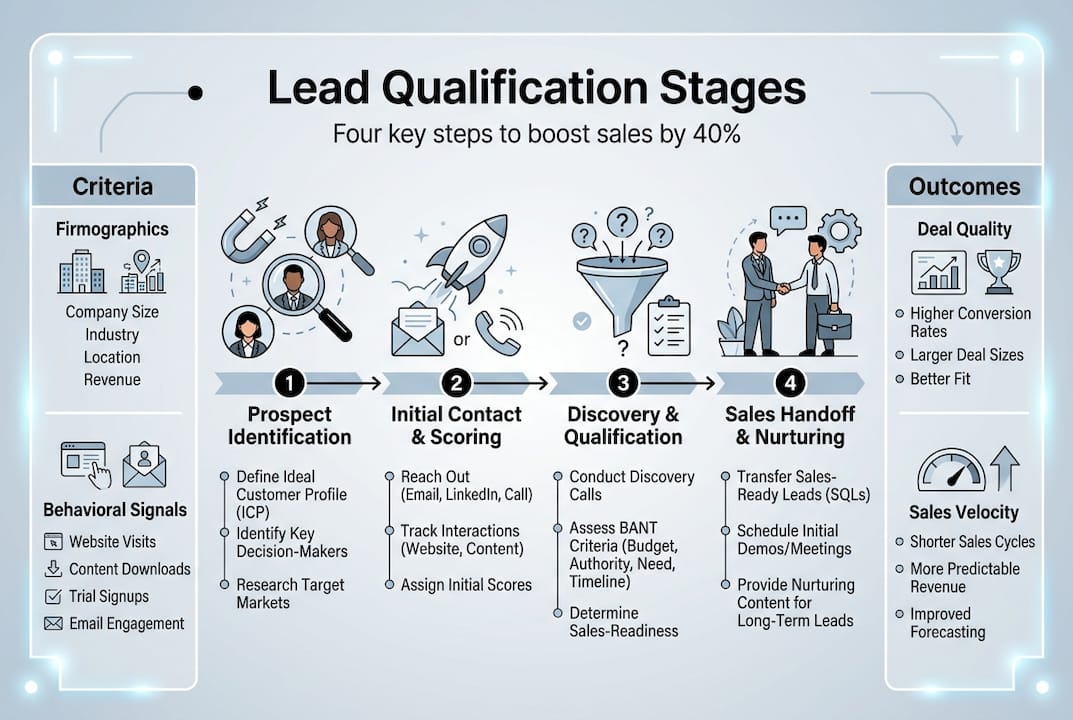
Building a qualification framework requires breaking the process into distinct stages, each with specific criteria and actions. This structure ensures consistency across your team while allowing flexibility for different prospect scenarios.
The qualification journey typically flows through four stages:
Your qualification criteria should combine firmographic data with behavioral signals. Firmographics include industry vertical, company size, revenue range, technology stack, and geographic location. These attributes indicate whether a prospect matches your ideal customer profile. Behavioral signals reveal engagement level and buying intent through actions like downloading whitepapers, attending webinars, requesting demos, or visiting pricing pages multiple times.

Lead scoring models translate these criteria into actionable priorities. Assign point values to each attribute and behavior, then set thresholds that trigger different actions. A prospect from your target industry might earn 10 points, while a C-level contact adds 15 points. Attending a product demo could add 20 points, and visiting your pricing page three times in a week adds 25 points. When a lead crosses your qualification threshold, say 60 points, they automatically route to sales for immediate outreach.
Proven lead qualification models systematically increase deal quality and sales velocity in IT business environments. The key is collaboration between sales and marketing to define these standards together. Marketing understands which campaigns generate engaged prospects, while sales knows which characteristics predict closed deals. Regular calibration sessions ensure both teams stay aligned as your market evolves.
Pro Tip: Review your qualification criteria quarterly using data from closed-won and closed-lost opportunities. Look for patterns in company attributes, engagement behaviors, and objections that emerged during sales conversations. Update your scoring model to reflect these insights, ensuring your framework stays predictive rather than becoming outdated guesswork.
Modern CRM platforms and sales enablement tools transform lead qualification from manual guesswork into a data-driven science. The right technology stack automates repetitive tasks, surfaces insights in real time, and creates accountability through transparent metrics.
Leading CRM systems for IT companies offer specialized qualification features:
| Platform Capability | Automation Benefit | Integration Strength |
|---|---|---|
| Automated lead scoring | Assigns points based on rules you define, updating scores as prospects engage | Connects with marketing automation to track cross-channel behavior |
| Workflow triggers | Routes qualified leads to appropriate reps instantly, sends alerts for hot prospects | Integrates with email, calendar, and communication tools for seamless handoffs |
| Custom qualification fields | Captures IT-specific criteria like tech stack, cloud maturity, or compliance needs | Syncs with data enrichment services to auto-populate firmographic details |
| Reporting dashboards | Visualizes qualification metrics and conversion rates across pipeline stages | Pulls data from multiple sources for unified performance views |
Using CRM software and lead scoring automation significantly improves qualification efficiency and data-driven decision making. Instead of manually reviewing each lead, your team focuses on prospects the system identifies as sales-ready based on your criteria.
Track these essential KPIs to measure and improve qualification performance:
These metrics reveal bottlenecks and opportunities. If your qualification rate drops suddenly, investigate whether marketing shifted tactics or market conditions changed. If conversion rates vary dramatically by source, double down on high-performing channels and refine or eliminate weak ones. When sales cycle length for qualified leads remains high, examine whether your criteria actually predict buying readiness or just surface-level interest.
Pro Tip: Set up automated weekly reports that compare current qualification metrics against historical averages and goals. Share these dashboards with both sales and marketing leadership to maintain alignment and quickly spot trends requiring attention. Use monthly deep dives to analyze outliers, like deals that closed despite low scores or high-scoring leads that went cold, refining your model based on real outcomes.
Transforming your lead qualification process requires methodical planning and continuous improvement rather than a one-time overhaul. Sales leaders who succeed treat implementation as an iterative journey, learning and adapting as they gather real-world results.
Start by assessing your current state honestly:
Next, define your qualification criteria collaboratively. Bring together sales leadership, top-performing reps, and marketing managers for working sessions. Use your analysis to build consensus around firmographic requirements, behavioral signals, and scoring thresholds. Document these standards in a shared playbook that becomes your team’s reference guide. Be specific: instead of “enterprise companies,” specify “B2B IT companies with 200 to 5,000 employees and annual revenue above €10 million.”
Select tools that match your team’s size and technical sophistication. A startup might begin with basic CRM scoring rules, while a larger organization could implement advanced marketing automation with predictive analytics. Prioritize platforms that integrate with your existing tech stack to avoid data silos. Continuous process audits, collaborative refinement, and training are essential to maintaining high-performing lead qualification.
Train both teams thoroughly before launch. Sales reps need to understand the new qualification criteria and why certain leads receive priority. Marketing teams must learn how their campaigns impact lead scores and what content drives qualification. Role-play scenarios where reps practice applying criteria to real prospect examples, building confidence and consistency.
Pilot your new process with a subset of leads or a single region before full rollout. Collect feedback daily from participating reps about what works and what creates confusion. Monitor metrics closely to catch unexpected issues early. Adjust scoring rules, refine criteria definitions, or modify workflows based on this real-world testing. Only after your pilot shows improved conversion rates and team satisfaction should you scale across the organization.
Schedule regular review meetings, ideally monthly, to analyze qualification performance. Examine metrics for trends, celebrate wins, and tackle challenges collaboratively. Create feedback loops where sales shares insights about lead quality and marketing explains campaign strategy shifts. Use these sessions to update your qualification playbook, ensuring it evolves with your market, products, and competitive landscape. The companies that excel at lead qualification treat it as a living system requiring constant attention, not a set-it-and-forget-it checklist.
Transforming your lead qualification process delivers measurable revenue growth, but implementation challenges can slow progress without experienced guidance. Sales Label IT Consulting specializes in helping EU IT companies build and refine qualification frameworks that drive predictable results.
Our sales enablement methodology provides step-by-step support for defining qualification criteria, selecting the right technology, and training your teams for consistent execution. We work alongside your sales and marketing leaders to analyze your current process, identify quick wins, and design sustainable improvements. Whether you need a complete qualification overhaul or targeted optimization of specific stages, our expertise accelerates your path to higher conversion rates.
Explore our sales enablement best practices to discover proven strategies for aligning teams and measuring success. Our lead generation checklist for 2026 offers practical tools you can implement immediately to improve lead quality and sales productivity. These resources reflect real-world experience helping IT companies navigate complex sales challenges and achieve error-free execution.
A lead is any potential customer who has shown initial interest in your solution through actions like filling out a form or attending a webinar. A prospect is a qualified lead who meets your specific criteria for budget, authority, need, and timeline, making them more likely to convert. Understanding this distinction between leads and prospects helps you prioritize sales efforts on opportunities with genuine buying potential rather than chasing every inquiry.
Establish shared qualification criteria through collaborative working sessions where both teams define what constitutes a sales-ready lead based on historical data and market knowledge. Create regular communication forums, like weekly pipeline reviews, where marketing presents lead generation results and sales provides feedback on lead quality. Use joint metrics such as qualified lead conversion rate and cost per acquisition to maintain accountability. Implement feedback loops where closed deal insights inform marketing targeting and sales and marketing alignment practices continuously improve over time.
Track qualification rate to measure the percentage of total leads meeting your criteria, revealing marketing campaign effectiveness. Monitor conversion rate by qualification score to validate that your scoring model actually predicts closed deals. Measure lead response time to ensure sales contacts qualified prospects quickly before they cool. Calculate cost per qualified lead to assess efficiency and guide budget allocation. Key lead qualification metrics help identify process bottlenecks, like stages where prospects stall, enabling you to adjust strategies and improve overall pipeline performance.
Review qualification criteria quarterly using data from recent closed-won and closed-lost opportunities to identify emerging patterns. Conduct immediate reviews when you launch new products, enter new markets, or notice sudden changes in conversion rates. Schedule annual comprehensive audits that examine all aspects of your qualification framework against market shifts and competitive dynamics. Between formal reviews, maintain ongoing feedback channels where sales reps can flag leads that don’t match expected quality, ensuring your criteria stay predictive and relevant.
Lead scoring automates prioritization by assigning numeric values to firmographic attributes and behavioral signals, helping sales teams focus on prospects most likely to convert. Scores update in real time as leads engage with your content, visit your website, or match ideal customer profile criteria. When leads cross predefined thresholds, automated workflows trigger immediate sales outreach or nurturing campaigns. Effective scoring reduces manual lead review time, ensures consistent evaluation across your team, and provides data-driven justification for resource allocation decisions that maximize revenue potential.
Subscribe to our Insights: Expert productivity tips in your inbox
You'll receive 1-3 emails per month. Your data stays private, always.

CRO & Co-Founder with Sales Label Consulting

Watch our Sales Mates Podcast
September 14, 2026 - 10 min read
Read article Read articleSeptember 13, 2026 - 8 min read
Read article Read articleSeptember 12, 2026 - 10 min read
Read article Read articleSeptember 11, 2026 - 11 min read
Read article Read article