
Sales Team Structure: Unlocking RevOps Success
When sales numbers stall even as the market heats up, it is usually your team structure that holds growth back. For Heads of Sales in European tech companies, getting structure right is not just a process question—it shapes how quickly deals close and how teams collaborate. With revenue operations unifying sales, marketing, and customer success across people, processes, and technology, this article explores the essential building blocks that set high-performing teams apart from those struggling with silos.
| Point | Details |
|---|---|
| Importance of RevOps | Revenue Operations connect Sales, Marketing, and Customer Success, ensuring clarity in processes and uniformity in goals. Without RevOps, misalignment leads to inefficiencies and revenue loss. |
| Sales Team Structure | A well-defined sales team structure optimizes information flow, accountability, and supports RevOps in driving growth. Clarity in roles enhances performance and reduces overlap. |
| Alignment of Processes and Technology | Aligning sales processes with the right technology is crucial for efficiency. Integration across systems eliminates friction and supports smoother operations. |
| Breaking Down Silos | Silos hinder collaboration and revenue potential. Unified goals and shared definitions across departments are essential for maximizing efficiency and ensuring cohesive teamwork. |
You can’t talk about sales effectiveness without addressing how your team is organized. The structure you choose directly impacts how revenue flows through your organization, how quickly deals move, and whether your sales and marketing teams actually work together or operate in silos.
What RevOps Actually Is
Revenue operations unifies sales, marketing, and customer success across people, processes, and technology. Think of RevOps as the operating system that makes these teams speak the same language and chase the same goals. It’s not another department—it’s the backbone that connects everything.
Without RevOps, you get this painful picture:
Why Structure Matters More Than You Think
Your sales team structure determines information flow, accountability, and how your RevOps foundation actually works. A poorly structured team needs RevOps to fix the damage. A well-structured team uses RevOps to accelerate growth.
Consider this: When building a high-performance sales team from scratch, most companies get structure wrong before they even hire. They inherit outdated playbooks or copy competitors without understanding their own business model.
The Core Components
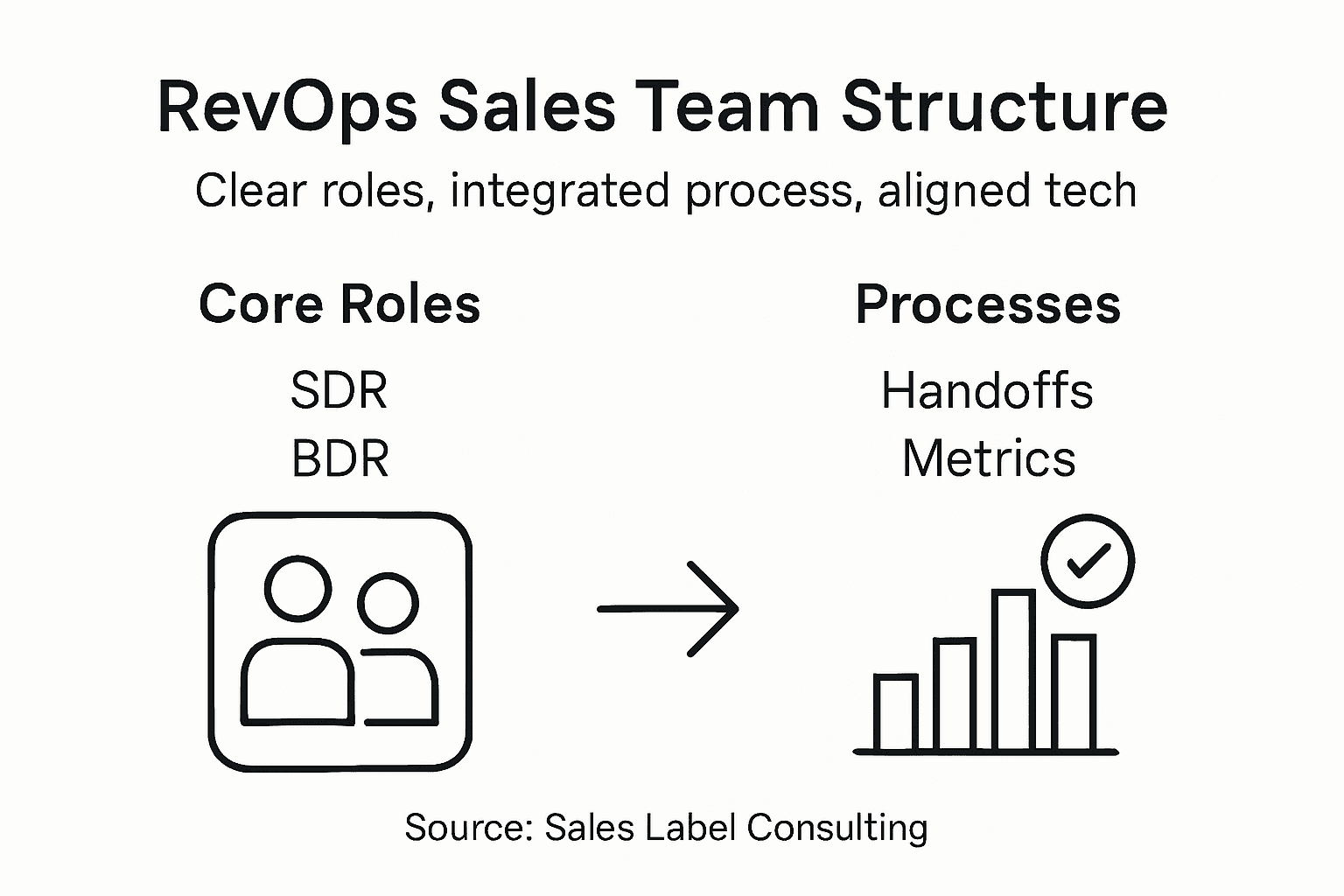
A RevOps-ready structure has these elements:
The Real Difference
When you define structure with RevOps in mind, you’re not just organizing people. You’re designing how information flows, how decisions get made, and how every team member contributes to predictable revenue growth.
A sales team structure without RevOps thinking creates friction. A RevOps-aligned structure creates momentum.
Your team structure is the foundation. Everything else—compensation, territory design, technology, coaching—builds on top of it. Get this wrong, and you’re fixing broken processes forever. Get this right, and RevOps becomes the tool that amplifies your team’s natural strengths.
Pro tip: Map your current handoff points between sales and marketing, then customer success and sales. You’ll quickly see where information gets lost and which structural changes would reduce friction most.
Your sales team isn’t a homogeneous block. Each role serves a distinct purpose, and getting role clarity is what separates high-performing teams from ones drowning in overlap and confusion.
The Foundation Roles
Most mid-sized tech companies operate with these core roles. Sales Development Representatives qualify leads and manage initial prospecting work. They’re the first filter, determining which opportunities deserve attention from senior closers.

Business Development Representatives focus differently. BDRs typically own outbound prospecting, partnership building, and sometimes account expansion within assigned territories. They’re hunters by design.
Account Executives close deals. They work with qualified opportunities, negotiate contracts, and own the sales cycle from qualification through signature. This is your primary revenue-generating role.
Account Managers nurture relationships post-sale. They manage renewals, identify upsells, and ensure customers succeed with your product. Many teams underinvest here and wonder why churn stays high.
Here’s a summary of key sales team roles and their primary focus:
| Sales Role | Main Responsibilities | Critical Skills |
|---|---|---|
| SDR | Qualifies inbound leads, conducts initial outreach | Strong communication, detail orientation |
| BDR | Drives outbound prospecting, builds partnerships | Prospecting, resilience, negotiation |
| Account Executive | Manages entire sales cycle, closes deals | Consultative selling, contract negotiation |
| Account Manager | Retains and grows accounts post-sale | Relationship building, upsell identification |
Why Role Clarity Matters
Without clear definitions, you get overlap. Two people working the same account. Nobody owning customer success conversations. Confusion about who’s accountable for what metric.
Role clarity improves conversion rates, reduces frustration, and makes sales management easier to execute. People know what they own. They can see how their work connects to others’ work.
Common Variations
Your specific structure depends on business model, customer type, and go-to-market strategy:
Your model isn’t “right” or “wrong”—it’s right or wrong for your business model.
Clear role definitions eliminate overlap and create accountability. Unclear roles create politics and lost revenue.
Sales roles extend beyond closing deals. They generate market intelligence, support product development, and manage complex customer relationships. The effectiveness of each role depends on how well it connects to others and how your organization supports it.
Pro tip: Write down exactly what each role owns: which leads they work, which stage they own, which metrics they’re accountable for. You’ll immediately spot where clarity is missing.
Tech companies operate at a different pace than traditional industries. Your sales team structure needs to match that velocity—or it becomes a bottleneck instead of an accelerant.
Why Tech Sales Structures Are Different
Tech buyers move faster. Deal cycles compress. Product complexity demands technical expertise. Your sales team structure must handle these realities or lose deals to competitors with better-organized teams.
Organizational structure in tech impacts role clarity, resource allocation, and scalability. It directly influences whether your team can handle rapid growth without falling apart.
Here’s what breaks most tech sales teams: They inherit structures from non-tech companies or copy a competitor’s model without understanding their own business. Then they wonder why execution falters.
What Tech-Ready Structures Include
You need role definitions that account for technical selling. This might look like:
Agility Matters More Than Perfection
Your tech team grows from five people to fifteen to fifty. Your structure at each stage needs to be different. Most companies stick with the old structure too long, creating frustration and inefficiency.
Structure at fifteen people looks nothing like structure at fifty. Accept this. Build flexibility in.
A tech sales structure that works for one growth stage breaks at the next. Design for adaptation, not permanence.
The Role of Strategy
Sales strategy shapes how your team structure supports revenue goals. You need to know whether you’re hunting new logos or expanding existing accounts. That shapes everything: team composition, compensation, territory design, and hiring priorities.
Without strategy clarity, structure becomes arbitrary. With it, every role exists for a reason.
Common Tech Sales Structures
Most mid-sized tech companies use one of these:
None is universally right. Pick based on your GTM strategy and customer acquisition model.
Compare different tech sales team structures to see which fits your strategy:
| Structure Type | Best For | Key Characteristics |
|---|---|---|
| Pod Model | High collaboration | Small teams own accounts together |
| Specialized Model | Large pipelines | Separate inbound & outbound roles |
| Hybrid Model | Mixed segments | Blend of pod and specialization |
| Territory Model | Geographic focus | Teams split by region or account size |
Pro tip: Map your current customer acquisition funnel against your team structure. You’ll quickly see which roles are undersized, which are redundant, and where handoffs create friction.
You can have the best team structure in the world, but without aligned processes and technology, you’re asking people to work around broken systems instead of leveraging them.
The Alignment Problem
Most mid-sized tech companies have the same issue: sales tools that don’t talk to each other, processes that contradict each other, and data scattered across systems. Your AEs use one CRM, marketing uses another. Customer success has their own database. Nobody has a single source of truth.
This creates friction. People spend time manual-entering data instead of selling. Leadership makes decisions on incomplete information. Pipeline visibility becomes impossible.
What RevOps Alignment Actually Means
RevOps integrates people, processes, technology, and data into unified operations. It’s not about having the newest tools. It’s about having tools that work together and processes that support how your team actually sells.
Alignment means your sales process lives in your CRM. Your marketing automation feeds qualified leads directly to the right AE. Your customer success system knows deal terms so they’re not blindsided at renewal. Your compensation system reflects your actual revenue goals.
Start With Process, Not Technology
Too many companies buy software first, then try to bend their process to fit it. Reverse that.
Map your actual sales process:
Only after you have process clarity should you evaluate technology.
The Technology Layer
Once you know your process, technology should support it seamlessly. Your stack typically includes:
You don’t need every tool. You need the right tools working together.
Common Misalignment Patterns
Watch for these red flags:
Process alignment enables 40% faster deal progression. Technology misalignment creates 40% more work for no gain.
Sales process optimization directly impacts how effectively your team executes. When processes are clear and technology supports them, your team moves faster and closes more deals.
The Path Forward
Start by auditing your current state:
Then build alignment systematically. Don’t try to fix everything at once. Pick the highest-friction area and align process and technology there first.
Pro tip: Audit one full deal from lead to close. Document every step, every system touched, every manual entry. You’ll immediately see where misalignment costs you the most time.
Silos destroy revenue. Sales chases activity while marketing focuses on lead quality. Customer success operates independently from both. Nobody shares the same definition of a qualified lead or a successful deal.
How Silos Form
They rarely start intentionally. They emerge when teams optimize for their own metrics instead of company revenue. When communication happens in isolation. When nobody owns the full customer journey.
Siloed operations arise from lack of unified tools, misaligned goals, and poor communication between teams. Each department builds its own systems, processes, and definitions of success. Then you wonder why handoffs create friction and deals fall through cracks.
The Cost of Silos
You can measure silo damage:
The Real Problem
Silos don’t happen because people are difficult. They happen because structure and incentives allow them. Your compensation system rewards individual metrics instead of team revenue. Your processes were designed for each function independently, not for handoffs. Your tools don’t connect, forcing manual work between systems.
Structure beats heroics. Fix the structure.
Breaking Down Silos
Effective revenue operations unify sales, marketing, and customer success through shared goals, integrated systems, and collaborative workflows. This requires deliberate action across five dimensions:
Common Pitfalls to Avoid
Watch for these patterns that recreate silos:
Silos cost you 20-30% of potential revenue through lost opportunities, slower cycles, and higher churn. Breaking them is the highest-ROI RevOps investment you can make.
Starting Small
Don’t try to unify everything at once. Pick one high-friction handoff. Make it work. Then expand.
Most teams start with the sales-to-customer-success handoff because deal failures happen there regularly. Map what information needs to flow. Build a simple process. Connect the systems. Measure results. Then move to the next friction point.
Pro tip: Schedule a meeting with sales leadership, marketing leadership, and customer success leadership. Have each person write down what they think the definition of a qualified lead is. You’ll immediately see where silos are costing you.
Navigating the complexities of sales team structure and achieving true RevOps alignment can feel overwhelming. This article highlights how unclear role definitions, siloed operations, and disconnected processes often slow down growth and frustrate teams. You deserve a partnership that helps you clarify roles, streamline handoffs, and build a structure designed for predictable revenue.

Discover how Sales Label Consulting leverages deep tech entrepreneurial experience to empower Heads of Sales, VPs of Sales, and RevOps leaders. Our consulting services in Sales Enablement, Sales Audit, and Demand Generation focus on eliminating friction and accelerating pipeline velocity. Act now to move beyond guesswork and broken processes. Visit us to start building a sales team structure that drives momentum and consistent results.
RevOps unifies sales, marketing, and customer success across people, processes, and technology, serving as the backbone that connects these teams and aligns their goals.
A well-defined sales team structure improves information flow, accountability, and enhances the effectiveness of RevOps, while a poorly structured team may hinder growth and efficiency.
A RevOps-ready structure includes clear role definitions, aligned incentives, defined handoff points, technology infrastructure that connects data, and regular accountability cadences.
Tech companies should build flexible sales structures that can evolve as the team grows, ensuring roles and responsibilities are clearly defined for each growth stage to avoid bottlenecks.
Subscribe to our Insights: Expert productivity tips in your inbox
You'll receive 1-3 emails per month. Your data stays private, always.

CRO & Co-Founder with Sales Label Consulting

Lets book a free consultation
October 15, 2026 - 9 min read
Read article Read articleOctober 14, 2026 - 7 min read
Read article Read articleOctober 13, 2026 - 10 min read
Read article Read articleOctober 12, 2026 - 11 min read
Read article Read article