
Role of Sales Strategy: Fueling Tech Revenue Growth
Sales teams across European tech companies face unique pressures to align fast-changing technology, customer needs, and business targets. Traditional sales tactics rarely deliver the consistent growth these organizations seek. Embracing a comprehensive sales strategy that integrates advanced tools and data-driven insights opens the path to measurable performance improvements and sustainable revenue. Discover actionable frameworks and proven methods to help your team drive predictable success in a complex marketplace.
| Point | Details |
|---|---|
| Comprehensive Sales Strategy | A successful tech sales strategy integrates market segmentation, value proposition development, and sales technology to drive revenue growth. |
| Buyer Engagement Shift | Modern buyers expect personalized engagement, requiring sales teams to adopt consultative selling approaches. |
| Continuous Optimization | Regular auditing and refining of sales strategies based on performance metrics and market insights are essential for sustained success. |
| Avoiding Common Pitfalls | Misaligned team priorities and inadequate market research can derail sales initiatives; regular cross-functional reviews can mitigate these risks. |
A sales strategy in the technology sector is far more than a traditional selling approach – it represents a comprehensive blueprint for achieving predictable revenue growth through strategic alignment, technological integration, and customer-centric methodologies. Unlike conventional industries, tech sales demand sophisticated frameworks that leverage advanced capabilities and data-driven insights to drive sustainable business performance.
The fundamental components of an effective tech sales strategy encompass several critical dimensions:
Successful tech sales strategies recognize that modern buyers are sophisticated, informed, and demand personalized engagement. This requires sales teams to transition from traditional transactional approaches to consultative selling models that prioritize understanding complex technological ecosystems and demonstrating measurable business value.
Technology has fundamentally transformed sales strategy, introducing unprecedented capabilities for data analysis, customer insights, and predictive modeling. Advanced tools like artificial intelligence, machine learning, and sophisticated CRM platforms enable sales professionals to create more targeted, efficient, and responsive engagement strategies.
Pro tip: Continuously invest in sales team technological upskilling to ensure your strategy remains adaptive and competitive in the rapidly evolving tech landscape.
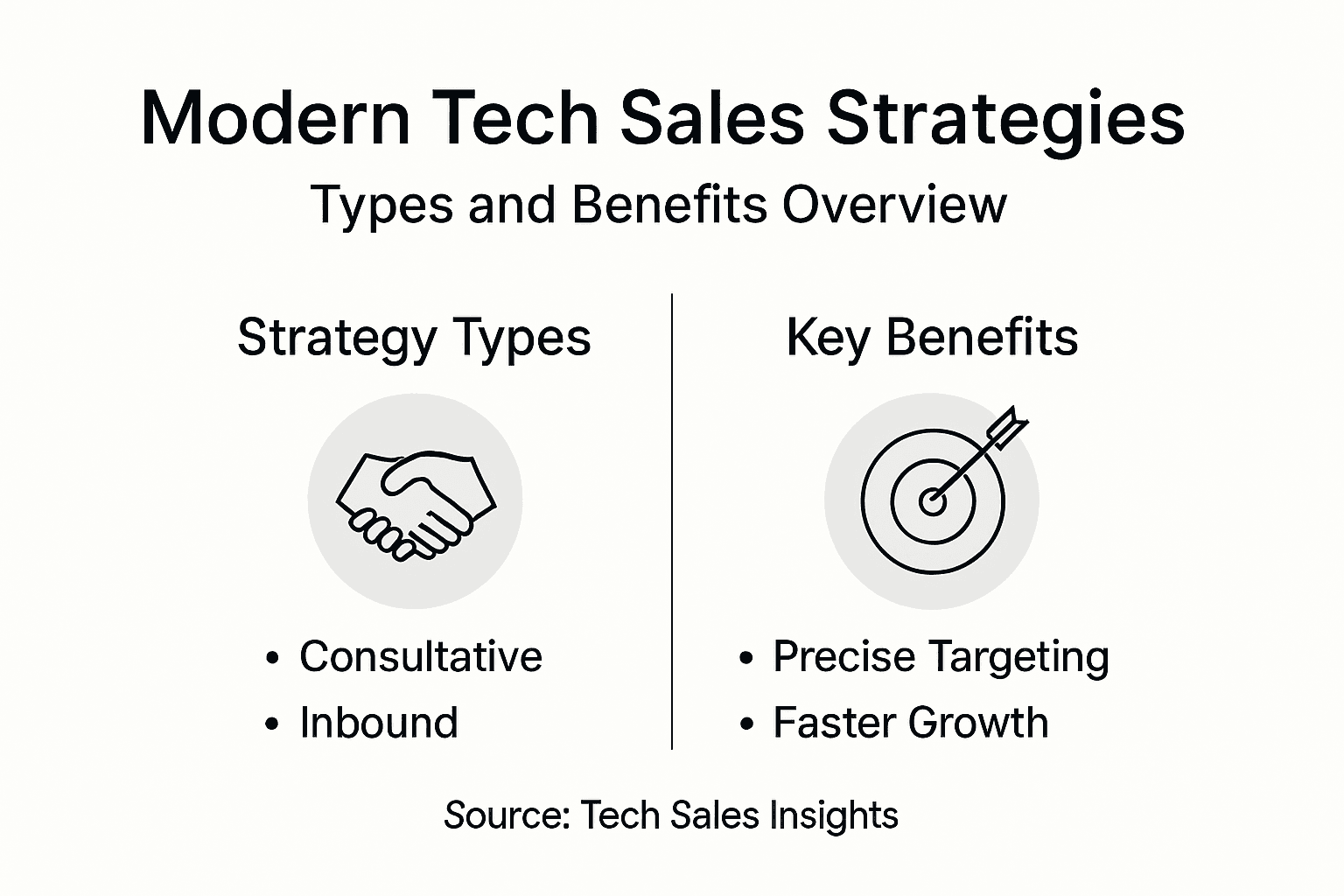
Modern sales strategies in the technology sector have evolved dramatically, moving beyond traditional transactional approaches to more sophisticated, data-driven methodologies. Core sales strategy frameworks now emphasize adaptability, customer-centricity, and technological integration to drive predictable revenue growth.
The primary types of contemporary sales strategies include:
Each strategy represents a nuanced approach to navigating the complex technology sales landscape. Consultative selling requires deep technological understanding, enabling sales professionals to act as trusted advisors who diagnose customer needs before presenting solutions. Account-based selling takes a surgical approach, concentrating resources on pre-identified high-potential accounts with customized engagement strategies.
Here’s how key modern sales strategies differ in approach and business focus:
| Strategy Type | Key Characteristic | Main Business Benefit |
|---|---|---|
| Consultative Selling | Solution-focused advice | Deeper client trust |
| Account-Based Selling | Targeted account engagement | Higher deal conversion |
| Solution Selling | End-to-end problem solving | Reduced sales cycles |
| Digital-First | Tech-enabled interactions | Increased efficiency |
| Data-Driven Sales | Analytics-informed decisions | Smarter resource use |
Technology has fundamentally transformed these strategies, introducing unprecedented capabilities for precise targeting, personalization, and performance tracking. Modern sales teams now integrate artificial intelligence, machine learning, and sophisticated CRM platforms to create more intelligent, responsive, and efficient sales processes that can dynamically adapt to changing market conditions.
Pro tip: Continuously audit and refine your sales strategy by regularly collecting performance data and maintaining flexibility to pivot approaches based on emerging market insights.
Building an effective sales strategy requires a systematic approach that combines careful planning, precise execution, and continuous optimization. Strategic sales planning frameworks provide tech companies with a structured methodology to transform high-level business objectives into actionable sales initiatives that drive predictable revenue growth.
The key components of building and executing a robust sales strategy include:
Successful execution demands more than just strategic planning. Tactical implementation requires creating detailed sales playbooks that outline specific processes, communication protocols, and engagement strategies. This involves developing comprehensive training programs, creating targeted content resources, and establishing clear escalation and support mechanisms for the sales team.

Technology plays a critical role in modern sales strategy execution, enabling real-time performance tracking, predictive analytics, and dynamic resource allocation. Sales leaders must continuously adapt their approaches, leveraging data-driven insights to refine targeting, optimize resource deployment, and respond quickly to changing market dynamics.
Pro tip: Implement a quarterly strategy review process that combines quantitative performance data with qualitative team feedback to maintain strategic agility and responsiveness.
Tech sales strategies are fraught with potential missteps that can derail even the most promising revenue growth initiatives. Sales strategy pitfalls represent critical areas where organizations frequently stumble, undermining their ability to achieve predictable and sustainable revenue expansion.
The most significant pitfalls in tech sales strategy include:
Technology companies often make the critical error of rushing into digital transformation without a comprehensive understanding of their specific organizational needs. Strategic implementation requires more than just acquiring cutting-edge tools; it demands a holistic approach that considers existing workflows, team capabilities, and long-term business objectives.
Competitive landscapes in technology evolve rapidly, making it essential for sales organizations to maintain strategic agility. Successful teams avoid becoming trapped by legacy thinking, continuously reassessing their approaches, challenging assumptions, and remaining open to innovative methodologies that can provide competitive advantages.
The table below summarizes potential pitfalls and their business consequences:
| Common Pitfall | Risk to Business | Recommended Remedy |
|---|---|---|
| Misaligned Priorities | Lost revenue opportunities | Cross-team alignment reviews |
| Shallow Market Research | Missed customer needs | Ongoing market analysis |
| Overreliance on Tech | Inefficient tool use | Strategy-driven integration |
| Vanity Metrics Focus | Misguided decision making | Track actionable KPIs |
| Rigid Processes | Slowed responsiveness | Agile process updates |
Pro tip: Conduct monthly cross-functional strategy reviews that include representatives from sales, marketing, and product teams to identify potential misalignments before they become systemic problems.
Auditing a sales strategy is not a one-time event but a continuous process of assessment, refinement, and strategic realignment. Performance evaluation frameworks provide tech organizations with systematic approaches to diagnose, measure, and continuously improve their sales strategy effectiveness.
Key components of an effective sales strategy audit include:
Successful audits go beyond surface-level data collection. Strategic optimization requires deep analytical capabilities that transform raw information into actionable insights. This means developing robust feedback mechanisms, creating transparent performance dashboards, and establishing clear communication channels that enable rapid strategic pivots.
Technology has revolutionized the auditing process, introducing advanced analytics tools that provide unprecedented visibility into sales performance. Modern sales leaders can now leverage machine learning algorithms, predictive modeling, and real-time data visualization to make more informed strategic decisions, dramatically reducing the time between identifying performance gaps and implementing corrective actions.
Pro tip: Implement a quarterly strategic review process that combines quantitative performance data with qualitative team and customer insights to maintain continuous improvement and strategic responsiveness.
The article highlights key challenges like misaligned team priorities, overreliance on technology without strategy, and the critical need for consultative, data-driven sales approaches. If you recognize the struggle to connect sales, marketing, and product teams or to implement actionable sales strategies that truly resonate with modern, sophisticated buyers you are not alone. Many technology companies face difficulty turning market insights into effective execution while maintaining agility and continuous optimization.
At Sales Label Consulting, we specialize in transforming these complex pain points into clear, confident action plans. Our expertise in Sales Enablement, Sales Audit, and Demand Generation empowers sales leaders including RevOps, Heads of Sales, and VPs of Sales to confidently navigate evolving tech landscapes and ensure error-free, predictable results. By aligning your teams and integrating strategic technology use with proven frameworks you can avoid common pitfalls and accelerate growth.
Unlock the full potential of your tech sales strategy today

Discover how to build and execute a sales strategy that fuels revenue growth and adapts to fast-changing markets. Visit Sales Label Consulting now to start your journey toward smarter, more sustainable sales success.
The key components include market segmentation, value proposition development, sales technology integration, and performance measurement through KPIs.
Technology enhances sales strategies by enabling data analysis, customer insights, and predictive modeling, allowing for more targeted and efficient sales approaches.
Common pitfalls include misaligned team priorities, inadequate market research, technology overreliance, metrics mismanagement, and maintaining rigid sales processes that don’t adapt to changes.
Organizations can effectively audit their sales strategy by analyzing performance metrics, evaluating customer feedback, scanning the competitive landscape, reviewing technology utilization, and assessing team capabilities.
Subscribe to our Insights: Expert productivity tips in your inbox
You'll receive 1-3 emails per month. Your data stays private, always.

CRO & Co-Founder with Sales Label Consulting

Book a free consultation call
October 15, 2026 - 9 min read
Read article Read articleOctober 14, 2026 - 7 min read
Read article Read articleOctober 13, 2026 - 10 min read
Read article Read articleOctober 12, 2026 - 11 min read
Read article Read article