
Why Sales Data Quality Matters for Revenue Growth
TL;DR:
- Poor sales data quality causes organizations to lose an average of $12.9 million annually due to forecast errors and wasted resources. High-quality, accurate, complete, and timely data improves rep productivity, trust, and revenue growth by enabling better decision-making. RevOps teams should enforce data standards at entry and conduct regular audits to maintain reliable pipeline information.
Sales data quality is defined as the accuracy, completeness, and reliability of customer and pipeline information that directly drives every sales decision your team makes. Poor data quality costs organizations an average of $12.9 million annually, with over 25% of companies reporting losses of $5 million or more each year. That number isn’t abstract. It shows up in missed forecasts, wasted rep hours, and deals that fall apart because the wrong person got the wrong message at the wrong time. Understanding why sales data quality matters is the first step toward fixing it.
Sales reps are your most expensive resource. When their data is dirty, they spend that expensive time on the wrong work. Sales professionals spend only about 28% of their time actually selling. The rest goes to administrative cleanup, manual research, and fixing errors that should never have existed.

The productivity math is brutal. Cleaning data takes up to 8 minutes per lead with poor data hygiene. High-quality data cuts that to 2 minutes. For a rep handling 50 leads daily, that’s more than 6 hours of selling time recovered every week. That’s not a marginal gain. That’s a full additional selling day per rep, per week.
The impact goes beyond time. Poor data breaks personalized outreach. When a rep calls the wrong contact, references an outdated deal stage, or sends a pitch to a churned customer, trust erodes fast. High-quality data makes every touchpoint more relevant and every conversation more credible.
Here’s what dirty data does to daily operations:
Pro Tip: Track the average time your reps spend on data research per lead for one week. If it exceeds 3 minutes, you have a data quality problem that’s costing you real selling capacity.
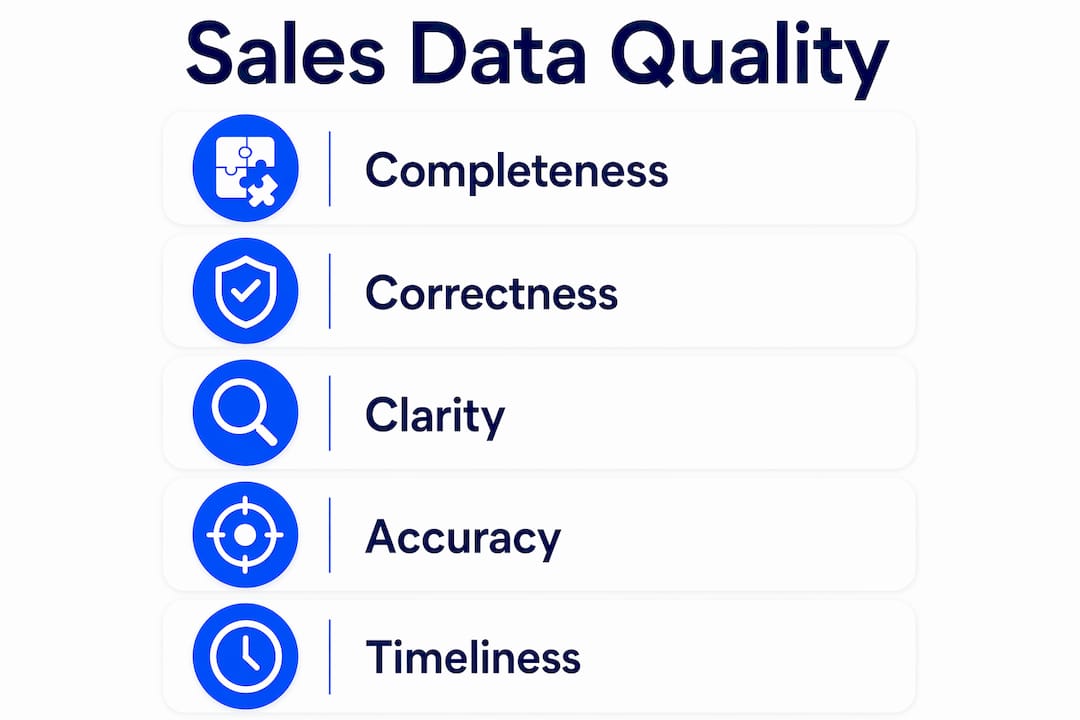
Sales data quality isn’t a single metric. It’s a set of dimensions that each affect a different part of your sales motion. The three core dimensions are completeness, correctness, and clarity. Think of them as the 3 C’s of data integrity.
Completeness means every required field is filled. A contact record without a phone number or job title is half a record. It forces reps to fill gaps manually or skip outreach entirely.
Correctness means the data reflects reality. An email address that bounces, a company size that’s three years out of date, or a deal stage that was never updated after a call are all correctness failures. They corrupt your segmentation and your forecasts.
Clarity means the data is formatted and labeled consistently. “VP Sales,” “VP of Sales,” and “Vice President, Sales” are the same role. If your CRM treats them as three different values, your segmentation breaks and your reports lie.
Beyond the 3 C’s, four additional dimensions determine whether your data actually drives results:
| Data quality dimension | What it measures | Sales impact |
|---|---|---|
| Accuracy | Data matches real-world facts | Prevents wrong-person outreach and bad forecasts |
| Consistency | Same format across all systems | Enables reliable segmentation and reporting |
| Timeliness | Data is current and updated regularly | Keeps pipeline stages and contact info relevant |
| Enrichment | Data is augmented with third-party signals | Improves lead scoring and personalization depth |
KPIs worth tracking include duplicate record rate, field completion percentage, and validation error rate per data source. These numbers tell you where your pipeline health is at risk before a missed quarter tells you instead.
Real talk: data quality is not a rep discipline problem. It’s a RevOps architecture challenge. When you rely on reps to maintain clean data, you’re asking the people under the most time pressure to do the most detail-oriented work. That’s a structural mismatch. High-performing teams fix this by enforcing standards at the point of data entry, not after the fact.
Here’s a practical framework for building data quality into your sales process:
Pro Tip: Data decay is inevitable. Contact information goes stale at roughly 30% per year as people change jobs and companies restructure. Schedule automated re-enrichment cycles every 90 days to prevent your database from aging out of usefulness.
Cross-functional alignment matters here too. Marketing, sales, and customer success all touch the same records. When each team uses different naming conventions or skips required fields, the data siloes fast. A shared error-free sales process with agreed standards across teams is the only way to prevent this at scale.
Key practices that prevent data decay:
Clean data doesn’t just make your CRM look tidy. It changes what your team can actually do with analytics. 84% of sales leaders report that their analytics programs underperform because of poor data quality, privacy concerns, and limited collaboration. That’s not a tooling problem. Most sales analytics failures stem from foundational data and process issues, not from choosing the wrong software.
The gap between descriptive and prescriptive analytics is where revenue gets made or lost. Descriptive analytics tells you what happened last quarter. Prescriptive analytics tells you what to do next week. You can only reach prescriptive insights when your data is clean enough to trust. Dirty data keeps you stuck in the rearview mirror.
“Companies that leverage data-driven decision-making are 23x more likely to gain customers and 19x more profitable than competitors who don’t.”
That’s not a marginal advantage. It’s a structural one. When your pipeline data is accurate, your forecast is credible. When your forecast is credible, your leadership makes better resource decisions. When resources go to the right deals, your close rate improves. The whole system compounds.
By 2026, 65% of B2B sales decisions are expected to shift from intuition-based to data-driven. Sales teams that build data quality infrastructure now will have a compounding advantage as that shift accelerates. Teams that don’t will find their analytics programs producing noise instead of signal.
The role of RevOps in sales is central here. RevOps teams that integrate sales plays with CRM data and maintain high data quality close the execution gap faster than teams that treat data as an afterthought. Pipeline visibility improves, rep coaching becomes more targeted, and revenue planning gets grounded in reality rather than optimism.
Pro Tip: Before trusting any forecast, check the field completion rate on your open opportunities. If more than 20% of records are missing close date, deal size, or next step, your forecast is built on guesswork.
Sales data quality is the foundation of every reliable forecast, productive rep, and revenue decision your organization makes.
| Point | Details |
|---|---|
| Poor data has a direct cost | Organizations lose an average of $12.9 million annually from data quality failures. |
| Rep time is the clearest signal | Reps spend only 28% of their time selling when data is dirty; clean data recovers hours weekly. |
| Quality has measurable dimensions | Track completeness, correctness, accuracy, and timeliness as distinct KPIs, not one vague score. |
| RevOps owns the fix | Data hygiene is an architecture problem, not a rep behavior problem. Enforce standards at entry. |
| Clean data unlocks revenue growth | Data-driven teams are 23x more likely to acquire customers than teams relying on intuition. |
I’ve worked with sales organizations that had enterprise CRM platforms, solid rep teams, and aggressive growth targets. And they were still missing quota. When we dug in, the problem wasn’t effort. It was that their pipeline data was so unreliable that every forecast was a fiction. Leadership was making headcount and budget decisions based on numbers nobody actually trusted.
The mindset shift that matters most isn’t technical. It’s cultural. Sales leaders need to stop demanding perfect data and start practicing what I call data humility. Imperfect data becomes a decision liability when it’s treated as authoritative. The teams that win are the ones who know where their data is solid and where it’s shaky, and who factor that uncertainty into their decisions.
The practical move is to build RevOps as the owner of data standards, not the enforcer of rep behavior. Automation handles the repetitive validation. RevOps sets the rules. Reps focus on selling. That’s the structure that scales. Explore sales data analysis as a discipline, not just a reporting function, and you’ll start seeing your pipeline for what it actually is.
— Antony
Sales teams that struggle with data quality don’t need another tool. They need a process built around data integrity from the start.
Saleslabelconsulting works with RevOps leaders, Heads of Sales, and VPs of Sales to build sales enablement frameworks that put data quality at the center of the revenue engine. From audit to execution, the work focuses on predictable, error-free results. If your pipeline data isn’t reliable enough to trust, that’s exactly the problem we solve. Start with the sales enablement guide to see how a structured approach to data and process creates consistent, forecastable revenue.
Sales data quality is the measure of accuracy, completeness, consistency, and timeliness of the customer and pipeline data your team uses to sell. Poor quality in any of these dimensions degrades forecast reliability and rep productivity.
Poor data quality forces reps to spend time on manual research and cleanup instead of selling. Sales professionals spend only about 28% of their time on actual selling when data is dirty, according to CRM performance research.
RevOps owns data quality as an architecture problem, not a rep discipline issue. High-performing teams enforce data standards at the point of entry and run regular audits rather than relying on reps to self-correct.
Poor data quality costs organizations an average of $12.9 million annually. Over 25% of companies report losses of $5 million or more per year directly tied to data quality failures.
Track duplicate record rate, field completion percentage, and validation error rate per data source. These three KPIs give you a clear picture of where your pipeline health is at risk before it shows up in a missed quarter.
Subscribe to our Insights: Expert productivity tips in your inbox
You'll receive 1-3 emails per month. Your data stays private, always.

CRO & Co-Founder with Sales Label Consulting

Watch our Sales Mates Podcast
September 20, 2026 - 13 min read
Read article Read articleSeptember 19, 2026 - 13 min read
Read article Read articleSeptember 18, 2026 - 10 min read
Read article Read articleSeptember 17, 2026 - 16 min read
Read article Read article