
Sales audit checklist: boost IT sales performance now
TL;DR:
- Sales audits systematically identify pipeline leaks, process gaps, and improvement opportunities.
- Regular checklists and reviews improve forecast accuracy, win rates, and sales consistency.
- Successful audits are embedded as a strategic habit, driven by leadership and continuous iteration.
Most IT sales leaders believe that refining their sales process is enough to drive predictable revenue. It’s not. Without a structured sales audit checklist, even well-designed processes drift, blind spots accumulate, and forecast accuracy drops without anyone noticing until it’s too late. The gap between where your team thinks it performs and where it actually performs can cost you significant ARR every quarter. This article breaks down exactly what a sales audit checklist is, what it must include, how to implement it, and how to measure its real impact on your IT sales organization.
| Point | Details |
|---|---|
| Audit checklists clarify gaps | A structured checklist helps IT sales leaders uncover blind spots and process weak points quickly. |
| Implementation trumps intention | Consistent use and regular updates of the checklist drive real, measurable improvements. |
| Metrics drive optimization | Tracking specific sales KPIs after audits ensures that changes have a direct impact on win rates and revenue. |
| Compliance protects growth | Effective audit checklists help align IT sales practices with industry standards and reduce regulatory risks. |
A sales audit checklist is a structured, repeatable framework used to systematically evaluate every stage of your sales process, from lead generation through deal close and post-sale handoff. Think of it as a diagnostic tool, not a report card. It tells you where your pipeline is leaking, where your reps are losing momentum, and where your playbook has gone stale.
Here’s the honest truth: most IT sales teams skip audits because they feel like overhead. There’s always a deal to chase, a proposal to send, a demo to prep. The audit gets pushed to “next quarter” indefinitely. But that delay compounds. Sales audit steps show that a systematic approach increases reliability and forecast accuracy in sales outcomes, which means less scrambling at quarter-end and more predictable growth.
So why does a checklist specifically matter? Because human memory is inconsistent. A checklist removes subjectivity and creates a shared language across your sales org. When everyone on the team is evaluating the same checkpoints, patterns become visible. You stop guessing and start knowing.
Here are the core elements a strong sales audit checklist covers:
“The audit isn’t about catching people doing something wrong. It’s about building a system that makes it easy to do things right.”
For IT companies specifically, following audit best practices that align sales processes with internal governance standards also reduces compliance risk during external reviews. That’s a two-for-one win most teams overlook entirely.
Now that you understand the concept, let’s get specific about what belongs in a modern sales audit checklist for IT organizations.
Higher win rates for EU tech firms are directly tied to checklists tailored to their specific sales environment, including longer deal cycles, technical buyers, and compliance requirements. Cookie-cutter checklists from generic sales blogs won’t cut it here.
Here’s a sequential breakdown of what to include:
To give you context, here’s how sales audit components compare across industries:
| Audit component | IT sales focus | Traditional B2B focus |
|---|---|---|
| ICP validation | Technical fit + compliance | Budget + authority |
| Deal qualification | Multi-stakeholder + security | Single buyer + pricing |
| CRM data hygiene | Integration logs + touchpoints | Contact and stage data |
| Messaging consistency | Technical + business value | Value proposition only |
| Compliance check | Security standards alignment | General legal review |
This table isn’t just academic. It shows why your audit checklist needs to reflect IT-specific realities. A compliance preparation guide can help you align sales audit steps with broader security and standards requirements, especially if your customers are in regulated industries.
Pro Tip: Don’t launch your audit checklist in a leadership meeting. Run a quiet pilot with two or three reps first, collect their friction points, and refine before rolling out org-wide. Adoption rates are dramatically higher when reps feel like co-creators, not subjects.

Knowing what to include is step one. Actually making it stick is where most teams stumble. Here’s how to implement a sales audit checklist that your team actually uses.
Consistent sales process improvement implementation increases win rates and clarifies process bottlenecks, but only when the audit is treated as an operational rhythm, not a one-off event.
Follow these steps to operationalize effectively:
Change management is real. Reps often see audits as surveillance. Reframe it clearly: the audit finds process failures, not people failures. When reps see that audit findings lead to better tools, clearer messaging, and less friction in their day-to-day, resistance drops fast.
Following audit implementation guidelines also helps ensure your process aligns with organizational governance standards, which matters when selling to enterprise clients who ask about your internal controls.
Pro Tip: Use your review process for teams as the foundation for your audit rhythm. Layer the checklist on top of what you already review, rather than building a parallel process from scratch.
Implementation is just the beginning. Knowing whether your audit efforts are actually paying off requires the right metrics and feedback loops.
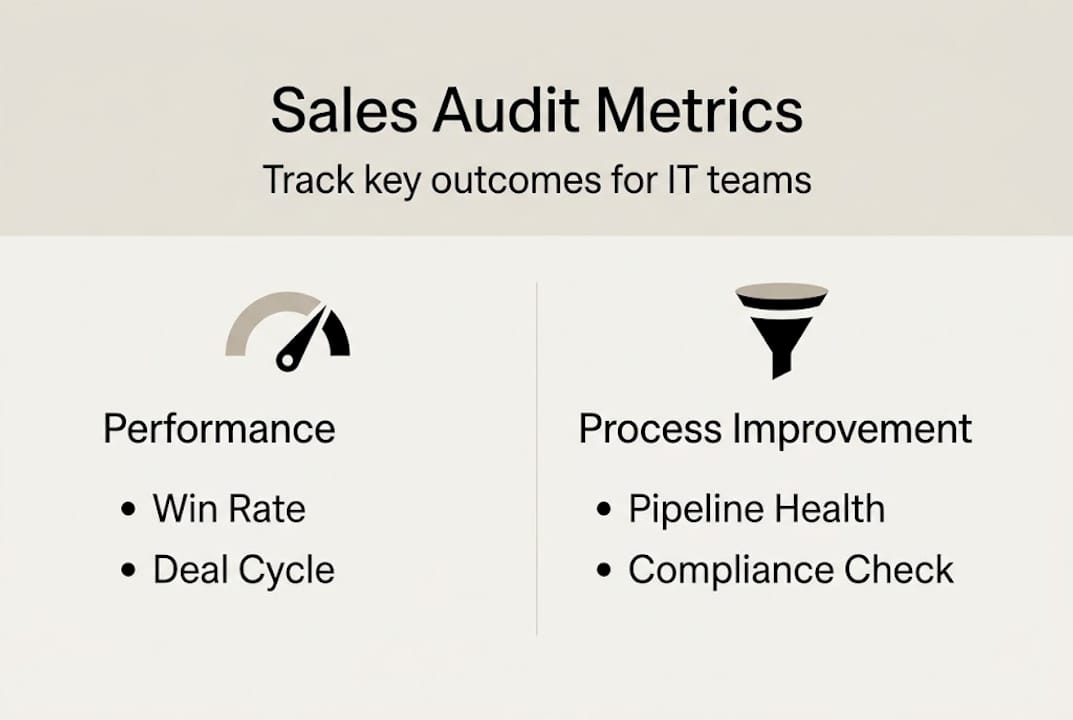
Performance review metrics confirm that data-backed audits drive measurable sales growth and reveal next-step optimizations in IT sales teams. Without tracking, you’re flying blind after the audit, which defeats the purpose entirely.
Here are the top metrics to monitor post-audit:
| Metric | What it tells you | Target direction |
|---|---|---|
| Win rate | Overall close effectiveness | Increasing quarter over quarter |
| Pipeline velocity | How fast deals move through stages | Accelerating |
| Deal cycle length | Time from first touch to close | Decreasing |
| Stage conversion rate | Where deals stall or drop | Improving per stage |
| Forecast accuracy | Reliability of revenue predictions | Tightening variance |
| Rep ramp time | How fast new reps hit quota | Shortening |
Beyond the numbers, build a structured feedback loop. After each audit cycle, hold a 30-minute debrief with the sales team. Ask three simple questions: What did the audit surface that surprised you? What change was most impactful? What should we stop reviewing because it’s not actionable?
Signs your checklist is genuinely moving the needle include:
One practical note: your checklist should evolve every six months at minimum. Markets shift, your ICP sharpens, your tech stack changes. Use pipeline optimization strategies to inform what new checkpoints your audit needs as your sales motion matures. And review the audit value guide periodically to benchmark your approach against broader data governance standards.
Here’s something most articles won’t say directly: a lot of sales audits fail not because of bad checklists, but because of bad intent. Leaders run them to produce a report, not to change behavior. That’s the checkbox audit. It looks thorough, it feels productive, and it changes absolutely nothing.
The teams we’ve seen win consistently treat audits as a strategic habit, not an administrative task. They embed audit findings into rep coaching, territory planning, and product feedback loops. The audit becomes connective tissue across the entire revenue org.
The mindset shift is simple but hard to execute: stop asking “did we complete the audit?” and start asking “what did the audit change?” That reframe is the difference between a document that collects dust and a system that compounds over time.
Building audit discipline starts at the top. If the VP of Sales or Head of Sales doesn’t take the findings seriously, neither will the team. Learn more about consulting’s role in sales growth and how external perspective accelerates the cultural shift that makes audits genuinely transformative.
You’ve got the framework. Now it’s time to act on it.

At Sales Label Consulting, we work directly with RevOps leaders, Heads of Sales, and VPs across European IT companies to build audit systems that produce real, measurable results. Whether you’re starting from scratch or refining an existing process, our tools and expertise meet you where you are. Explore our detailed audit steps, apply our proven review checklist tools, and download the sales process checklist built specifically for EU tech teams. Let’s build a sales org that doesn’t just grow fast, but grows right.
A sales audit checklist ensures all sales processes are reviewed systematically for gaps and improvement opportunities. It creates a reliable revenue system by surfacing process issues before they compound into lost revenue.
IT companies should perform a sales audit at least once per quarter, with annual comprehensive reviews in detail. Regular reviews drive better win rates and help teams stay aligned with shifting market conditions.
Track win rates, pipeline velocity, and changes in deal cycle lengths for the clearest audit impact. These key metrics reveal whether audit findings are translating into real process improvements.
They ensure that processes meet industry and security standards, reducing risk during audits or certifications. Compliance-ready checklists reduce audit risks and build credibility with enterprise clients in regulated industries.
Treating the checklist as a one-time activity rather than a living, iterative tool undermines results. Consistent implementation is what separates teams that see compounding gains from those that see none.
Subscribe to our Insights: Expert productivity tips in your inbox
You'll receive 1-3 emails per month. Your data stays private, always.

CRO & Co-Founder with Sales Label Consulting

Watch our Sales Mates Podcast
Available
April 23, 2026 - 8 min read
Read article Read articleApril 22, 2026 - 8 min read
Read article Read articleApril 21, 2026 - 9 min read
Read article Read articleApril 20, 2026 - 8 min read
Read article Read articleDrop us a line to talk
about your project