
Multi-Channel Sales Explained for Sales Leaders
TL;DR:
- Multi-channel sales involves selling through multiple independent platforms, each with its own customer experience. It expands reach and diversifies revenue, improving forecasting and targeting through behavioral data. Building a successful system starts with stabilizing one channel before scaling and consolidating data for future omnichannel integration.
Multi-channel sales is defined as selling products or services through multiple independent channels simultaneously, including ecommerce stores, physical retail locations, online marketplaces, social commerce platforms, and mobile apps. Each channel operates as its own storefront with separate purchasing capabilities. Understanding what is multi-channel sales matters now more than ever: global retail ecommerce sales are projected to reach $6.8 trillion by 2028. That number tells you where buyers are going. Sales leaders who spread their presence across channels capture more of that demand than those who rely on a single path to purchase.
Multi-channel retailing involves selling through multiple independent platforms, each functioning as its own storefront. The key word is independent. A customer who buys on Amazon has a completely different experience from one who walks into your store or clicks through your Instagram shop. That independence is the defining feature of the model.
The most common channels in a multi-channel strategy include:
Each channel attracts a different buyer profile. A marketplace buyer is hunting for price and convenience. A social commerce buyer is impulse-driven and visually motivated. A B2B portal user wants speed and account-level pricing. Treating all of them the same way is a fast path to underperformance.
Pro Tip: Map the primary buyer intent for each channel before you write a single product description. The language that converts on Amazon is rarely the same language that converts on your own site.

Multi-channel sales strategies increase customer reach, improve revenue potential, and let businesses engage buyers on their preferred platforms. Those three outcomes compound each other. More reach means more data. More data means better targeting. Better targeting means higher conversion rates across every channel.
Here are the core benefits, ranked by impact:
The data benefit is underrated. Most sales leaders focus on the revenue upside and miss the intelligence upside. When you run five channels, you run five parallel experiments on buyer behavior. That data feeds better forecasting, better inventory decisions, and better sales funnel optimization across the board.
Pro Tip: Assign a dedicated revenue owner to each channel from day one. Without clear ownership, channel data gets siloed and the intelligence benefit disappears entirely.
This is the question that trips up most sales leaders, and the confusion is understandable. Both models use multiple channels. The difference is in how those channels relate to each other.
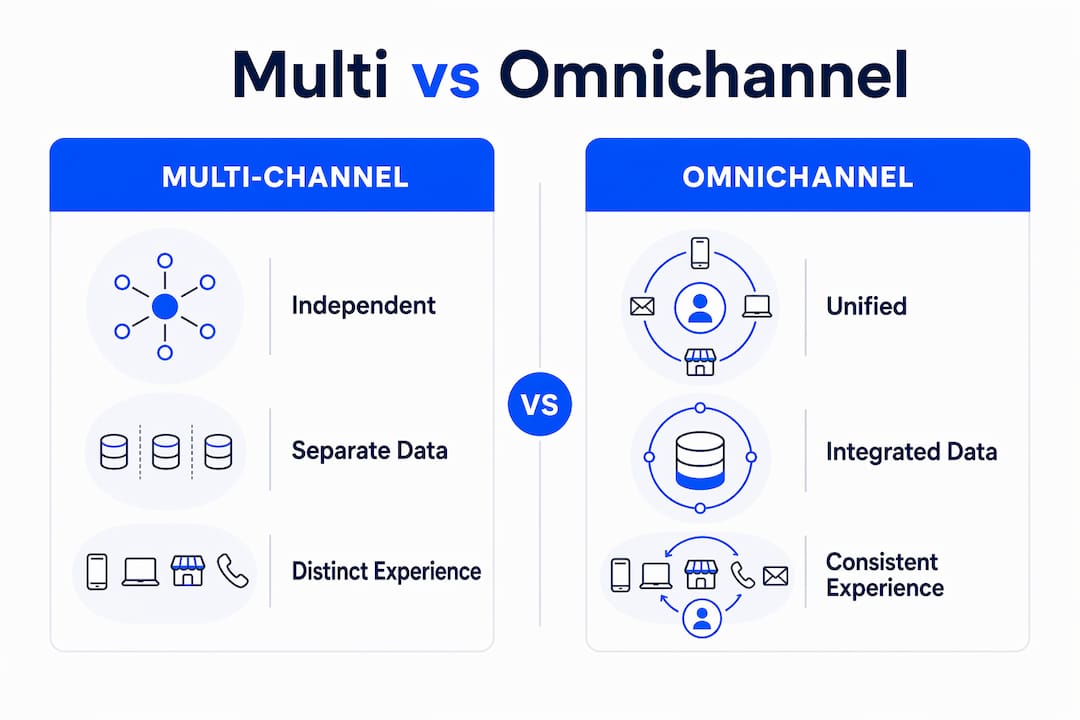
Omnichannel sales unify the customer experience across channels with integrated data and inventory. Multi-channel sales lets channels operate independently. That integration gap has real operational consequences.
| Dimension | Multi-channel sales | Omnichannel sales |
|---|---|---|
| Channel relationship | Independent, separate operations | Unified, integrated experience |
| Inventory management | Managed per channel | Shared, real-time inventory view |
| Customer data | Siloed by channel | Consolidated across all touchpoints |
| Customer experience | Varies by channel | Consistent regardless of channel |
| Implementation complexity | Moderate | High |
| Best suited for | Growth-stage businesses scaling reach | Mature businesses prioritizing CX |
The practical implication: a customer who abandons a cart on your website will not see that cart when they open your mobile app in a multi-channel setup. In an omnichannel setup, they will. That continuity requires shared data infrastructure, unified inventory systems, and cross-channel customer identity resolution. It is a significant engineering and operational lift.
Multi-channel is not a lesser version of omnichannel. It is a different strategic choice, and for many businesses it is the right one. Consolidating data from all sales channels into a unified view is the foundational step that eventually enables omnichannel maturity. Think of multi-channel as the architecture you build first, and omnichannel as the integration layer you add when the business is ready.
Effective multi-channel management relies on consolidating sales and inventory data, defining clear channel ownership, and scaling channels iteratively. Most teams that struggle with multi-channel sales skip one of those three. Here is how to get each one right.
The discipline of optimizing sales outreach per channel is what separates teams that scale multi-channel successfully from those that spread themselves thin and see diminishing returns everywhere.
Challenges in multi-channel sales include inventory mismanagement, data silos, inconsistent messaging, increased costs, and complex sales attribution. None of these are fatal. All of them are predictable. That means you can plan for them before they hit.
The teams that handle these challenges best are the ones that treat multi-channel as a system, not a collection of separate experiments. Structure beats heroics every time.
Multi-channel sales requires independent channel operations, clear ownership structures, and consolidated data to generate predictable revenue growth.
| Point | Details |
|---|---|
| Core definition | Multi-channel sales means selling through independent channels, each with its own storefront and buyer experience. |
| Multi-channel vs. omnichannel | Multi-channel channels operate independently; omnichannel integrates them with shared data and inventory. |
| Top benefit | Channel diversification protects revenue and generates parallel behavioral data for better forecasting. |
| Critical management practice | Define ownership per channel and consolidate all sales data into one view before scaling. |
| Common pitfall | Launching too many channels at once creates inventory chaos and inconsistent brand messaging. |
I have seen sales teams launch four channels in a quarter and wonder why nothing is working six months later. The answer is almost always the same: they treated multi-channel as a distribution problem when it is actually an operations problem.
The teams that get this right start with one channel, make it profitable, document what works, and then replicate that discipline on the next channel. That sounds slow. It is not. It is the fastest path to a multi-channel operation that actually scales.
The other thing I would push back on is the rush to omnichannel. Omnichannel is the right destination for many businesses, but it requires a data foundation that most companies have not built yet. Channel-specific customer journey mapping is the work that tells you whether you are ready to integrate or whether you still need to stabilize. Skip that mapping step and your omnichannel investment will underdeliver.
Real talk: the businesses I have worked with that generate the most predictable revenue from multi-channel are not the ones with the most channels. They are the ones with the clearest ownership, the cleanest data, and the discipline to cut what is not working. More channels is not the goal. More revenue per channel is.
— Antony
Running multiple sales channels without a clear framework is expensive and exhausting. Saleslabelconsulting works with RevOps leaders, Heads of Sales, and VPs of Sales to build the operational structure that makes multi-channel sales predictable.
Our sales enablement frameworks give your team the channel ownership models, data consolidation playbooks, and performance measurement systems needed to scale without chaos. We have done this across tech companies at multiple growth stages, and we know where the operational gaps appear before they cost you pipeline. If you are ready to build a multi-channel operation that generates consistent, measurable revenue, Saleslabelconsulting is the team to call.
Multi-channel sales is the practice of selling through multiple independent platforms, such as your own website, Amazon, and physical stores, at the same time. Each channel operates separately with its own customer experience and purchasing process.
Multi-channel sales runs each channel independently, while omnichannel integrates all channels with shared data, inventory, and a unified customer experience. Omnichannel requires significantly more infrastructure investment.
The primary benefits are expanded customer reach, revenue diversification across channels, and channel-specific behavioral data that improves forecasting and targeting decisions.
Start with one channel, stabilize it, and then add the next. Launching multiple channels simultaneously creates inventory and messaging problems that are difficult to fix at scale.
Building a multi-channel operation creates the data foundation and operational discipline needed for omnichannel integration. Consolidating channel data into a unified view is the critical first step toward omnichannel maturity.
Subscribe to our Insights: Expert productivity tips in your inbox
You'll receive 1-3 emails per month. Your data stays private, always.

CRO & Co-Founder with Sales Label Consulting

Watch our Sales Mates Podcast
July 26, 2026 - 13 min read
Read article Read articleJuly 25, 2026 - 8 min read
Read article Read articleJuly 24, 2026 - 11 min read
Read article Read articleJuly 23, 2026 - 17 min read
Read article Read article