
90-Day Fix From a Demand Generation Audit for Marketing & Sales Heads
A demand generation audit tells you one thing that matters: whether your engine builds pipeline or just produces vanity leads. Run a structured review across ICP fit, channels, data hygiene, scoring, and sales handoff, and you’ll walk away with 3 to 5 priority fixes and a 90-day sprint to execute them.
TL;DR:
- An effective demand generation audit should focus on pipeline contribution metrics, ICP alignment, channel efficiency, and the quality of sales handoff processes.
- Red flags include poorly defined SLAs, channels consuming disproportionate budgets with low pipeline impact, and content gaps at the decision stage.
- Improvements should prioritize quick wins like fixing form friction, recalibrating scoring, and establishing clear sales-marketing feedback loops within 90 days.
- Seasonal demand patterns and competitor activities must be factored into a realistic, long-term performance assessment.
- A well-structured, data-driven approach can reveal common leaks, such as misaligned scoring or broken attribution, that impair pipeline growth.
A real audit demand generation process doesn’t start with channels. It starts with agreement on what “working” even means. Skip that step, and you’ll spend six weeks debating whether a 40% MQL to SQL rate is good or terrible.
Here’s the sequence we run when we evaluate demand generation for B2B tech clients, and the pass/fail signal for each step.
This is the same structure behind most modern B2B demand gen audit frameworks, and it’s built to feed directly into execution, not sit in a slide deck.
An audit demand generation review is only useful if it produces numbers you can act on. Track pipeline contribution by channel, MQL to SQL rate, CAC for the demand-gen portion of spend, content-influenced pipeline, and branded search growth as a proxy for authority building, since demand generation is fundamentally about long-term pipeline contribution, not short-term lead spikes.
Pro Tip: Don’t expect full pipeline impact in month one. Leading indicators like content traffic, email engagement, and video views move first, with full pipeline impact typically showing up over a 6 to 12 month horizon.
| Timeframe | What to track | What “on track” looks like |
|---|---|---|
| 90 days | SLA compliance, data hygiene fixes, quick wins shipped | most red-flag items closed |
| 60 days | Lead scoring recalibration, nurture activation latency | Scoring matches closed-won patterns |
| 90 days | MQL to SQL rate, pipeline contribution by channel | Measurable lift versus baseline |
Benchmarks shift with average contract value and company stage, so treat any external number as a directional guide, not a target to hit blindly.
The handoff is where most demand generation strategy work quietly dies. Clear SLAs paired with speed-to-lead under five minutes materially improve conversion, and a missing SLA is one of the most common audit findings we see.
Build the handoff around four elements:
Pro Tip: If sales can’t tell you why a lead was rejected within 48 hours, your feedback loop is broken. Fix that before you touch ad spend. Learn more about aligning sales and marketing on handoff standards.
You don’t need new software to run this. You need to check what you already have.
Our lead generation checklist and this marketing automation checklist both work well as starting templates for these checks.
Score every audit finding by impact times effort, then pick the top 3 to 5 interventions. A broken SLA is high impact and low effort. A full MA platform migration is high impact and high effort, so it waits.
One caution audits routinely surface: a meaningful share of marketing spend produces no pipeline at all, and the leak usually sits in activation and measurement, not creative or ad targeting. That pattern showed up in our work with CodeIT, where adjustments to lead generation and sales alignment drove sustainable growth once the handoff and scoring layers were fixed.
Pull at least 18 to 24 months of campaign data before you draw conclusions from any single quarter. B2B tech buying cycles often slow in July and August and again in late December, and a dip in that window looks like a program failure when it’s actually a calendar effect.
Chart pipeline contribution and MQL volume by month, not just by quarter, and overlay it against past budget cycles and fiscal-year-end pushes from your buyers’ industries. If a spike consistently follows a specific trade show, product launch, or renewal cycle, that’s a pattern worth building future campaigns around, not a one-time win to celebrate and forget.
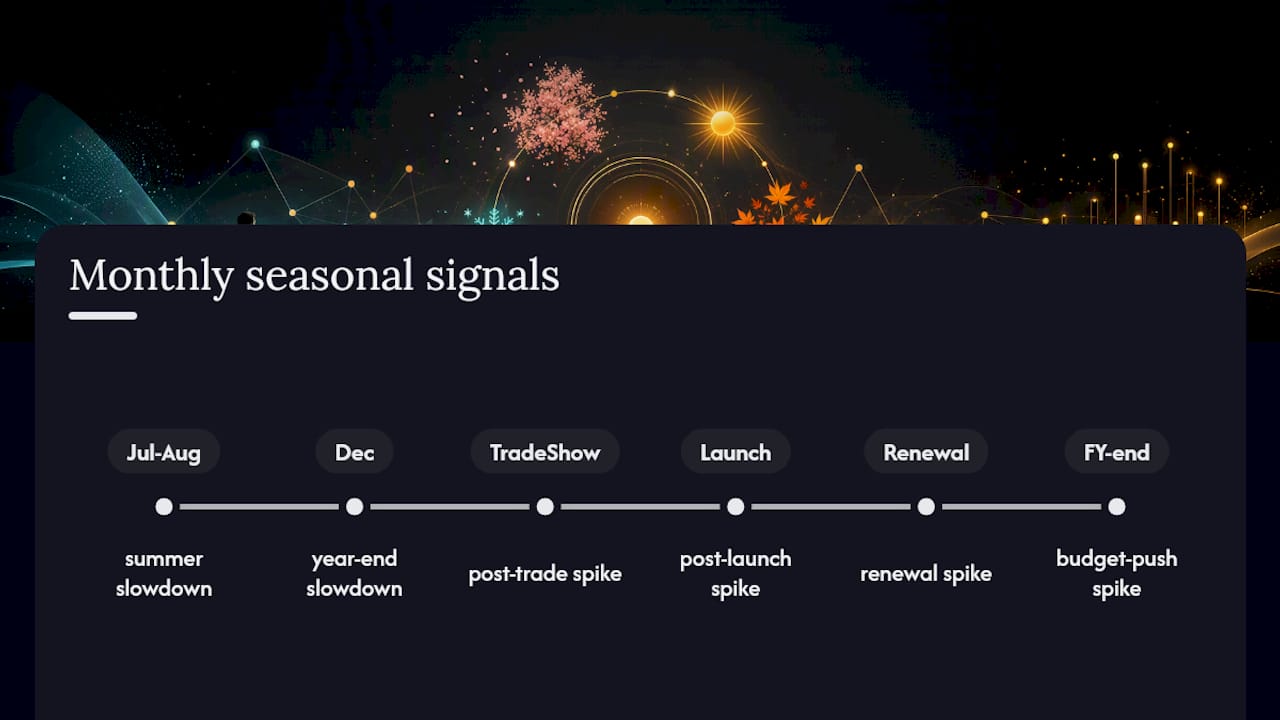
The audit should also flag whether your team already adjusts spend for these cycles or just reacts to them after the fact. Plenty of demand generation best practices assume flat, year-round demand, when the real pattern in most B2B tech categories is lumpy and tied to budget cycles, conference calendars, and renewal timing. A demand generation assessment that ignores 12 months of history and only looks at last month’s numbers will misread a seasonal dip as a strategy failure, and misread a seasonal spike as proof a new tactic is working when it isn’t.
Build a simple monthly trend line into your scorecard. It costs almost nothing to maintain and prevents the single most common misread we see in quarterly business reviews: panicking over a slow month that happens every single year.
You can’t audit in a vacuum. Part of evaluating your own program means understanding what comparable companies in your category are doing, and where your approach looks thin by comparison.
Start with public signals: competitor content cadence, the channels they’re visibly investing in (sponsored content, paid social, webinars, review-site presence), and how their messaging positions against yours. Check review platforms like G2 and Capterra for competitor mentions and see which pain points show up most in buyer comments, since those often reveal gaps in the market your own content isn’t addressing.
Look at their gated versus ungated content strategy too. A hybrid approach, where educational content stays open but proprietary tools or reports get gated, tends to outperform an all-gated or all-open strategy, and it’s worth checking whether your competitors have figured that out before you have.
This isn’t about copying a competitor’s playbook. It’s about spotting where your program is quietly behind: if three competitors run active webinar series and you don’t, that’s a coverage gap worth testing. If a competitor’s review-site presence dwarfs yours, that’s a signal your BoFu content and customer advocacy program need attention. Competitor benchmarking works best as a sanity check against your own audit findings, not as the primary driver of strategy. Use it to validate what your internal data already suggests, not to chase every move a competitor makes.
CRM and marketing automation integration checks matter, but they’re not the whole story. A demand generation audit needs to look at the full stack: intent data providers, ad platform connections, analytics tooling, and whatever sits between your website and your CRM.
Start with the gaps that don’t show up in a simple integration check. Do you have a way to capture and act on intent signals before a prospect ever fills out a form? Is your analytics setup actually attributing multi-touch journeys, or is it defaulting to last-touch and quietly crediting the wrong channel for every deal? Many teams pass their CRM and MA integration test and still have a broken measurement layer because nobody checked whether the analytics platform and the ad platforms are talking to each other correctly.
Also check for tool sprawl. It’s common for a marketing team to run five or six point solutions, layered in over several years, with overlapping functions and no clear owner for any of them. That sprawl creates data silos, and data silos are exactly what break attribution accuracy. The fix isn’t always buying new software. Often it’s consolidating what you already own and retiring the tools nobody fully adopted.

Finally, check whether your stack supports account-level routing and scoring, not just individual lead scoring. B2B buying committees involve multiple people, and a stack that only tracks one contact per account will miss the signal when three people from the same company are researching you at once.
Three patterns repeat across almost every audit we run. First, teams overestimate how well their lead scoring predicts revenue, usually because nobody has checked it against closed-won data in over a year. Second, the sales handoff is weaker than either team admits, with no real SLA and no feedback loop. Third, content coverage always has a decision-stage gap, because it’s the hardest content to write and the easiest to postpone.
If you want the fixes to stick, put the audit findings on the agenda at the next quarterly revenue review, not in a separate marketing meeting. Assign an owner and a deadline to each fix in front of both marketing and sales leadership.
— Antony
This service offers an alternative to hiring a full-time RevOps analyst or running this audit internally with a team that’s already stretched thin. We bring an outside, revenue-focused read on where your demand engine leaks pipeline, then stay hands-on through execution instead of handing you a report and disappearing.
A typical engagement includes a diagnostic across ICP fit, channel performance, scoring logic, and sales handoff, followed by a prioritized roadmap ranked by impact and effort. From there, we run weekly sprints through the 90-day window, tracking SLA compliance, MQL to SQL movement, and pipeline contribution by channel so you can see the fixes working in real time, not just on a slide at quarter’s end. If your team has the audit findings but lacks the bandwidth to execute them, this type of engagement can help close that gap.
Ready to see where your program leaks? Start with our sales audit process to scope the engagement and get a prioritized plan built around your own pipeline data.
Subscribe to our Insights: Expert productivity tips in your inbox
You'll receive 1-3 emails per month. Your data stays private, always.

CRO & Co-Founder with Sales Label Consulting

Watch our Sales Mates Podcast
September 8, 2026 - 7 min read
Read article Read articleSeptember 7, 2026 - 9 min read
Read article Read articleSeptember 6, 2026 - 10 min read
Read article Read articleSeptember 5, 2026 - 8 min read
Read article Read article