
Fix Forecast Accuracy in 90 Days: Pipeline Governance for Sales VPs
Pipeline governance is the RevOps-owned ruleset, stage gates, required evidence, SLAs, and inspection rituals, that makes your forecast auditable instead of aspirational. Get it right and you cut zombie deals, shrink the debate over “is this really a commit,” and give managers a shortlist of deals worth their coaching time instead of a spreadsheet full of noise. The rest of this playbook shows you exactly how to build it, artifact by artifact, in about 90 days.
TL;DR:
- Effective pipeline governance requires clear, evidence-based stage definitions linked to buyer behavior, not seller activity or opinions.
- Weekly KPI tracking should focus on coverage ratio derived from actual win rate, pipeline velocity, next step completeness, stale deals, and date pushes.
- A three-tier inspection rhythm—weekly, monthly, quarterly—ensures governance rules are enforced, refines stage criteria, and updates coverage targets.
- The full rollout of pipeline governance typically takes 90 days in three phases: mapping, validating, and full deployment with published scorecards.
- Owners for governance include RevOps, sales managers, data owners, and decision makers, each with designated responsibilities and a clear RACI.
Governance is not a vibe. It is a specific set of artifacts and rules that RevOps has to own, publish, and defend, because without them your forecast is just a collection of individual opinions about deals.
Here is the checklist that matters:
The reason evidence-based movement beats opinion-based advancement is simple: a stage change backed by a signed budget confirmation survives a board review, while “the rep feels good about it” does not. This is why a revenue data dictionary matters as much as any dashboard, since it defines what every field actually means before anyone builds a report on top of it. Funnel governance frameworks generally recommend structuring this into three layers: definition, movement, and inspection.
Vague stage criteria are the single biggest reason forecasts fall apart. If “Opportunity” means five different things to five different reps, your coverage math is fiction before you even run it. The fix is writing criteria that reference customer evidence, not seller activity, following the same logic funnel governance research uses to separate lifecycle stages by proof, not by hope.
A meeting note that says “went well, they’re interested” is not evidence. A calendar invite for a follow-up with the economic buyer is. This distinction is where MEDDPICC-style qualification earns its reputation. Enforcing fields like Metrics, Economic Buyer, and Decision Criteria in the CRM stops reps from advancing deals on gut feel alone.
Not every field should be mandatory everywhere. Requiring “Competitor” at the MQL stage just trains reps to type junk into a field to get past a validation rule.
Move it later in the funnel where the answer actually exists.*
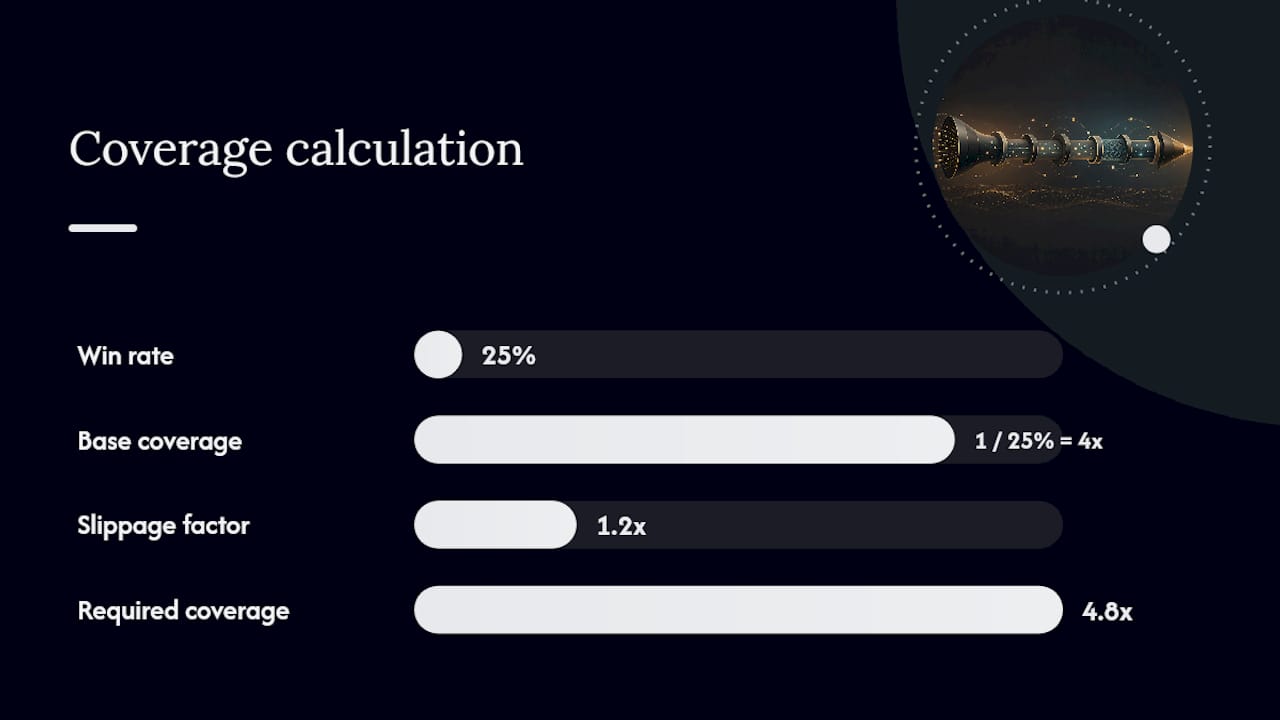
Coverage ratio is the metric everyone quotes and almost nobody calculates correctly. The right way is to derive it from your actual win rate: Required Coverage = (1 / Win Rate) × Slippage Factor. A team closing 25% of qualified opportunities with a 1.2x slippage factor needs roughly 4.8x pipeline coverage. Not the generic “3x to 5x” rule of thumb everyone recites without checking their own numbers.
Pipeline velocity beats raw coverage as a headline metric, because velocity ties deal movement to actual value and win rate instead of rewarding reps for stuffing the pipe with deals that never move.
Your weekly scorecard needs at minimum:
Governance dies without a rhythm to enforce it. A three-tier cadence, weekly, monthly, quarterly, keeps the rules alive instead of gathering dust in a wiki nobody opens.
This structure mirrors what pipeline management research describes as the minimum cadence for keeping a forecast trustworthy quarter over quarter.
Ninety days is enough to go from undefined stages to a published scorecard your VP actually trusts, provided you run it in three deliberate phases rather than trying to fix everything in week one.
Pro Tip: Pilot the new stage criteria on one team before forcing it org-wide. You’ll catch the fields nobody can actually fill in before it becomes a company-wide argument.
Ambiguous ownership kills more governance programs than bad metrics ever do. A working RACI needs exactly four roles, not a committee.
Automated consequences slot directly into this chain: a stale deal gets flagged at 30 days, pulled from the forecast at 90 days, and auto-closed as lost by 6 to 12 months unless a manager documents a real reason to keep it open.
Most governance programs don’t fail from a lack of rules. They fail because the rules are unenforced, unclear, or ignored the moment a rep is chasing quota.
That drop is not a problem. It is the first honest signal you’ve had in a while.
Most sales leaders treat governance as a compliance exercise, something RevOps enforces so Finance stops complaining about forecast accuracy. That framing is backwards. Governance is a coaching tool disguised as a data policy. When stage criteria are evidence-based, a manager doesn’t spend Monday’s forecast call arguing about whether a deal is “really” a commit. They spend it asking why the champion hasn’t looped in the economic buyer yet, which is a far more useful conversation.

The other mistake is over-engineering the first version. Teams build 40-field data dictionaries and twelve-stage funnels before they’ve proven anyone will follow a five-field version. Start with the shortest rule set that changes behavior, then add complexity only where the data proves you need it. That is also why the MEDDPICC framework works better as a set of required fields inside existing stages than as a parallel process reps have to remember separately.
Consulting engagements in sales pipeline governance often show a consistent pattern: the CRM was never the problem. The absence of a written, owned, inspected ruleset was. A pipeline optimization audit usually finds the fixes buried in existing tools, not in a new platform purchase.
— Antony
Reading a governance framework and running one inside a real CRM with real reps are two different problems. Governance artifacts like stage criteria sheets, data dictionaries, SLA tables, and exception logs can be built as structured deliverables inside a broader revenue system rebuild, rather than as generic templates pulled off a shelf.
A typical engagement starts with a Sales Workflow Audit to baseline your current hygiene metrics and stage definitions, then moves into designing the Revenue Operating System that runs your weekly, monthly, and quarterly inspection cadence going forward. Because Sales Label Consulting works hands-on inside your actual pipeline rather than handing you a slide deck, the deliverables at day 90 are the same artifacts and CRM rules your team runs on day 91 and beyond. If your forecast debates keep circling back to “well, it depends who you ask,” book a diagnostic call and find out which of your stage gates are actually costing you accuracy.
Pipeline governance is the set of rules, stage definitions, required data fields, SLAs, and inspection rituals that a RevOps team owns to keep deal progression evidence-based and forecasts auditable. It typically covers three layers: how stages are defined, how deals move between them, and how often they get inspected, as outlined in funnel governance frameworks.
Required coverage comes from your actual win rate, not a generic industry rule. The formula is Required Coverage = (1 / Win Rate) × Slippage Factor, which for a 25% win rate with a 1.2x slippage factor works out to roughly 4.8x, well above the commonly repeated “3x to 5x” shortcut.
Evidence means something a buyer did or confirmed, not something a seller wrote in a note. Examples include a signed budget confirmation, a recorded discovery call with the economic buyer, or a dated next-step meeting on the calendar, consistent with the stage criteria examples governance frameworks recommend.
A structured rollout typically runs 90 days across three phases: mapping stages and baselining hygiene in the first 30 days, building CRM validation rules and piloting inspections in the next 30, and rolling out fully with a published scorecard in the final 30. Sales Label Consulting runs this exact phasing inside its Sales Workflow Audit and Revenue Operating System engagements.
Sales Label Consulting builds the actual governance artifacts, stage criteria sheets, data dictionaries, SLA tables, and exception logs, inside your existing CRM rather than delivering generic templates. Pricing for engagements like the Revenue System Diagnostics or Sales Workflow Audit is available on request through the services page.
Subscribe to our Insights: Expert productivity tips in your inbox
You'll receive 1-3 emails per month. Your data stays private, always.

CRO & Co-Founder with Sales Label Consulting

Watch our Sales Mates Podcast
September 22, 2026 - 11 min read
Read article Read articleSeptember 21, 2026 - 8 min read
Read article Read articleSeptember 20, 2026 - 13 min read
Read article Read articleSeptember 19, 2026 - 13 min read
Read article Read article