
Stabilize Sales Ops First, Add RevOps in 90 Days for Leaders
RevOps orchestrates revenue across marketing, sales, and customer success; Sales Ops focuses on making the sales team run better. Start with Sales Ops to stabilize execution, then add RevOps once multiple GTM motions or cross-team friction start eating into revenue. If your finance team and your sales team report two different pipeline numbers, or you’re now running product-led and sales-led motions side by side, that’s RevOps territory.
TL;DR:
- Sales Ops should be established first to improve sales process and metric accuracy before scaling RevOps to address cross-team revenue leaks.
- RevOps owns broader KPIs like revenue predictability, net revenue retention, and go-to-market efficiency, which require data and process alignment across multiple departments.
- Sales Ops is responsible for tactical, sales-focused tasks such as CRM management, deal approval workflows, and territory design, with immediate metrics like win rate and forecast accuracy.
- Selection between Sales Ops and RevOps should be based on signals such as forecast inconsistencies or cross-team friction; sequencing is essential when both issues are present.
- Most companies succeed with a phased approach: stabilize sales execution with Sales Ops first, then unify definitions and governance through RevOps, avoiding full RevOps deployment before foundational sales processes are solid.
Before you dig into the details, here’s the fast version. Scope, reporting line, and the metrics each function owns tell you almost everything you need to know:
One-sentence rule: choose Sales Ops when the problem lives inside the sales team, choose RevOps when the problem lives between teams.
RevOps is a full-funnel operating model, not a bigger version of Sales Ops; see how CRM automation for sports and entertainment brands can reduce cross-team revenue leakage. It governs the customer lifecycle end to end, unifies the data model marketing, sales, and customer success all pull from, and owns the technology stack that connects them. Gartner frames RevOps as the function that produces a single revenue number the board can actually trust, which is a fundamentally different job than optimizing a sales team’s output.
On a given week, a RevOps leader might reconcile how marketing defines a qualified lead against how sales defines a working opportunity, since misaligned definitions between MQL and closed-won are one of the most common sources of cross-team friction. They’ll sit in planning meetings with customer success to model expansion revenue, audit whether the CRM, marketing automation platform, and billing system actually agree with each other, and build the forecast rollup that finance uses to set guidance.
That cross-functional reach is exactly why RevOps stakeholders include department heads who have never had to align with Sales Ops before: marketing leadership, customer success leadership, and finance.
The KPIs reflect that scope. RevOps typically owns:
These metrics differ from sales metrics because they can’t be fixed by one department alone. A win rate problem lives inside sales. A net revenue retention problem might trace back to a marketing handoff, a pricing model, or a customer success gap, which is precisely the kind of issue RevOps exists to diagnose. Sales Label Consulting’s guide to RevOps in sales covers the prerequisites that need to be in place before this model produces results.
Sales Ops is tactical, sales team focused, and usually the first operational hire a growing B2B company makes. Its job is to make the sales team run better, not to govern the whole revenue engine. That means CRM administration, forecasting mechanics, quota and territory design, and deal desk work: approving discounts, structuring non-standard contracts, and keeping pricing consistent across reps.
The daily work is concrete. A Sales Ops manager cleans up duplicate records in the CRM, builds the dashboard reps actually use before a pipeline review, adjusts territory boundaries when a new rep gets hired, and runs the weekly forecast call where sales leadership decides what to tell the board. None of this requires marketing or customer success in the room. That’s the point. Sales Ops solves problems Sales Ops can solve on its own.
Concrete tasks that move the needle here include building a standardized deal-approval workflow so reps aren’t guessing what discount they can offer, automating handoffs between SDRs and account executives, and running quarterly territory rebalancing so quota assignments track actual market opportunity. Sales Label Consulting’s breakdown of Sales Ops responsibilities goes deeper on forecasting and CRM hygiene specifically.
The KPIs are narrower and more immediate than RevOps metrics:
A Sales Ops team that improves forecast accuracy from wildly off to consistently close builds something a lot of companies underrate: trust. When a VP of Sales tells the board a number and that number holds up quarter after quarter, that’s Sales Ops doing its job well. It’s a narrower mandate than RevOps, but it’s the foundation everything else gets built on.
Scope and stakeholders determine authority. Sales Ops answers to the sales organization and influences reps, sales managers, and the VP of Sales. RevOps answers to a broader executive circle and influences marketing leadership, customer success leadership, and finance, because RevOps orchestrates data, process, and technology across the entire go-to-market engine rather than one department’s execution.
That difference in scope shapes how KPIs should show up on an executive dashboard. Sales Ops metrics belong on a sales leadership scorecard: win rate, pipeline velocity, forecast accuracy by rep and by segment. RevOps metrics belong on the board deck: one revenue number, net revenue retention, blended GTM efficiency across every acquisition motion running. Mixing these two dashboards is a common mistake. A board doesn’t need rep-level pipeline velocity, and a sales manager doesn’t need blended NRR.
Tools and data ownership is where conflicts actually surface. Sales Ops owns the CRM configuration and the sales forecast model. RevOps owns the single source of truth that reconciles CRM data with marketing automation data and customer success platform data. When those three systems disagree, and they usually do at some point, RevOps is the function with the mandate to fix it. Without that governance layer, marketing reports one pipeline number, sales reports another, and finance has to guess which one to believe.
Reporting-line design follows directly from this. A Sales Ops leader reporting to a VP of Sales makes sense because the job is entirely inside that department. A RevOps leader reporting to the same VP of Sales creates a conflict of interest, since RevOps is supposed to arbitrate between sales, marketing, and customer success impartially. That’s why RevOps typically reports to a CRO, COO, or CFO instead. It needs organizational altitude that a department head role doesn’t have.
Hiring triggers separate the two clearly enough to act on. Look for these signals:
Pro Tip: Before you post a RevOps job description, audit whether your Sales Ops function can already answer basic questions consistently: what’s our current pipeline value, what’s our forecast for next quarter, and what’s our win rate by segment. If those answers vary depending on who you ask, fix that first. Adding a RevOps layer on top of inconsistent Sales Ops data just adds a second layer of confusion.
Most companies don’t need a philosophical debate here. They need a checklist. Run through this in order.
That third step matters more than most companies realize. A common mistake is standing up a full RevOps function before Sales Ops fundamentals are solid, which tends to compound the chaos instead of fixing it. Fix execution first. Govern second.
In practice, these functions don’t compete. At scale, Sales Ops usually sits inside RevOps as a specialized team, still handling CRM configuration, quota mechanics, and deal desk work, while RevOps governs cross-team definitions and forecasting above it. In earlier-stage companies, Sales Ops reports to VP Sales while a lighter RevOps layer sets shared definitions everyone uses.
Ownership stays clear when you assign it explicitly: Sales Ops owns CRM configuration and deal desk approvals, RevOps owns the definitions that feed the CRM and the forecast rollup that combines every team’s numbers. Picture a lead moving from marketing to sales to customer success. Marketing scores it using a definition RevOps set. Sales works it using a process Sales Ops built. Customer success expands it using retention data RevOps reconciled against the original deal terms. Sales Label Consulting’s guide to structuring these reporting lines walks through this in more detail.
Before touching RevOps, confirm three things: a stable sales motion, clean pipeline hygiene, and real executive sponsorship for cross-team governance. Without those, RevOps has nothing solid to build on.
A workable 90-day sequence: Days 1 to 30, audit where Sales Ops execution is leaking (forecast accuracy, CRM hygiene, handoffs). Days 31 to 60, fix the highest-impact Sales Ops gaps first. Days 61 to 90, unify lead and opportunity definitions across departments and run a small cross-functional governance pilot before scaling it further.
Most of the debate around RevOps vs Sales Ops treats it like a naming exercise, as if calling your Sales Ops team “RevOps” magically extends its authority into marketing and customer success. It doesn’t. The title change without the operating model change is where a lot of RevOps hires quietly fail within the first year.
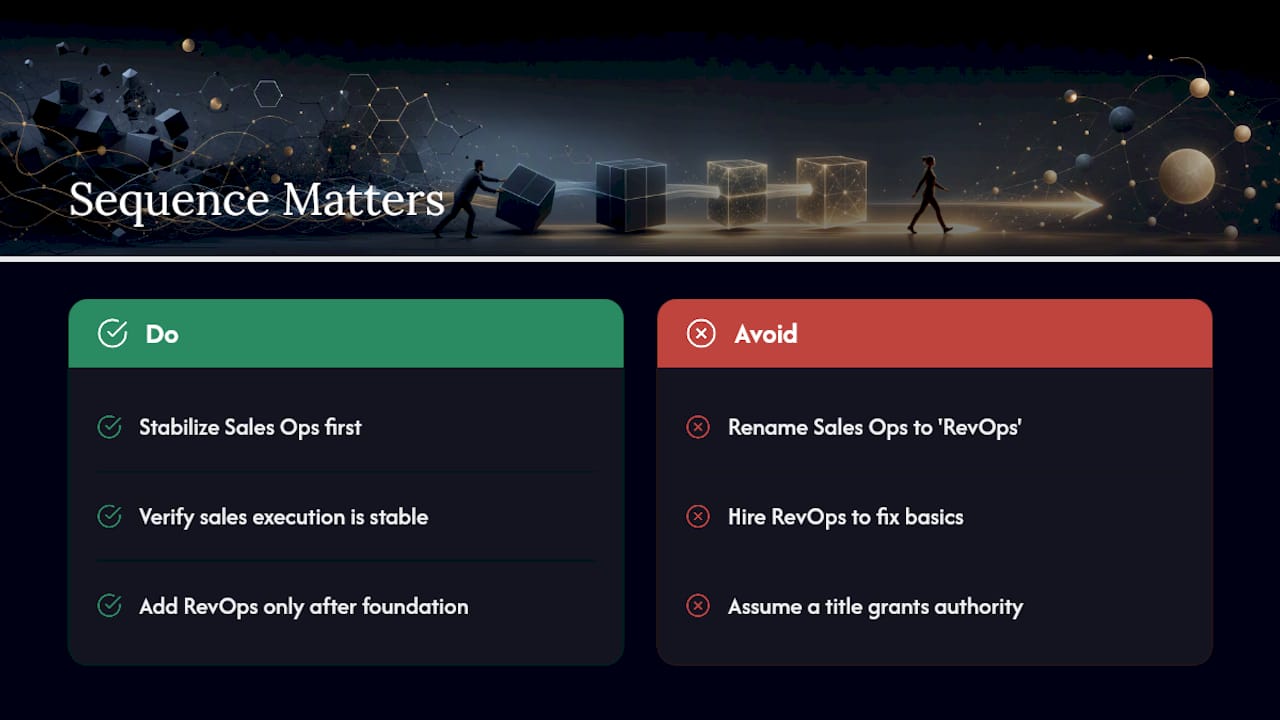
What the evidence actually supports is sequence discipline. A strong RevOps function almost always sits on top of a Sales Ops function that already works. Skip that foundation and you get a RevOps hire spending their first six months doing basic CRM cleanup that should have been solved two years earlier, while the cross-functional governance problems they were actually hired to fix go untouched.
The overrated idea here is that RevOps is simply “Sales Ops for the whole company.” It’s not a bigger version of the same job. It’s a different job that requires organizational altitude Sales Ops was never designed to have. If you’re a leader deciding what to build next, the priority isn’t picking the trendier title. It’s asking honestly whether your sales execution is stable enough that the next real leak is happening between departments, not inside one.
— Antony
Whether your gap sits inside sales execution or between departments, the fix usually starts with the same first step: finding out exactly where the leak is before you restructure anything. A Sales Workflow Audit or Revenue System Diagnostics pinpoints whether your forecast problem is a Sales Ops issue (CRM hygiene, quota design, deal desk bottlenecks) or a cross-functional one that needs a Revenue Operating System built around shared definitions and unified governance.

These systems are built from field experience running real B2B tech sales organizations, not from a framework applied without regard to actual pipeline data. The outcome most leaders want out of this work is straightforward: a forecast number everyone trusts, less revenue leaking between handoffs, and pipeline data clean enough to make decisions on. If that sounds like where your organization is stuck, the full breakdown of engagement options, including the Sales Workflow Audit and Revenue Operating System builds, is on the services page. Book a diagnostic conversation before you hire your next RevOps role, not after.
RevOps is a growing career track with strong upward mobility because it sits close to the executive team and directly influences board-level revenue reporting, though it typically requires prior Sales Ops or sales management experience to be effective in the role.
A RevOps professional reconciles data and definitions across marketing, sales, and customer success, governs the shared tech stack, and builds the unified forecast that feeds executive reporting rather than managing individual sales reps.
RevOps typically reports to a CRO, COO, or CFO rather than a VP of Sales, since the role requires impartial authority across multiple departments.
RevOps as a Service describes an external consulting engagement, like the Revenue Operating System or Revenue System Diagnostics work Sales Label Consulting offers, where a firm designs and implements cross-functional revenue governance without the company hiring a full internal RevOps team.
Yes. Sales Ops functions independently in most early and mid-stage companies, and only becomes insufficient once multiple GTM motions or cross-team data conflicts start causing revenue leakage that one department can’t resolve alone.
Subscribe to our Insights: Expert productivity tips in your inbox
You'll receive 1-3 emails per month. Your data stays private, always.

CRO & Co-Founder with Sales Label Consulting

Watch our Sales Mates Podcast
September 17, 2026 - 16 min read
Read article Read articleSeptember 16, 2026 - 14 min read
Read article Read articleSeptember 15, 2026 - 10 min read
Read article Read articleSeptember 14, 2026 - 10 min read
Read article Read article