
Restore Forecast Trust in 90 Days for RevOps and Finance
RevOps and finance alignment produces one thing above all: forecasts finance actually believes. Get there by agreeing on shared metric definitions this week, assembling a finance-facing operating packet, and locking a weekly RevOps-finance cadence. A 90-day playbook to make it stick follows below.
TL;DR:
- Sharing a single set of metric definitions and a standard operating packet helps reduce reconciliation time and build trust between RevOps and finance.
- Properly reconciling bookings, billings, and revenue requires understanding their differences and regularly verifying the deferred revenue identity.
- Automating data synchronization and commission calculations across CRM, billing, and ERP systems minimizes manual errors and dispute risks.
- A structured 90-day plan with clear milestones from agreement on definitions to scaling reporting ensures steady progress in alignment efforts.
- Maintaining a consistent communication cadence and documenting decisions prevent misinterpretations and foster collaboration.
Misalignment costs you twice: once in wasted hours reconciling spreadsheets, and again when the board catches a forecast miss finance never saw coming. Companies with tight internal alignment tend to grow faster and post higher profits, but RevOps teams routinely overlook their connection to finance, and that gap shows up as unreliable forecasts and commission fights that drag on for weeks.
The risks compound fast when nobody’s watching the seams:
Alignment fixes the root cause, not the symptom. When RevOps and finance share one set of numbers, reconciliation time drops and forecast variance actually becomes explainable instead of mysterious.
Every alignment failure traces back to one of three structural fights. Name them and you can fix them.
Fullcast’s framework names exactly these three: planning, data, and pay. Fix all three at once, because patching one while ignoring the others just moves the friction somewhere else.
Confusing these three terms is the single fastest way to lose finance’s trust. Bookings are the signed commitment, recorded when the deal closes in the CRM. Billings happen when you invoice the customer. Revenue is recognized only when the performance obligation is actually delivered, per ASC 606 rules that govern SaaS revenue recognition.
Pro Tip: Run this reconciliation identity every close: Billings minus Revenue equals the change in deferred revenue. If the math doesn’t hold, one of your source systems has a data problem. The identity holds for any subscription business and takes about ten minutes to check once your systems feed clean numbers.
The most common pitfalls, and how to catch them before the board meeting:
Build a one-page glossary with both teams in the room, get sign-off from the CFO and the head of RevOps, and revisit it every time you launch a new pricing motion. Pricing changes break more reconciliations than any other single event.
Alignment doesn’t happen because two people like each other. It happens because roles are explicit and the cadence forces the conversation. Finance owns the plan and the scenarios; RevOps owns the operating evidence, pipeline hygiene, and the “why” behind every number finance is asked to trust.
A workable RACI split looks like this:
Cadence matters more than most leaders admit. A weekly 30-minute sync between RevOps and FP&A catches drift before it becomes a quarter-end surprise. A monthly deeper session reconciles bookings against billings and revenue. A quarterly planning session resets assumptions before finance locks the board deck.
The centerpiece of this model is the finance-facing operating packet, a short document RevOps hands finance before every planning cycle. It should contain pipeline coverage by segment, win-rate trends, average sales-cycle length, rep ramp status, and any known risks to the current-quarter number. A short operating packet shared consistently prevents leaders from defaulting to shadow spreadsheets, which is where most trust actually breaks down. Assign one owner to the packet, keep it to two pages, and update it on the same day every cycle so finance knows exactly when to expect it.
Four systems need to agree before RevOps and finance can trust the same number: the CRM, the billing platform, the ERP/general ledger, and the commission engine. The CRM feeds bookings and pipeline stage data. Billing feeds invoice timing. The ERP recognizes revenue against contract terms. The commission system needs inputs from all three to calculate pay correctly.
You have two integration paths, and the choice depends on how fast your board wants answers. Near-real-time integration syncs CRM and billing data continuously, which is expensive to build but gives finance same-day visibility into deal movement. Nightly ETL batches are cheaper and good enough for most mid-market teams, as long as everyone agrees the “morning number” is yesterday’s close, not this minute’s.
Either way, build a canonical metric layer that sits above all four systems. A single revenue command center reduces reconciliation time dramatically and makes forecast variance something you can actually explain in a sentence, not a spreadsheet archaeology project.
Three quick wins that pay off before any big system investment:
Tools that surface dormant CRM signals, like Reactivation AI’s approach to reviving stalled pipeline data, can also tighten the connection between what’s sitting in the CRM and what actually becomes billable revenue.
Commission disputes are almost always a rules problem, not a people problem. If sales gets paid the moment a deal closes but finance only recognizes revenue over twelve months, you’ve built a structural argument into the compensation plan itself.
The fix is to tie commission triggers explicitly to either the booking event or the revenue-recognition schedule, and to write that choice into the comp plan document, not just into someone’s memory. If you pay on booking, build in a clawback clause for early cancellations or non-payment. If you pay on recognized revenue, make sure reps understand the timing before they sign their offer letter, not after their first confusing paycheck.
Pro Tip: Automating commission logic into one platform removes the most common source of disputes: two teams calculating the same number with two different spreadsheets.
For accrual accounting, finance should book estimated commission expense in the same period as the associated revenue, not the period the deal closed. That single rule change eliminates most of the “why does my accrual not match my commission statement” conversations before they start.
A forecast is only as good as the inputs feeding it, and finance can’t build scenarios on vibes. RevOps needs to hand over pipeline by segment, historical win rates, average cycle length by deal size, and current rep ramp status, every single cycle, in the same format.
This workflow only works if the underlying forecast accuracy improves at the pipeline level first, since a clean rollup built on messy CRM data just produces a confident wrong answer faster.
You don’t need a year-long transformation project. You need three focused sprints.
| Phase | Primary goal | Success signal |
|---|---|---|
| Days 0 to 30 | Shared definitions and first packet | Glossary signed off by CFO and RevOps lead |
| Days 31 to 60 | Automated cadence and commission logic | Commission disputes drop, packet auto-generates |
| Days 61 to 90 | Scaled reporting and scenario planning | Board deck built without a shadow spreadsheet |
The most common blocker isn’t technical, it’s political: someone’s spreadsheet becomes their security blanket. Name that risk on day one and assign an executive sponsor to retire the old model publicly, not quietly.
Most alignment failures aren’t caused by bad data. They’re caused by bad meetings. If RevOps and finance only talk during the tense quarter-end scramble, every conversation starts adversarial.
Fix the rhythm first. A short weekly sync, even 20 minutes, keeps both sides current on deal movement and forecast risk before it becomes a surprise. Bring the same two or three people every time; rotating attendees forces you to re-explain context and kills momentum.
Speak in numbers both sides recognize. “Revenue is behind plan” means nothing actionable; “three enterprise deals slipped from this quarter’s recognition into next” gives RevOps something to actually chase.
Document decisions, not just discussions. When finance and RevOps agree on a metric definition or a forecast caveat, write it down in the shared glossary the same day, because verbal agreements evaporate the moment the next fire drill starts. And when a number is wrong, own it fast. Teams that treat a forecast miss as a shared problem to solve, rather than a blame exercise, rebuild trust faster than teams that spend the postmortem assigning fault.
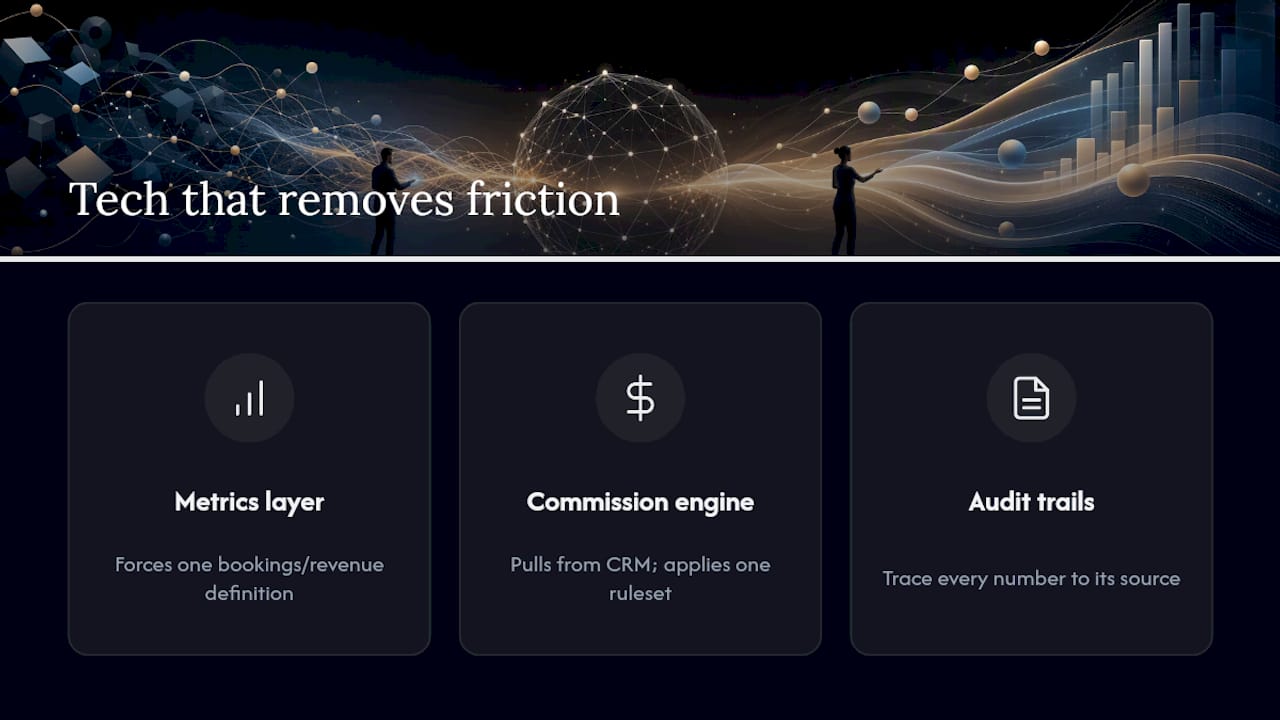
Technology doesn’t create alignment by itself, but the right stack removes the friction that makes alignment exhausting to maintain manually. The goal isn’t buying more software. It’s making sure the systems you already run talk to each other without a human copying numbers between tabs.
A canonical metrics layer sitting above your CRM, billing platform, and ERP is the single highest-leverage investment most teams can make, because it forces one definition of “bookings” and one definition of “revenue” across every dashboard anyone opens. Without it, every department builds its own version of the truth, and reconciliation becomes a monthly archaeology dig.
Automated commission engines matter almost as much. Manual commission calculation in spreadsheets is where trust between sales and finance goes to die, one rounding error at a time. A single-logic engine that pulls straight from the CRM and applies one set of rules eliminates the “your number doesn’t match my number” argument entirely.
Audit trails are the quiet hero here. When every number can be traced back to its source system automatically, finance stops needing to ask RevOps to “just double-check that one.” That alone saves hours every close cycle. The technology doesn’t need to be exotic. It needs to be connected, consistently applied, and boring in the best sense: nobody notices it because it just works.
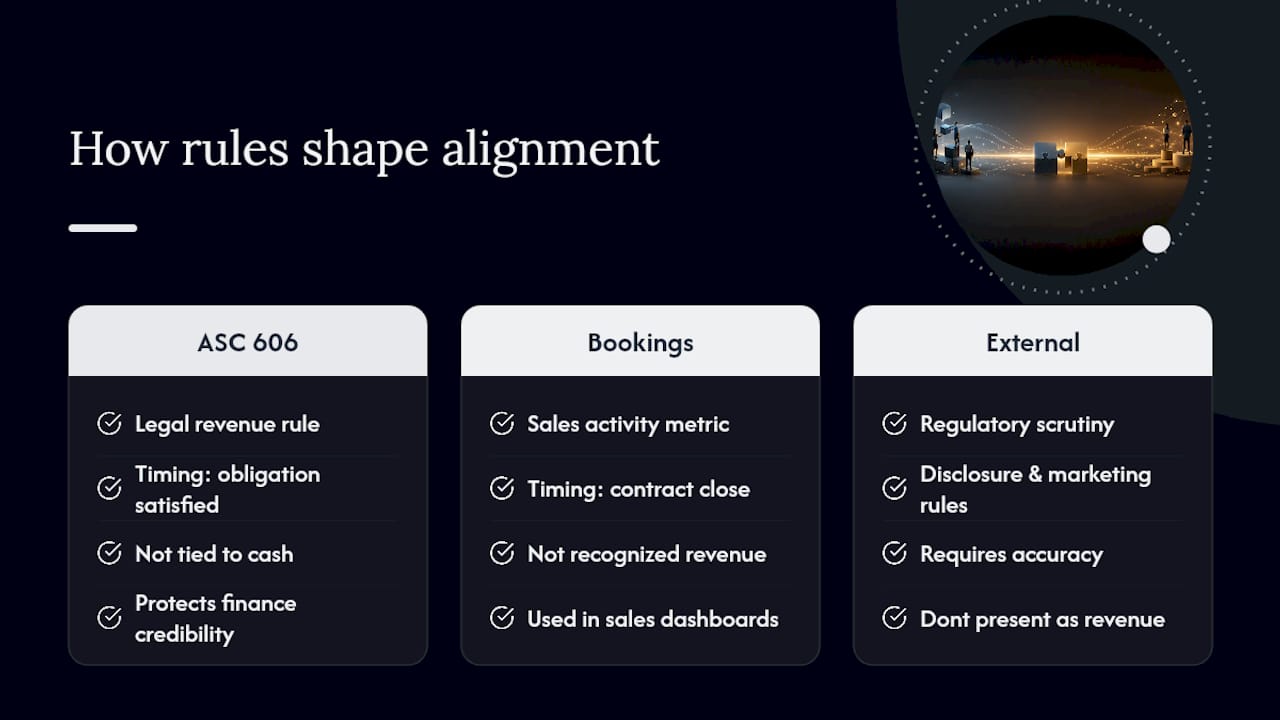
Revenue recognition isn’t just an internal preference; it’s governed by accounting standards that determine when a number can legally be called revenue. ASC 606 sets the rule that revenue is recorded when a performance obligation is satisfied, not when cash arrives or a contract gets signed. That single standard is why bookings, billings, and revenue can never be treated as interchangeable, no matter how convenient that would be for a sales dashboard.
Public companies and any business preparing for a fundraise or exit face additional scrutiny on how revenue-related metrics get presented externally. Regulatory guidance on marketing and disclosure compliance exists precisely because inflated or ambiguous revenue claims create real legal exposure, not just an embarrassing board conversation.
For most B2B tech companies, the practical takeaway is simpler than a compliance department makes it sound: never let a marketing deck, an investor update, or a sales presentation state a bookings number as if it were recognized revenue. That distinction protects you legally and it protects the credibility of every number your finance team puts in front of a board or an auditor afterward.
The fastest wins almost always come from the boring fix nobody wanted to prioritize: cleaning close-date hygiene in the CRM and forcing stage-evidence rules before a deal advances. Clients running the 90-day playbook consistently see forecast trust rebuild faster than expected, usually because the operating packet gives finance something concrete to react to instead of a verbal promise.
The overrated fix is buying new software before fixing the definitions underneath it. One alignment case study showed a 208% revenue growth outcome, and the root cause wasn’t a tool switch. It was getting sales, marketing, and finance to finally agree on what a qualified opportunity actually meant.
— Antony
You could try to build this operating model with internal bandwidth alone, borrowing a Friday afternoon here and a spreadsheet template there, but most RevOps teams are already stretched running the pipeline, not redesigning how finance trusts it. Saleslabelconsulting exists for exactly this gap: hands-on sales system design and audit work that installs the metric glossary, the operating packet, and the commission logic fixes described above, without pulling your team off quota-carrying work for a quarter.

Our engagements typically start with a sales process audit that surfaces exactly where bookings, billings, and revenue are diverging in your current stack, then move into sales enablement work that builds the cadence and packet into your team’s actual workflow, not a slide deck nobody opens again. If you’re a Head of Sales or RevOps leader trying to get finance to trust your next forecast, book a consult and walk through where your current model breaks first.
For teams that want the underlying accounting logic, NetSuite’s breakdown of bookings, billings, and revenue covers ASC 606 in practical terms. Fullcast’s alignment framework and Rework’s forecasting resources both expand on the operating models referenced throughout this piece, and Saleslabelconsulting’s sales pipeline optimization guide covers the forecasting inputs in more depth.
Subscribe to our Insights: Expert productivity tips in your inbox
You'll receive 1-3 emails per month. Your data stays private, always.

CRO & Co-Founder with Sales Label Consulting

Watch our Sales Mates Podcast
October 24, 2026 - 8 min read
Read article Read articleOctober 23, 2026 - 10 min read
Read article Read articleOctober 22, 2026 - 9 min read
Read article Read articleOctober 21, 2026 - 9 min read
Read article Read article