
Why Sales Audits Fail: A Playbook for Heads of Sales
Sales process audits fail when scope, data quality, and governance aren’t aligned with execution — and the single most important move you can make right now is to stop auditing outputs and start auditing the decisions your pipeline actually depends on. Industry analyses place CRM implementation failure rates around 50–55%, with most failures tracing back to people and process, not technology. That same pattern shows up in sales audits: the tool isn’t the problem. The missing decision-focus is.
Three moves to make this week:
Pro Tip: Before you kick off any audit, write down the three decisions the findings must inform. If you can’t name them, the audit will drift into a reporting exercise.
Sales process audits fail when they’re scoped for reporting instead of decisions, and the fix is a focused, record-level audit with an executive sponsor and a RACI-enforced corrective plan.
| Point | Details |
|---|---|
| Scope to decisions, not outputs | Name the three decisions the audit must inform before sampling a single record. |
| Sample records, not dashboards | Pull closed-lost deals and live opportunities; dashboards hide the root causes. |
| CRM failure rates are a warning | 50–55% of CRM implementations fail — people and process, not technology, are the cause. |
| Enforce with a RACI and checkpoints | Assign every fix an owner and a deadline; review tickets weekly for the first 30 days. |
| Saleslabelconsulting delivers the full cycle | Focused audit sprints, prioritized roadmaps, and retained advisory to ensure fixes ship. |
Real talk: most audits fail before the first finding lands. Here’s where things break.
Pro Tip: Ask your auditor: “Which three findings, if fixed in 30 days, would move the forecast needle?” If they can’t answer immediately, the scope is wrong.
Failed audits aren’t neutral. They actively damage your revenue system.
Direct consequences: wasted budget, false confidence in forecasts, continued revenue leakage, and fractured trust between sales, finance, and customer success. Leaders who ran an audit and saw no change are harder to re-engage the next time.
Red flags that your current audit is already failing:
Timing and cadence: A structured RevOps audit covers 12 categories annually and runs focused 4-category audits quarterly to prevent drift. A focused sprint takes 2–6 weeks. A full-funnel audit runs 6–12 weeks. Choosing the wrong mode wastes time; matching the audit mode to the problem — focused, full-funnel, or governance — is itself a decision.
When to bring in external help: if your last internal audit produced findings that were never implemented, or if the audit is touching politically sensitive territory (quota design, territory splits, comp structure), an external practitioner removes the bias and the politics.
Pro Tip: A focused, decision-scoped audit almost always delivers faster ROI than a broad, tool-driven one. Scope down before you scope out.
This is the framework we use. It’s designed to produce decisions, not just findings.
Step 1: Define audit decisions and sample frame. Name the specific decision the audit must inform — forecast accuracy, stage-exit criteria, or MQL handoff quality. Then define your sample: which deals, which time period, which sellers.
Step 2: Inspect records, not dashboards. Pull 20–30 live opportunities, 10–15 closed-won, and 10–15 closed-lost deals. Conduct 8–12 seller interviews. Map what you find against your stage exit criteria. A rigorous sales audit examines pipeline health, seller output, lead quality, methodology, and resourcing together — not in isolation.
Step 3: Technical health check. Review your top integrations, enrichment sources, lead scoring logic, routing rules, and speed-to-lead performance. The benchmark: leads contacted within five minutes qualify at materially higher rates than those contacted after 30 minutes. If your median speed-to-lead is measured in hours, that’s a finding.
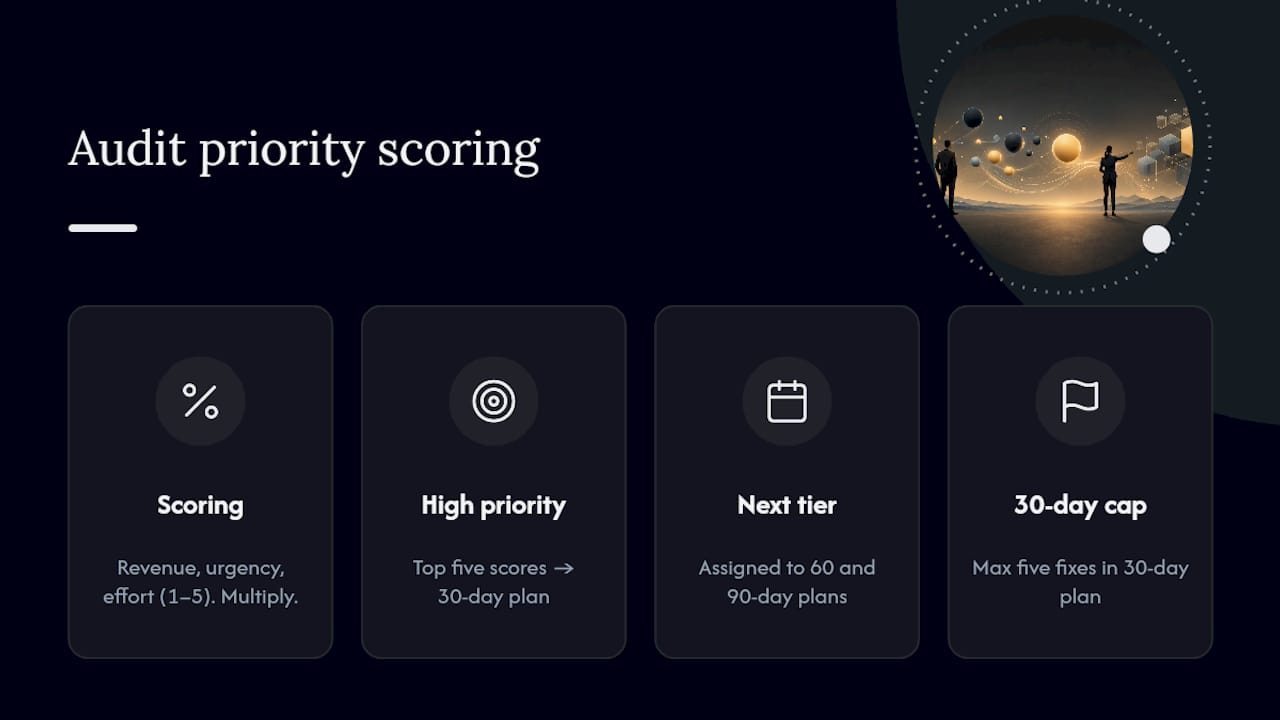
Step 4: Root-cause mapping and prioritization. Score each finding on three dimensions: revenue impact (1–5), urgency (1–5), and effort-to-fix (1–5, inverted). Multiply for a priority score. The top five scores become your 30-day plan. The next tier becomes 60 and 90 days.
Step 5: Handoff, governance, and measurement. RACI every fix. Set three success metrics before you close the audit: conversion lift at a named stage, forecast accuracy improvement, and reduction in stale deals. Schedule enforcement checkpoints at 30, 60, and 90 days.
Pro Tip: The 30-day plan should contain no more than five fixes. Five things done beats 40 things documented.
For a detailed checklist mapped to each step, the sales audit checklist for IT sales performance covers the full item set with ticket templates.
If your audit doesn’t produce these deliverables, it’s incomplete.
Deliverables checklist:
RACI for audit execution:
| Role | Responsibility |
|---|---|
| RevOps / Auditor | Evidence collection, record sampling, technical health check |
| Sales Manager | Validates findings against observed rep behavior |
| CRO / Head of Sales | Approves prioritization, owns 30/60/90 enforcement |
| IT / Enablement | Delivers ticketed fixes within agreed sprint windows |
Critical data points every audit report must include:
| Metric | Why it matters |
|---|---|
| Sample size (deals reviewed) | Validates statistical credibility of findings |
| % stale deals in active pipeline | Signals forecast inflation risk |
| MQL acceptance rate | Measures marketing-to-sales handoff health |
| Speed-to-lead median (minutes) | Benchmarks qualification efficiency |
| Discount distribution by stage | Reveals negotiation and qualification gaps |
Sponsorship isn’t a nice-to-have. Executive leaders who visibly use audit outputs are the difference between a roadmap and a shelf document.
Common objections and direct responses:
Tactics that make sponsorship stick:
Template: executive sponsorship request (one paragraph). “We’re running a focused 4-week audit on [specific decision: forecast accuracy / MQL handoff / stage exit criteria]. I need your visible endorsement for the findings and your sign-off on the top five fixes. The ask is two hours of your time: one kickoff, one findings review. Without your sign-off, the fixes won’t get resourced.”
Pro Tip: Tie the audit launch to a board meeting or QBR. When leadership knows findings will be presented externally, internal enforcement tightens automatically.
Here’s a condensed example from a B2B tech engagement where the audit recovered a stalled revenue system.
MQL acceptance by sales was below 35%. Sellers were logging activity manually, creating a 60-day lag between real deal status and CRM data.
Audit scope chosen: focused audit on three areas — stage exit criteria, MQL handoff definition, and speed-to-lead routing.
Three prioritized fixes:
The result: MQL acceptance climbed from below 35% to above 60% within 90 days. Stale deals in active pipeline dropped by roughly half. Forecast accuracy improved enough that the CFO stopped rebuilding the model manually.
What prevented the usual failure modes was practitioner involvement at every handoff: the auditor owned the RACI, enforced the 30-day checkpoint, and escalated two tickets that RevOps had deprioritized. Structure beat heroics.
The audit ends when the findings are delivered. The revenue improvement starts after that.
Most corrective plans fail for the same reason audits do: no owner, no deadline, no enforcement. Fix that first.
Build the corrective plan in three layers. The 30-day layer contains only the five highest-priority fixes — the ones with the highest revenue impact and lowest effort-to-fix scores. The 60-day layer addresses structural issues: stage criteria rewrites, routing rule updates, and data hygiene projects. The 90-day layer handles governance: updated playbooks, new RACI assignments, and cadence changes.

Run weekly enforcement checkpoints for the first 30 days. Not status updates — actual ticket reviews. If a fix is blocked, escalate it the same day. Blocked tickets that sit for a week become abandoned tickets.
Measure three things post-audit: conversion rate at the audited stage, percentage of stale deals in active pipeline, and forecast accuracy at 30 and 60 days. If none of those numbers move in 30 days, the corrective plan has an ownership problem, not a findings problem.
For teams that need a structured post-audit framework, how to audit your sales process for predictable IT revenue covers the full corrective planning sequence. Digital audit practices that improve cross-functional measurement are also worth reviewing when the corrective plan spans marketing-to-sales handoffs.
Most sales audits are designed to report, not to decide. That’s the real problem.
When an audit is scoped around what leadership wants to present at the next board meeting, it produces a polished slide deck that describes symptoms. When it’s scoped around the three decisions the business needs to make in the next 90 days, it produces a prioritized fix list with owners and deadlines.
A RevOps audit should diagnose whether the GTM operating model turns strategy into measurable, accountable execution — the CRM shows symptoms, not causes. The most common fixable root cause isn’t bad data or the wrong tool. It’s an audit designed for optics instead of outcomes.
One non-obvious tactic: before the audit starts, ask every stakeholder to write down the one decision they’d make differently if the audit confirmed their suspicion. Collect those answers. They become your scope. They also become your enforcement mechanism — because now every stakeholder has skin in the findings.
Most B2B tech companies don’t need a longer audit. They need a sharper one, with someone who will enforce the fixes afterward.
Saleslabelconsulting runs focused audit sprints and full-funnel RevOps audits for B2B tech companies, delivering a prioritized 30/60/90 roadmap, a RACI-assigned corrective plan, and retained advisory to ensure the fixes actually ship. Engagements are scoped as fixed-scope sprints or ongoing advisory retainers — no open-ended statements of work, no findings-only deliverables.
The starting point is a diagnostic call where we scope the audit to the decisions that matter most for your pipeline right now. From there, you get a sample delivery within the first two weeks and a 30-day priority plan before the sprint closes.
See how the audit engagement works and book a diagnostic call to get your corrective plan started.
Subscribe to our Insights: Expert productivity tips in your inbox
You'll receive 1-3 emails per month. Your data stays private, always.

CRO & Co-Founder with Sales Label Consulting

Watch our Sales Mates Podcast
August 10, 2026 - 10 min read
Read article Read articleAugust 9, 2026 - 14 min read
Read article Read articleAugust 8, 2026 - 12 min read
Read article Read articleAugust 7, 2026 - 13 min read
Read article Read article