
What Is Deal Flow for B2B Tech CEOs and Sales Leaders
TL;DR:
- Focusing on the quality of deal flow and precise attribution improves pipeline health and growth sustainability. Using stage discipline, diversified sourcing, and dedicated tools helps keep the pipeline transparent and optimized. Most issues stem from attribution blindness and unclear stage criteria, not from simply generating more leads.
Deal flow is the continuous pipeline of qualified revenue opportunities moving through your sales process, from initial sourcing all the way to signed contract. That’s the definition. But here’s what actually matters for B2B tech leaders: the quality of that pipeline, not the raw count of deals in it.
Three things to act on right now. First, measure source attribution, not just volume. Second, track conversion ratios at each stage so you know where deals die. Third, operationalize your pipeline through RevOps and CRM integrations so visibility isn’t dependent on one person’s memory or a spreadsheet.
TL;DR: Identify your top three sourcing channels and start tracking attribution this week. Everything else builds from that.
Deal flow describes the rate and quality of business opportunities reaching your sales organization, from first contact through close. Finance professionals, including venture capitalists and investment bankers, coined the term, but it maps directly onto B2B tech sales: your pipeline is your deal flow, and its health determines your ARR trajectory.
The critical distinction is that deal flow is a qualitative signal, not a quantitative one. A firm that reviews 200 deals per year and closes two isn’t better positioned than one that reviews 80 and closes three. Volume without relevance is noise. The leaders who build durable pipelines focus on which channels produce closeable, high-fit opportunities, not which channels produce the most activity.
For a B2B tech company, a credible sourcing strategy also serves a second purpose: it tells your board and investors how you’ll sustain growth, not just what you’ve closed so far.
The standard deal-flow process follows six stages. Each one has a clear owner, a required artifact, and an exit signal. Without those three things, deals stall and no one knows why.
Typical deal cycles in B2B tech can vary in length depending on the account size and complexity. Handoff signals matter because stage ambiguity, where a deal sits in “negotiation” for 45 days with no clear next step, is one of the most common pipeline killers we see.

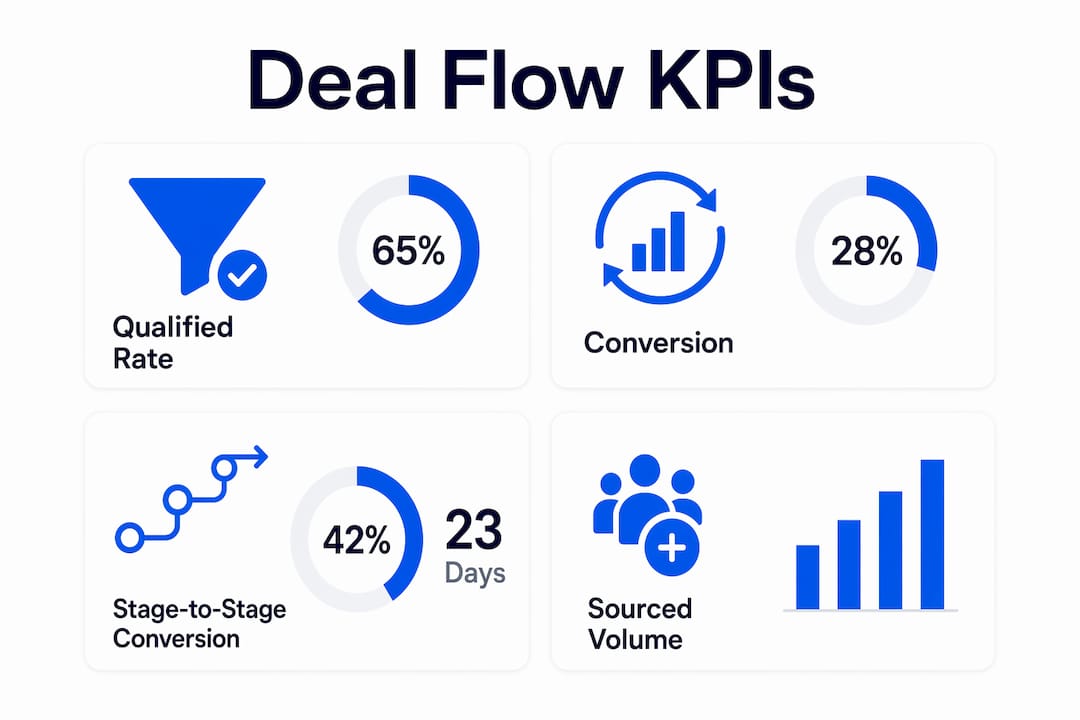
Tracking raw deal count tells you almost nothing. The metrics that matter are conversion ratios and velocity. Here’s how to compute the core ones:
Qualified conversion rate = (Opportunities that passed screening ÷ Total leads reviewed) × 100
Stage-to-stage conversion = (Deals entering Stage N+1 ÷ Deals entering Stage N) × 100
Deal velocity = Total pipeline value × Win rate ÷ Average sales cycle length
| KPI | Formula / Definition | Reporting Cadence |
|---|---|---|
| Sourced volume | Count of new leads entering CRM per period | Weekly |
| Source attribution share | % of closed-won deals by channel | Monthly |
| Review-to-qualified rate | Qualified opps ÷ leads reviewed × 100 | Weekly |
| Qualified-to-opportunity rate | Opps advanced ÷ qualified leads × 100 | Monthly |
| Deal velocity (median days/stage) | Median days a deal spends per stage | Monthly |
| Pipeline coverage ratio | Total pipeline value ÷ revenue target | Weekly |
| Win rate | Closed-won ÷ total closed deals × 100 | Monthly/Quarterly |
Run a weekly funnel health check on volume and coverage. Review conversion trends monthly. Do a quarterly strategic source review to decide where to invest or cut sourcing spend. Documented sales best practices make this cadence repeatable rather than heroic.
Proprietary deal flow consistently outperforms intermediated channels because it avoids competitive auctions and gives you more time for diligence. That’s the strategic principle. Here’s how it plays out across channels:
Diversification isn’t just a hedge. Single-channel reliance is one of the most common failure modes we see, especially when that channel is outbound alone.
Pro Tip: Build a referral loop with your existing customers by creating a simple, repeatable ask: after a successful QBR or milestone, ask for one warm introduction. Track those introductions in your CRM with a “referral” source tag and compare their win rate against outbound. Most teams are surprised by the gap.
Manual spreadsheets become a bottleneck fast. Once you have more than a handful of active deals, visibility and collaboration require dedicated tooling. Here’s the minimum stack for a B2B tech sales org:
| Tool Type | Purpose | Connect First? |
|---|---|---|
| CRM (e.g., Salesforce, HubSpot) | Single source of truth for all deal stages and attribution | Yes — foundation |
| Sales engagement/sequencing | Automate outreach, track replies, feed CRM | Second |
| RevOps analytics | Conversion reporting, pipeline coverage, source attribution | Third |
| Marketing automation | Inbound lead capture, nurture, attribution tagging | Third |
| Virtual data room (VDR) | Secure document sharing during diligence | As needed |
| Contract lifecycle management (CLM) | Redlining, approvals, e-signature | As needed |
Connect your CRM first, always. Attribution reporting is only as good as the data going in, so CRM hygiene is a prerequisite for everything else. AI-enhanced RevOps tools can accelerate diligence Q&A and flag at-risk deals based on engagement signals, which is increasingly standard in AI-enhanced revenue operations.
Pro Tip: When migrating off spreadsheets, run both systems in parallel for 30 days. Use that window to identify every field your team actually uses, then build only those fields in the CRM. Unused fields create data debt.
| Milestone | Owner | Activities | Effort | Expected Outcome |
|---|---|---|---|---|
| Day 30 | RevOps | CRM audit, source attribution fields live, stage-exit criteria documented | Medium | Source attribution accuracy ≥ 90%; all deals in CRM |
| Day 30 | Head of Sales | Stage definitions agreed and communicated to AE team | Low | Zero stage ambiguity; consistent handoff signals |
| Day 60 | RevOps | Weekly conversion dashboard live; pipeline coverage ratio tracked | Medium | Conversion ratios visible by stage and channel |
| Day 60 | Head of Sales | Referral program launched; partner channel outreach initiated | Medium | At least one new sourcing channel active |
| Day 90 | CEO + Head of Sales | Quarterly source review completed; channel investment decisions made | Low | Sourcing mix diversified; proprietary channel share growing |
| Day 90 | RevOps | AI-enhanced deal-risk flagging configured | High | At-risk deals flagged 2+ weeks earlier than before |
Dependencies: CRM cleanup must happen before attribution reporting. Stage-exit criteria must be agreed before conversion tracking is meaningful. Cost ballpark: low effort items are internal time only; medium items may require a RevOps contractor or consulting support; high effort items typically involve tool configuration or integration work.
Healthy deal flow is built on source attribution, stage discipline, and channel diversification, not on the number of leads your team generates each month.
| Point | Details |
|---|---|
| Quality over volume | Track conversion ratios and source attribution, not raw lead count. |
| Stage discipline | Document exit criteria for every stage; ambiguity stalls deals and hides problems. |
| Diversify sourcing | Proprietary and referral channels consistently outperform single-channel outbound. |
| 30/60/90 ownership | RevOps leads attribution and reporting; Head of Sales owns stage criteria and channel mix. |
| Saleslabelconsulting | Saleslabelconsulting runs sales audits and RevOps integration to activate this plan in 30–90 days. |
Most B2B tech leaders treat deal flow as a volume problem. They push for more leads, more sequences, more SDR activity. The pipeline looks full, the team looks busy, and then the quarter closes short. Sound familiar?
The real issue is almost never volume. It’s attribution blindness. When you don’t know which channels produce your closed-won deals, you can’t invest in the right ones. You end up funding the noisiest channel, not the most productive one. Referrals and proprietary outreach, the channels that actually close at higher rates, get starved of attention because they’re harder to measure and slower to show activity.
The second thing most leaders underestimate is stage discipline. A deal that’s been in “negotiation” for 60 days isn’t a deal. It’s a hope. Stage-exit criteria aren’t bureaucracy. They’re the mechanism that forces honest pipeline reviews and surfaces problems early enough to fix them.
Structure beats heroics every time. The teams that build durable pipeline management aren’t the ones with the most aggressive outbound. They’re the ones who know exactly where every deal is, why it’s there, and what it will take to move it forward.
Faster attribution setup and cleaner pipeline visibility are the two outcomes B2B tech leaders tell us they need most. Saleslabelconsulting delivers both through fixed-scope sales audit and RevOps integration engagements designed specifically for tech companies.
In a typical engagement, source attribution is live within 30 days, conversion reporting is running by day 60, and channel investment decisions are data-backed by day 90. We cover sales process audit, outbound and pipeline system design, demand generation, and AI-enhanced RevOps, so you’re not stitching together three different consultants. If your internal capacity is limited, that’s exactly the situation we’re built for. Book a diagnostic with Saleslabelconsulting and walk away with a clear picture of where your pipeline is leaking and what to fix first.
Subscribe to our Insights: Expert productivity tips in your inbox
You'll receive 1-3 emails per month. Your data stays private, always.

CRO & Co-Founder with Sales Label Consulting

Watch our Sales Mates Podcast
August 1, 2026 - 10 min read
Read article Read articleJuly 31, 2026 - 13 min read
Read article Read articleJuly 30, 2026 - 14 min read
Read article Read articleJuly 29, 2026 - 14 min read
Read article Read article