
B2B Sales Cycle Acceleration: Your 2026 Strategy Guide
TL;DR:
- Accelerating the B2B sales cycle reduces the time from initial contact to deal closure by removing internal friction. It improves speed, conversion, and efficiency without sacrificing deal quality or buyer trust. Tracking stage-specific metrics guides targeted improvements and sustainable growth.
B2B sales cycle acceleration is defined as the deliberate reduction of time and friction from initial contact to closed deal, enabling sales teams to close more deals faster without sacrificing quality or buyer trust. B2B sales cycles average 10 months, but targeted acceleration can compress that timeline to 30–45 days on specific deal types. That gap represents real revenue sitting idle in your pipeline. This guide breaks down the structure, strategies, metrics, and practical steps you need to make acceleration work in your B2B sales process.
B2B sales cycle acceleration is the industry term for a set of practices that reduce the time between a prospect’s first interaction and a signed contract. The standard industry phrase for this is “sales velocity improvement,” though acceleration is the more common working term among practitioners. Both describe the same goal: moving qualified buyers through your pipeline faster and with fewer stalls.
The core purpose is not just speed. Acceleration operates across three measurable dimensions: speed, conversion, and efficiency. Speed means reducing time-to-close. Conversion means improving win rates by qualifying better and engaging the right stakeholders earlier. Efficiency means removing friction so your reps accomplish more without adding headcount.
Why does this matter to you as a sales leader? Every day a deal sits in your pipeline without moving, it costs you money and forecasting accuracy. Compressing the cycle by even 20% compounds across your entire book of business. That’s the difference between hitting ARR targets and explaining misses to the board.
Understanding the structure of your sales cycle is the prerequisite to accelerating it. You cannot speed up what you haven’t mapped. The typical B2B sales process runs through seven stages: lead generation, discovery, qualification, pitching, negotiation, closing, and post-close nurturing.
Each stage needs clear entry and exit criteria. A repeatable sales cycle with defined criteria creates predictable progression and gives your team a consistent playbook. Without those criteria, reps make judgment calls that vary deal to deal, and your pipeline data becomes unreliable.
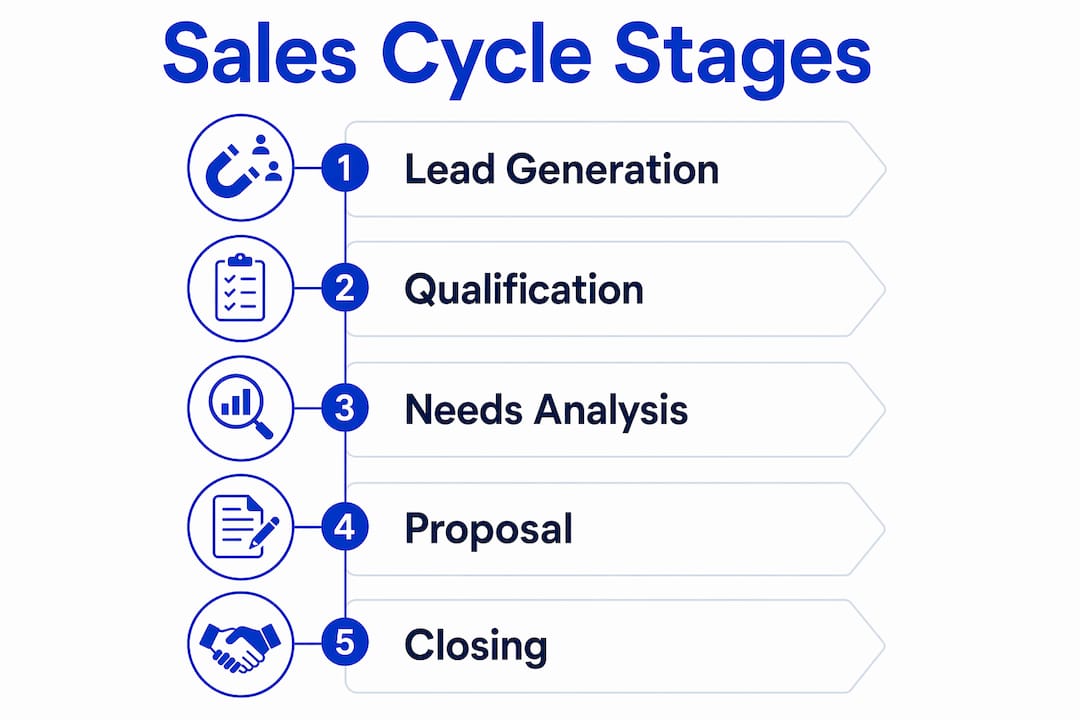
One distinction that matters for acceleration: the sales cycle is your process, and the pipeline is a snapshot of where your current deals sit within that process. Distinguishing between the sales cycle and the pipeline is critical for systematic acceleration and forecasting accuracy. Mixing them up leads to generic fixes applied to the wrong problem.
Here is where friction most commonly hides in each stage:
Pro Tip: Map your average time spent in each stage, then rank stages by average duration. The longest stage is almost always your biggest acceleration opportunity, not the stage where deals die.

Effective acceleration is not about pushing buyers harder. Buyers typically need 8–14 days for evaluation, and forcing them faster risks losing the deal entirely. The real work is removing the friction that adds unnecessary days without adding buyer value.
Here are the core strategies, organized by dimension:
Speed: Cut internal lag, not buyer time. Most delays in B2B sales happen inside your own organization. Slow proposal turnarounds, approval bottlenecks, and handoff gaps between SDR and AE teams add weeks to your cycle. Fix your internal processes before you try to speed up the buyer.
Conversion: Multi-thread early. Single-threaded deals die when your champion leaves or loses internal support. Engage multiple stakeholders from discovery onward. Using mutual action plans and engaging all key stakeholders early reduces delays and keeps deals progressing without surprises.
Efficiency: Automate the routine, protect the human. Automation handles repetitive sales tasks, freeing reps for personalized engagement and negotiation. Use CRM automation for follow-up sequences, e-signatures for contract execution, and sales engagement platforms for outreach cadences. Reserve your reps’ time for discovery calls, executive conversations, and negotiation.
Buyer enablement: Build a content repository. Buyer-ready assets and self-serve infrastructure enable faster decision-making and reduce friction compared to scheduled meetings. When your champion can share a product demo, ROI calculator, or security FAQ with their internal team without waiting for your next call, deals move faster.
Data-driven leak detection: Fix the right stage. Acceleration is most effective when focused on specific funnel stage leaks rather than generic speed tactics. Pull your stage-by-stage conversion data and find where deals stall or drop. That’s where you invest your acceleration effort.
Pro Tip: Before buying new technology, audit your current CRM data for stage duration by deal size and industry. You’ll likely find that one stage accounts for 40% or more of your total cycle time. That’s your starting point, not a new tool.
You can also explore conversion rate improvement frameworks that apply directly to B2B pipeline stages, particularly at the evaluation and proposal phases.
Measurement is where most sales teams fall short. They track total cycle length but miss the stage-level data that tells them where to act. Accurate tracking of KPIs like cycle length, win rate, and pipeline velocity enables teams to optimize their acceleration efforts with precision.
The four metrics that matter most for acceleration:
| Metric | What it tells you | Action trigger |
|---|---|---|
| Sales cycle length | Overall process efficiency | Review if it grows quarter over quarter |
| Win rate | Quality of acceleration tactics | Investigate if it drops while cycle shortens |
| Pipeline velocity | Revenue generation speed | Use to forecast and set capacity targets |
| Stage conversion rate | Where deals stall or die | Fix the lowest-converting stage first |
Run a monthly review of these four metrics across your team. Align your marketing, sales, and customer success functions around the same pipeline velocity target. When all three teams pull toward the same number, handoff friction drops and cycle length follows.
Real acceleration comes from process discipline, not heroics. Here is what actually works:
For teams working on keeping long deals alive, the same principles apply. Momentum is maintained through consistent value delivery and clear next steps, not through pressure.
B2B sales cycle acceleration works when you remove internal friction, enable buyers to self-serve, and track stage-level metrics rather than applying generic speed tactics across the board.
| Point | Details |
|---|---|
| Define before you accelerate | Map your full sales cycle with entry and exit criteria before applying any speed tactics. |
| Three dimensions drive results | Speed, conversion, and efficiency must all improve together for acceleration to hold. |
| Buyer evaluation time is fixed | Buyers need 8–14 days to evaluate; cut internal lag instead of pushing buyers faster. |
| Stage-level data is your guide | Track conversion rates by stage to find where deals stall and target your fix there. |
| Mutual action plans reduce surprises | Shared accountability documents keep both sides on track and surface hidden blockers early. |
I’ve worked with sales teams that treated acceleration as a pressure campaign. More calls, tighter follow-up windows, aggressive close timelines. The results were predictable: shorter cycles on paper, but win rates that dropped and customer relationships that started on the wrong foot.
The teams that actually compress their cycles sustainably do something different. They obsess over their own internal processes first. They find the approval bottleneck, the slow proposal turnaround, the handoff gap between SDR and AE. Those are the days they cut. They don’t touch the buyer’s evaluation window.
The second thing I’ve seen work consistently is data specificity. Not “our cycle is too long,” but “our deals stall for an average of 18 days between proposal and negotiation, and here’s why.” That level of specificity changes the conversation from motivation to mechanics. You’re not asking reps to try harder. You’re removing a structural obstacle.
Technology helps, but it’s not the answer on its own. A CRM with bad data and no process discipline is just an expensive spreadsheet. The teams that get the most from their tools are the ones who standardized their process first, then automated the repeatable parts. Structure beats heroics every time.
The last thing I’ll say: train your team on this continuously. Acceleration is not a one-time project. It’s a discipline that compounds over time as you collect better data, refine your playbook, and build a culture of measurement. The teams that treat it as a quarterly initiative lose momentum. The teams that build it into their weekly rhythm keep improving.
— Antony
Saleslabelconsulting works directly with RevOps leaders, Heads of Sales, and VPs of Sales to build the process infrastructure that makes acceleration real and repeatable.
The work starts with a structured audit of your current sales process to identify exactly where deals stall and why. From there, Saleslabelconsulting builds the playbooks, enablement assets, and measurement frameworks your team needs to move deals faster without burning buyer trust. If you’re ready to build a predictable revenue engine with a shorter cycle and a higher win rate, the frameworks are already built. You just need to apply them to your specific pipeline.
B2B sales cycle acceleration is the process of reducing the time from first contact to closed deal by removing friction, improving qualification, and enabling buyers to make decisions faster. It operates across three dimensions: speed, conversion, and efficiency.
B2B sales cycles commonly average 10 months, though targeted acceleration strategies can compress specific deal types to 30–45 days without reducing deal quality.
The four core metrics are sales cycle length, win rate, pipeline velocity, and stage-level conversion rate. Tracking all four together shows whether acceleration is improving results or just moving problems downstream.
Poorly executed acceleration does hurt win rates, particularly when discovery is rushed or buyers are pushed before they’re ready. Effective acceleration targets internal friction and buyer enablement, which holds or improves win rates while reducing cycle time.
The sales cycle is your repeatable process with defined stages and criteria. The pipeline is a snapshot of where your current deals sit within that process. Confusing the two leads to misdiagnosed problems and fixes applied in the wrong place.
Subscribe to our Insights: Expert productivity tips in your inbox
You'll receive 1-3 emails per month. Your data stays private, always.

CRO & Co-Founder with Sales Label Consulting

Watch our Sales Mates Podcast
September 21, 2026 - 8 min read
Read article Read articleSeptember 20, 2026 - 13 min read
Read article Read articleSeptember 19, 2026 - 13 min read
Read article Read articleSeptember 18, 2026 - 10 min read
Read article Read article