
Why IT Companies Need Sales Consulting to Grow
TL;DR:
- Sales consulting helps IT firms develop structured sales processes that shorten sales cycles and increase win rates. It addresses core issues like multi-stakeholder deals, pipeline predictability, and qualification criteria, ensuring sustainable growth. AI enhances sales efficiency but requires a solid process foundation for maximum benefit.
Sales consulting is defined as the external diagnosis and redesign of a company’s sales strategy, process, and team performance to produce measurable revenue results. IT companies need sales consulting because technical expertise alone does not close enterprise deals. The average unstructured IT sales cycle runs close to nine months. Structured sales processes compress that to three to five months and produce 15–25% higher win rates. That gap between where you are and where you could be is exactly what sales consulting closes.
IT sales is not like selling a commodity. You’re asking buyers to commit budget, change internal processes, and trust a vendor with critical infrastructure. That complexity creates a specific set of problems that most IT teams try to solve by hiring more reps. More reps without a fixed process just scales the chaos.

Sales consulting, also called B2B revenue advisory or GTM optimization, addresses the root cause. A consultant audits your ICP definition, pipeline architecture, and messaging framework before recommending any changes. The output is a documented sales system that your team can run without the consultant in the room. That’s the goal: transfer of capability, not dependency.
Consultants build sales engines including ICP validation, methodology training, and KPI frameworks that compress development time from 9–12 months to 3–5 months. That time compression is the clearest argument for the investment.
IT sales has a set of structural problems that repeat across firms of every size. Recognizing them is the first step.
Pro Tip: If your pipeline problems have persisted for two or more quarters despite internal fixes, that’s a systemic infrastructure signal, not a headcount problem. Hire a consultant before you hire another rep.
The real talk here is that most IT executives recognize these symptoms but misdiagnose the cause. They assume the problem is motivation, market conditions, or product gaps. Usually, it’s process.
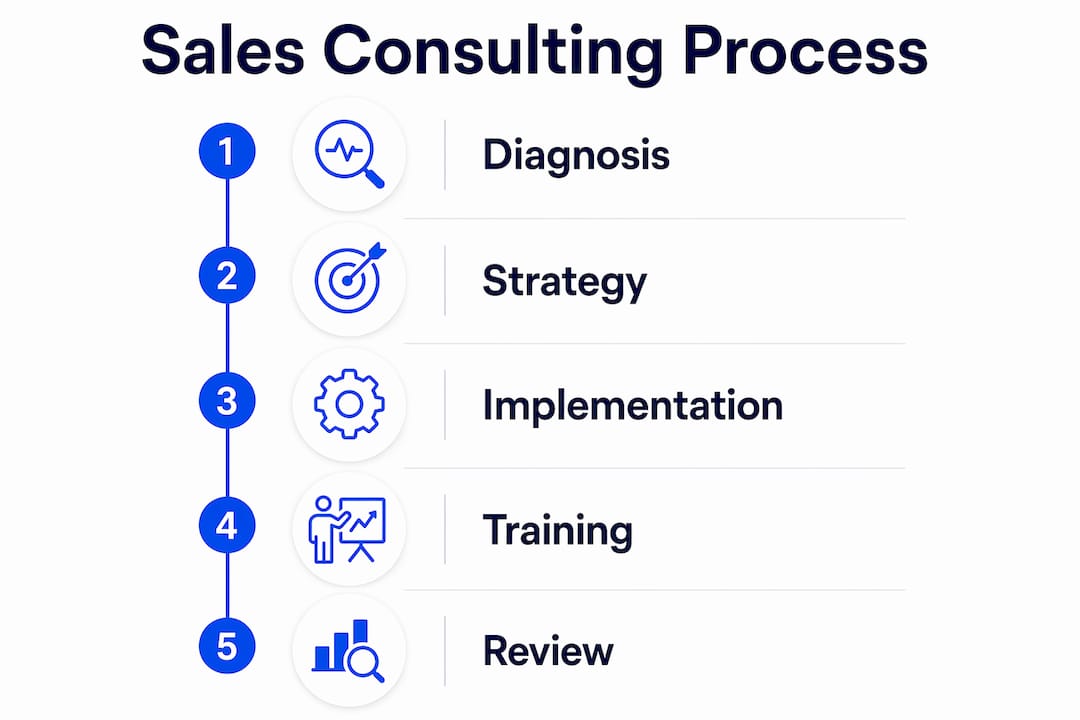
This is where consulting earns its fee. A structured engagement follows a clear sequence.
| Consulting phase | Primary deliverable | Typical timeline |
|---|---|---|
| Diagnosis | Gap analysis and priority map | Weeks 1–3 |
| Strategy design | ICP, methodology, messaging framework | Weeks 4–6 |
| Implementation support | Playbook, CRM configuration, training | Weeks 7–12 |
| Coaching and review | Performance dashboards, rep coaching | Ongoing |
Pro Tip: Don’t let a consulting engagement end at the strategy deck. Push for implementation support and at least one 90-day review. Strategy without execution support has a low adoption rate in IT sales teams.
The most expensive mistake is engaging a consultant before you have product-market fit. Hiring consultants pre-PMF yields significantly lower ROI because no sales process can fix a product customers don’t want. Consultants are systems architects. They build on a foundation you have to provide.
Here are the other common errors:
The pattern Saleslabelconsulting sees most often is an IT firm that has tried two or three internal fixes, seen temporary improvement, and then watched the numbers slide back. That’s the clearest sign that the problem is structural, not motivational.
AI is changing what sales consulting delivers and how fast it delivers it. The shift is real, and IT firms that ignore it are leaving measurable revenue on the table.
IT consulting firms using AI report 34% faster deal closure and 28% higher average contract values. Those numbers reflect what happens when AI handles the administrative layer and reps focus on the human work of building trust and navigating complex decisions.
The caution is real, though. AI augments human sales skills. It does not replace them. An IT firm that automates outreach without a clear ICP and compelling message just sends bad emails faster. Pair AI tools with a CRM built for sales workflows and a consultant-designed process, and the combination produces compounding results.
Pro Tip: Start AI adoption with one high-impact use case, such as proposal generation or call analysis, before rolling out multiple tools. Adoption rates drop sharply when teams face too many new systems at once.
B2B sales consulting engagements typically run $5,000–$25,000 per month on retainer or project basis. That range is generally less than the fully loaded cost of a senior sales leader. The right model depends on what you need.
Advisory model: The consultant reviews your data, attends key meetings, and provides recommendations. Your team executes. Best for firms with a capable internal sales leader who needs outside perspective.
Fractional VP of Sales: An experienced sales leader works part-time inside your org, owning the sales function without the full-time cost. Best for IT firms between $2M and $10M ARR that aren’t ready for a full-time VP.
Outsourced SDR model: The consultant provides the outbound prospecting function, including reps, tools, and process. Best for firms testing a new market or segment without committing to internal headcount.
The ROI metrics that matter are win rate improvement, sales cycle compression, new hire ramp time, and forecast accuracy. A well-run engagement should show measurable movement in at least two of those within the first 90 days. If it doesn’t, the engagement design or the internal adoption is broken.
IT companies that invest in structured sales consulting consistently outperform those that rely on informal processes and headcount alone.
| Point | Details |
|---|---|
| Structured processes win | IT firms with documented sales systems report 15–25% higher win rates and shorter cycles. |
| Playbooks accelerate ramp-up | Documented playbooks help new hires ramp 40–60% faster than informal onboarding methods. |
| Diagnose before you hire | Persistent pipeline problems signal systemic issues, not headcount gaps. Fix the process first. |
| AI amplifies, not replaces | AI tools cut proposal time and surface intent data, but human expertise drives complex deals. |
| Match the engagement model | Advisory, fractional VP, and outsourced SDR models serve different stages and budget levels. |
I’ve worked with IT firms that had brilliant products, sharp engineers, and zero ability to sell consistently. The pattern is almost always the same. The founders or early sales hires closed the first deals on relationships and reputation. Then growth stalled, they hired more reps, and the numbers didn’t move. By the time they called us, they’d burned through two or three sales leaders and were questioning the market.
The real problem was never the market. It was the absence of a repeatable system. Structure beats heroics every time. A single great rep who closes on instinct is a liability when they leave. A documented process is an asset that compounds.
What I’d tell any IT executive reading this: don’t wait for the pain to become unbearable before you get a diagnosis. The firms that engage consulting early, before the crisis, build faster and waste less. They also get more from the engagement because they’re not in firefighting mode.
The other thing I’d push back on is the idea that AI makes consulting less necessary. It makes it more necessary. AI tools require a clean process to amplify. Feed a broken qualification framework into an AI prospecting tool and you get faster, more expensive failure. The AI reshaping sales tech conversation is real, but the foundation has to be there first.
Treat sales consulting as a capital investment, not an operating expense. The return shows up in win rates, ramp times, and forecast accuracy. Those are the numbers that determine whether your IT firm scales or stalls.
— Antony
Saleslabelconsulting works with IT companies at the intersection of sales enablement, sales audits, and demand generation. The work starts with a clear diagnosis of where your sales system is breaking down, then moves into building the process, tools, and coaching cadence your team needs to perform consistently.
If your pipeline is unpredictable, your ramp times are long, or your win rates have plateaued, a sales enablement audit is the right starting point. Saleslabelconsulting has worked with IT consulting firms to compress sales cycles, document playbooks, and implement frameworks that produce results in the first quarter of engagement. The sales audit checklist is a practical first step if you want to assess your current state before committing to a full engagement.
IT sales involves long cycles, multiple stakeholders, and complex technical messaging. Sales consulting provides the structured process and qualification frameworks that turn those variables into predictable revenue.
Firms with structured sales systems report 15–25% higher win rates and sales cycles compressed from nine months to three to five months. New hire ramp times drop 40–60% with documented playbooks.
The right time is when pipeline problems persist for two or more quarters despite internal fixes. Engaging before product-market fit is established produces significantly lower returns.
AI handles administrative tasks like proposal generation and CRM data entry, freeing reps for high-value selling. IT firms using AI report 34% faster deal closure and 28% higher contract values when paired with a solid sales process.
Retainer and project-based engagements run $5,000–$25,000 per month, generally less than the fully loaded cost of a senior sales leader. The right model depends on your ARR stage and internal sales capability.
Subscribe to our Insights: Expert productivity tips in your inbox
You'll receive 1-3 emails per month. Your data stays private, always.

CRO & Co-Founder with Sales Label Consulting

Watch our Sales Mates Podcast
July 11, 2026 - 8 min read
Read article Read article