
How to Manage Sales Quotas and Hit Your Numbers
TL;DR:
- Effective quota management begins with thorough historical data analysis, realistic goal setting, and continuous pipeline monitoring. Leaders should regularly review leading indicators, coach to actual deals, and adjust quotas based on market shifts rather than individual performance. Transparent data sharing and well-aligned incentive structures are crucial for sustained attainment and team trust.
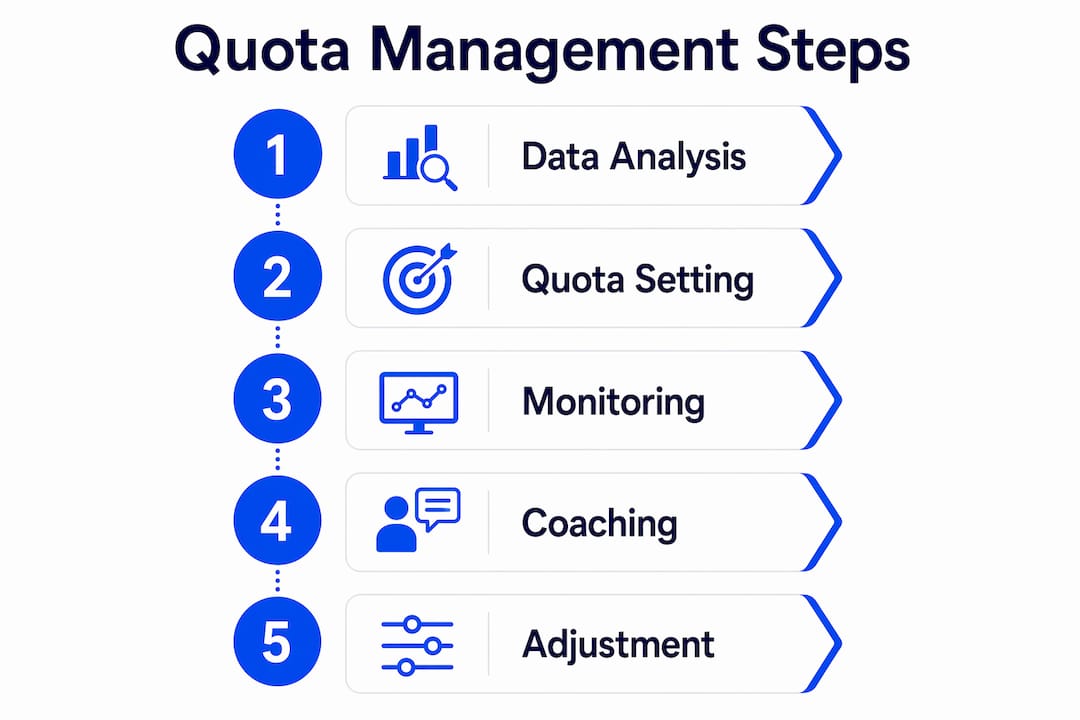
Quota management is one of those things where everyone thinks they’re doing it right until the numbers tell a different story. If your team consistently misses targets, the instinct is to push harder or add more activity. But the real problem is usually structural. Learning how to manage sales quotas well means building a system before the quarter starts, monitoring the right signals during it, and making smart adjustments without breaking team morale. This guide walks you through all of it, from the foundations to the fixes.

| Point | Details |
|---|---|
| Start with historical data | Use 12 months of regional sales data plus ramp adjustments to set quotas that are grounded in reality. |
| Track leading indicators weekly | Monitor pipeline coverage, conversion rates, and time-in-stage to catch problems before attainment lags. |
| Coach to real deals | Coaching to actual pipeline data raises attainment by 23% compared to scorecard-only coaching. |
| Diagnose before you adjust | If fewer than 60% of reps hit quota, treat it as a structural issue, not a rep performance problem. |
| Align incentives to behavior | Compensation structures must reward the behaviors that actually drive quota attainment, not just revenue volume. |
Before you can run effective quota management, you need to understand what you’re measuring and why. Sales quota management is the ongoing process of setting, tracking, and adjusting revenue targets across your team. The recognized industry framework splits quotas into four main types.
| Quota Type | What It Measures | Best Used For |
|---|---|---|
| Revenue quota | Total bookings or ARR generated | Most sales roles |
| Activity quota | Calls, demos, meetings booked | SDRs, early-stage reps |
| Volume quota | Units or deals closed | Product-led or transactional sales |
| Profit quota | Margin generated per deal | Complex, multi-product deals |
The metrics that matter most for tracking attainment are quota attainment (booked revenue divided by the target), pipeline coverage ratio, and time-in-stage. Most teams overweight attainment because it feels definitive. The problem is that by the time attainment is low, the quarter is already damaged.
You also need the right tools in place before the period starts. A CRM with stage-level timestamps, a forecasting tool that weights pipeline by probability, and a dashboard your managers actually use daily are non-negotiables. Without these, you’re flying by feel.
Pro Tip: Before locking in any quota, audit your measurement definitions. If some reps count bookings and others count ARR, your attainment data is already broken before the quarter begins. Agree on one definition across the whole team.
Historical data plus territory analysis and ramp period considerations form the foundation of effective quota setting. That sounds obvious, but most teams skip the territory piece, and it costs them.
Real talk: quotas that feel impossible from day one destroy morale faster than a bad product launch. Here’s a step-by-step process that builds credibility into the numbers from the start.
Pull 12 months of historical performance by territory. Look at closed-won revenue, average deal size, win rates by stage, and sales cycle length. Break it down by rep, region, and segment.
Layer in growth expectations and market conditions. Your finance team will hand you a top-down number. Your job is to stress-test it. Quota plans benefit from stress-testing against factors like resourcing, onboarding timelines, product changes, and economic conditions.
Engage frontline managers and top performers. Frontline input validates assumptions and surfaces hidden market dynamics you won’t find in a spreadsheet. Ask your best reps: “What would it take to grow 20% in your territory?” Their answers will tell you whether the number is plausible.
Adjust for ramp periods. New hires should not carry a full quota for at least 60 to 90 days. Model their contribution at 25%, 50%, and 75% of full quota across their first three months.
Run the sanity check. Calculate your total quota against your current pipeline coverage benchmarks. Early in a quarter, enterprise teams need roughly 3 to 4x pipeline coverage; mid-market teams need 4 to 5x. If the math doesn’t support the quota, the quota is wrong, not the math.
Model the distribution. A healthy quota model expects 70 to 75% of reps to attain. If your model predicts fewer than 60% reaching target, you’re setting the team up to fail.
Pro Tip: Never finalize quotas in a vacuum. Hold a pre-close review where three or four senior reps walk through their territory plans against the proposed number. If they all push back with data, listen.
This is where most quota management breaks down. Teams set the number, then wait until the last two weeks to panic. Structure beats heroics every time.
Track leading indicators weekly because quota attainment is a lagging metric. By the time it’s low, it’s too late to course-correct. The KPIs you should be reviewing every Monday morning:
For pacing, the math is simple. Pacing formulas compare required per-day quota against your current booking rate to tell you whether a rep is on track. If a rep needs $50,000 per month and they’ve booked $15,000 by day 10, their daily rate is $1,500 against a required $2,500. That gap doesn’t close itself.
| Week into Quarter | Pipeline Coverage Target (Mid-Market) | Pipeline Coverage Target (Enterprise) |
|---|---|---|
| Week 1 to 4 | 4 to 5x | 3 to 4x |
| Week 5 to 9 | 3x | 2.5x |
| Week 10 to 13 | 1.5 to 2x | 1.5x |
Real-time dashboards surface at-risk deals about 12 days earlier than weekly reviews. That’s 12 days of additional runway to intervene, which in a 90-day quarter is significant.
On the coaching side, the biggest lever you have is specificity. Coaching to actual deals and pipeline data raises attainment by 23% compared to scorecard-based coaching alone. Don’t review a rep’s call scores. Review the three deals they have in proposal stage and ask: “Who else is involved in this decision? When did you last speak to the economic buyer?” That’s coaching to the number.
Pro Tip: Separate your coaching conversations from your forecast reviews. When reps know that a coaching call is also a forecast call, they sandbag. Keep them distinct.
Mid-period adjustments are the most politically charged part of quota management. Do them too often and you signal that the original number was meaningless. Don’t do them when conditions genuinely shift and you demoralize your best reps.
Use a trigger-based governance model. Schedule periodic review points and trigger quota reassessment when market dynamics shift, not because an individual rep is struggling. Valid triggers include a major product being pulled from market, a significant competitor entering your territory, or a key account unexpectedly churning.
What should never trigger a quota adjustment:
On alignment, your quota management doesn’t exist in isolation. Your marketing team owns pipeline input, and if lead quality drops, your coverage ratio becomes fiction. Establish a monthly pipeline quality review with marketing. Look at ICP fit scores, multi-threading rates, and deal freshness. Pipeline quality filters like deal freshness and ICP fit prevent false confidence in coverage metrics.
Your incentive compensation structure also needs to reward the behaviors that drive attainment. Paying accelerators only on total revenue often rewards reps who inherited strong territories. Consider pay structures that reward new logo acquisition, expansion revenue, and deals closed within the target sales cycle length separately.
When attainment is consistently low across the team, the instinct is to coach harder. Before you do that, diagnose the root cause. The diagnostic is straightforward: if fewer than 60% of reps hit quota, treat it as a quota-setting or territory-design problem, not a rep performance problem. Above 80%? Your quotas are probably too easy and you’re leaving revenue on the table.
Here’s a quick troubleshooting framework:
Pro Tip: Build a “pipeline age” filter in your CRM that flags any deal that’s been sitting in the same stage for more than 30 days. Review those deals first in every coaching call.
I’ve seen organizations spend months rebuilding quota models, importing new forecasting tools, and rolling out elaborate scorecards. Most of the time, attainment doesn’t change. You know why? Because the manager’s weekly one-on-ones still sound like, “How’s it going? What’s in your pipeline? Great, keep it up.”
Structure without execution is theater.
What I’ve found actually works is radical transparency about pipeline data. When every rep can see their own pacing, their own stage conversion rates, and where they sit relative to the team, behavior changes without you having to say a word. People are competitive. Show them the number.
The second thing I’ve learned: stop treating quota adjustments like they’re failures. They’re governance decisions. Markets shift. Products change. The teams that adjust intelligently and communicate the rationale clearly maintain trust. The teams that either never adjust or adjust constantly with no explanation lose their best people.
And one more thing I’ll say plainly: if you’re a Head of Sales and you can’t explain how your quota was set to your own reps, you have a credibility problem that no coaching framework will fix. The number has to make sense to the people who carry it. That’s not just good practice for sales quota strategies. It’s basic leadership.
— Antony
At Saleslabelconsulting, we work directly with Heads of Sales, VP of Sales, and RevOps leaders who are tired of guessing. We’ve seen what separates teams that consistently attain from those that scramble every quarter. It’s not talent. It’s infrastructure.

If your quota management needs a structured overhaul, our step-by-step sales enablement guide walks through the exact operational model we use with clients to drive predictable revenue. You can also explore scaling revenue best practices to see how the best teams align quota-setting, coaching, and incentive compensation for consistent results. Or check out B2B sales tips for 2026 for tactical moves that complement a solid quota management system.
Healthy quota attainment sits between 70% and 80% of the team hitting their number. If fewer than 60% of reps attain, it signals a quota-setting or territory problem, not a rep performance issue.
Divide the rep’s booked revenue to date by the number of days elapsed, then compare that daily rate to the required daily rate based on the remaining quota and remaining days. This pacing formula helps forecast whether a rep will close the gap or fall short.
Adjust quotas when measurable market conditions change, such as a product discontinuation or major territory disruption. Adjustments triggered by market shifts rather than rep underperformance preserve credibility and maintain team morale.
Early in a quarter, mid-market teams need 4 to 5x pipeline coverage and enterprise teams need 3 to 4x. By the final third of the quarter, benchmark coverage drops to 1.5 to 2x against remaining quota.
Coaching to scorecards instead of actual deals. Leaders who coach using real pipeline data see 23% higher attainment than those relying on activity metrics alone. Review real deals, not just numbers on a dashboard.
Subscribe to our Insights: Expert productivity tips in your inbox
You'll receive 1-3 emails per month. Your data stays private, always.

CRO & Co-Founder with Sales Label Consulting

Watch our Sales Mates Podcast
September 17, 2026 - 16 min read
Read article Read articleSeptember 16, 2026 - 14 min read
Read article Read articleSeptember 15, 2026 - 10 min read
Read article Read articleSeptember 14, 2026 - 10 min read
Read article Read article