
Sales audit explained: unlock reliable revenue in 5 steps
TL;DR:
- Most EU sales teams struggle with low win rates despite increased efforts and activity.
- A comprehensive sales audit identifies root causes across lead qualification, pitch, negotiation, systems, and culture.
- Regular, structured audits guide prioritized actions, enhancing long-term sales performance and predictability.
Most European tech sales leaders are pushing harder than ever, running more outreach, adding headcount, and stacking tools. Yet quota attainment sits as low as 31% across B2B SaaS teams, with median win rates stuck between 20 and 30%. More activity is not fixing the problem. What fixes it is clarity, and that’s exactly what a structured sales audit delivers. This guide breaks down every major phase of a sales audit, shows you what benchmarks actually matter for EU tech companies, and gives you a clear path from diagnosis to a predictable, scalable revenue machine.
| Point | Details |
|---|---|
| Sales audits diagnose root issues | A thorough sales audit exposes hidden problems that sabotage consistent growth. |
| 5-phase framework drives results | Systematically reviewing leads, pipeline, systems, and culture reveals leverage points. |
| Benchmarks guide realistic targets | Industry benchmarks show whether your team’s metrics are on track and spur meaningful improvement. |
| Action plans turn insights into revenue | Prioritizing and implementing audit recommendations leads to sustainable, predictable sales outcomes. |
Now that you see why so many revenue teams hit a wall, let’s clarify what a sales audit actually is and why it plays a pivotal role.
A sales audit is not a pipeline review. It’s not a quarterly forecast call dressed up with a new name. It’s a systemized, end-to-end examination of your entire sales operation, from how leads enter the funnel to how deals close and why they don’t. Think of it as an MRI for your revenue engine. It doesn’t just show you the symptoms. It finds the root cause.
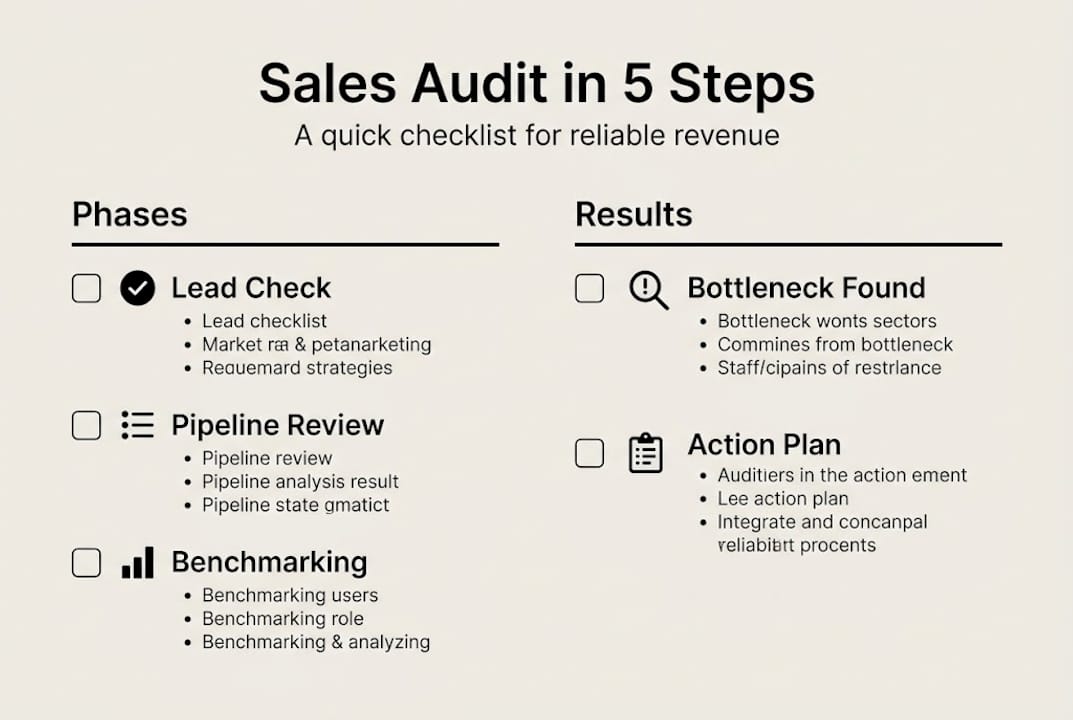
For sales leaders in European tech, this distinction matters enormously. You might see low win rates and assume your reps need better objection handling. But the audit might reveal that your ICP (Ideal Customer Profile) definition is too broad, your CRM data is unreliable, or your onboarding process is creating churn before deals even close. Treating symptoms without diagnosing root causes is expensive. Audits stop that cycle.
Here’s what a well-executed sales audit covers:
Sales audit methodologies confirm that the most effective frameworks use phased checklists across all five of these areas, covering everything from lead qualification using BANT or MEDDIC to negotiation post-mortems and cultural alignment.
Real talk: Most sales leaders we work with have never done a full audit. They’ve reviewed pipeline, yes. They’ve had performance conversations. But a structured, phased audit that touches systems, data, and culture? That’s rare. And that gap is often exactly where the revenue is hiding.
If you want to understand why analyzing sales performance is a strategic priority rather than a reporting exercise, the answer starts here. Audits give you the data and the narrative to make confident, revenue-backed decisions.
Understanding the ‘what’ and ‘why’ sets us up to take a closer look at ‘how’ sales audits are actually executed.
A strong audit follows a deliberate sequence. Each phase builds on the last, and skipping one creates blind spots. Here’s how the five-phase audit framework breaks down:
| Audit phase | Key focus area | Common finding |
|---|---|---|
| Lead qualification | ICP fit, BANT/MEDDIC | Too many unqualified leads |
| Pitch and demo | Consistency, relevance | Reps going off-script |
| Negotiation/closing | Deal velocity, objections | Deals stalling at procurement |
| Systems and data | CRM hygiene, tool adoption | Dirty data, low adoption |
| People and culture | Coaching, incentives | Misaligned motivation |
Pro Tip: Start your audit with Phase 1 every time. The quality of your sales cycle stages is directly determined by who enters the funnel. Fix qualification first, and the rest of the audit gets easier to prioritize.
Each phase surfaces a different category of bottleneck. The magic is in connecting them. A culture problem in Phase 5 often explains why a process fix in Phase 2 never stuck.
With the audit framework in hand, the next step is reading the numbers, knowing how to interpret what emerges from your sales data.

Benchmarks are not targets. They’re context. They tell you whether what you’re seeing in your audit is a you problem or an industry-wide pattern. That distinction changes how urgently you act and where you invest.
Here’s what current B2B SaaS benchmarks look like for EU tech companies:
| Metric | Benchmark range | What it signals |
|---|---|---|
| Win rate | 20 to 30% | Below 20% signals qualification or pitch issues |
| SMB sales cycle | ~38 days | Longer cycles suggest friction in demos or procurement |
| Enterprise win rate | ~28% | Competitive positioning and champion building matter |
| Pipeline coverage | 3 to 4x quota | Below 3x means you’re flying blind on forecast |
When your audit surfaces a win rate of 14%, that’s not just a number. It’s a signal that something is broken in qualification, pitch, or competitive positioning. When your pipeline coverage is 2x, you don’t have a closing problem. You have a top-of-funnel problem.
Audits reveal the story behind the stats. Here’s what to watch for:
The goal of benchmarking in an audit is not to make your team feel bad. It’s to prioritize. You can’t fix everything at once. Comparing your metrics to industry leaders helps you identify the two or three levers with the highest revenue impact. That’s where pipeline optimization strategies and targeted coaching investments pay off fastest.
Understanding your sales cycle length relative to peers also helps you set realistic expectations with leadership and investors, which is a credibility win in itself.
Benchmarks show where you need to be, but improvement is about decisive action. Here’s how to use your audit to make an impact.
An audit without action is just an expensive diagnosis. The real value comes from what you do next. Here’s a proven sequence for turning findings into results:
Pro Tip: Assign a clear owner to each audit finding. Recommendations without owners become shelfware. Tie each action item to a metric, a deadline, and a person. That’s how audit insights become pipeline optimization steps with real accountability.
Use a performance review checklist to track progress between audits. It keeps the team aligned and ensures improvements compound over time rather than fading after the initial push.
Here’s the uncomfortable truth we see repeatedly: most sales audits are incomplete. They cover pipeline metrics and rep performance. They might even touch on pitch quality. But they consistently underweight two areas that have outsized influence on whether changes actually stick: systems and data and team culture.
Dirty CRM data doesn’t just make reporting harder. It actively misleads your decisions. If your pipeline data is unreliable, your forecast is fiction. And yet, systems and culture phases are the most commonly skipped in standard audit frameworks.
Culture is even trickier. You can redesign your qualification process, retrain your reps, and implement a new playbook. But if the team culture rewards individual heroics over process adherence, none of it will stick. Change requires psychological safety and shared accountability.
Our take: the strongest sales outcomes come from aligning process, technology, and mindset simultaneously. Audit all three or audit none. Reviewing your team structure and culture alongside your systems isn’t optional. It’s the difference between a one-time improvement and a lasting performance shift.
If you want expert eyes covering every hidden angle of your sales operation, here’s where to start.
Running a thorough, five-phase sales audit takes time, objectivity, and a framework tested across dozens of EU tech companies. That’s exactly what Sales Label Consulting brings to the table. We don’t just hand you a checklist. We work alongside your RevOps, Head of Sales, and VP of Sales to surface the root causes, prioritize the fixes, and build the habits that make improvement permanent.
Whether you’re starting from scratch or refining an existing process, our step-by-step sales enablement approach covers every phase, from lead qualification to culture. And if you want a practical starting point, our sales performance checklist gives you an immediate, actionable tool to begin your audit today.
Quarterly audits are recommended for most EU tech teams to keep pace with fast-changing markets and ensure improvements compound rather than stall.
Aim for 20 to 30% win rates, sales cycles under 40 days for SMBs, and pipeline coverage of 3 to 4x quota as your baseline targets.
Lead qualification using BANT or MEDDIC typically delivers the fastest gains because it sets the quality baseline for every downstream metric in the funnel.
Absolutely. Phased checklists and post-mortems surface hidden blockers and provide specific, prioritized actions tailored to a team’s actual weaknesses rather than generic fixes.
A growth-focused culture ensures that audit-driven changes are adopted and sustained long-term, because process improvements only stick when the team’s mindset supports them.
Subscribe to our Insights: Expert productivity tips in your inbox
You'll receive 1-3 emails per month. Your data stays private, always.

CRO & Co-Founder with Sales Label Consulting

Watch our Sales Mates Podcast
October 11, 2026 - 7 min read
Read article Read articleOctober 10, 2026 - 8 min read
Read article Read articleOctober 9, 2026 - 7 min read
Read article Read articleOctober 8, 2026 - 10 min read
Read article Read article