
Turn Intent Data into Meetings in 30–60 Days for Sales Leaders
Intent data for sales shows you which accounts are actively researching a problem you solve, before they ever fill out a form. The single most important move: treat high-confidence first-party signals (pricing page visits, demo requests) as same-day outreach triggers, and use third-party topic surges to prioritize which accounts get a targeted play instead of a cold blast. Two metrics decide if this works: signal-to-meeting and signal-to-close, both measured against how fast you route the alert.
TL;DR:
- First-party signals like pricing page visits and demo requests should trigger same-day outreach to maximize conversion potential.
- Signals decay quickly, with pricing visits most valuable within hours to days, while third-party topic surges lose relevance after a few weeks.
- Combining multiple signals, such as a pricing visit plus a comparison page view, creates a stronger case for outreach than relying on a single touchpoint.
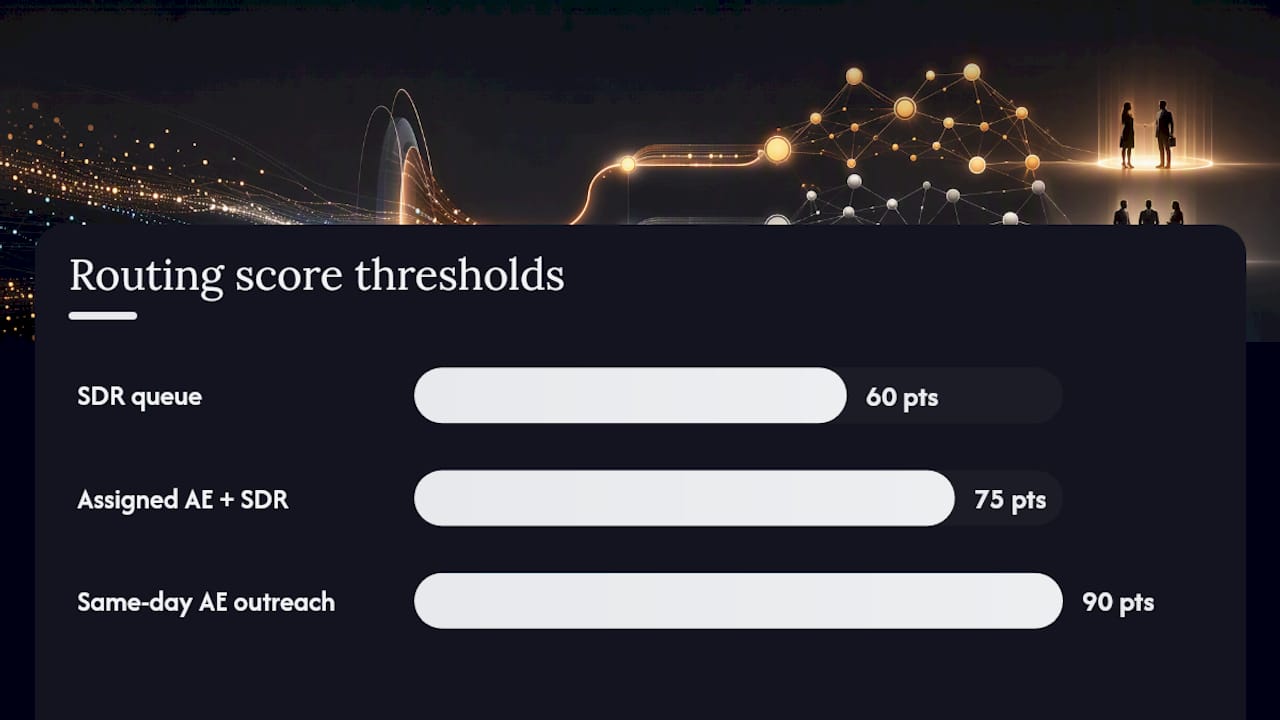
- Effective routing and scoring depend on recency, pointedness, and account fit, with thresholds set at 60, 75, and 90 to determine alert priority.
- Operational discipline in building the scoring, routing, and messaging layers is crucial, with recommended first steps including instrumenting first-party capture and calibrating every 90 days.
Intent data is behavioral evidence that a person or company is researching a topic tied to what you sell. Fit data tells you if an account looks like your best customer on paper; intent data tells you if they’re actually shopping right now. You need both. A perfect-fit account with zero activity is a name on a list. A mediocre-fit account spiking on your pricing page is a live opportunity.
Intent data captures signals from website visits, review-site activity, content consumption, searches, and trigger events. Here’s how the sources break down:
Third-party data widens your view of the market, but it’s a step removed from actual buyer behavior. Treat it as a prioritization layer, not a trigger for your best rep’s morning.
Not every website visit deserves a phone call. Build a mental ladder of pointedness: a blog view sits at the bottom, a comparison page view sits higher, a review-site visit or pricing page view sits at the top. Visit-based and review-site signals rank highest in confidence, while a single content download is often just someone doing early homework.
Freshness matters as much as pointedness. A signal that’s true today can be dead weight next week.
Statistic Callout: Signals decay on different clocks. Pricing visits are highest value for hours to days, topic surges taper within weeks, and funding events remain actionable for two to four weeks — which means a routing system built on a single freshness rule will misfire on half the signals it processes.
A single touchpoint rarely justifies a hard outreach push on its own. Wait for clustering: a pricing page visit plus a return visit to a comparison page plus a new hire at the account is a far stronger case than any one signal alone. The most common failure mode is reps treating a first blog view like a buying signal and torching the account with a premature pitch. The deep-knowledge take here is worth repeating: interest is not the same as commercial pointedness, and every pointedness tier needs its own play, not a one-size pitch.
A workable model scores every signal on three axes, then routes it automatically based on the total.
A workable scoring model uses these three axes with triage thresholds that determine who gets alerted. A common structure: score of 60 routes to an SDR queue, 75 pulls in the assigned AE alongside the SDR, and 90 triggers same-day AE outreach with no queue delay.
Routing has to carry context, not just a notification. The alert needs the account name, the specific signal, a verified contact, and enough detail that the rep isn’t starting from zero. Teams that route by account ownership and signal type convert better because net-new surges hit SDRs, activity on an open opportunity alerts the AE, and signals from existing customers route straight to Customer Success.
Three plays cover most scenarios:
The minimal stack for this to work is a CRM, a sales engagement tool, and a webhook connecting the two. Ownership splits cleanly: Marketing captures and defines the topics worth tracking, Sales acts on anything above threshold, and RevOps owns the routing infrastructure itself, a split Sales Label Consulting sees break down constantly when one team tries to own all three jobs.
Pro Tip: Don’t buy a third-party intent feed before you’ve instrumented your own site properly. Teams that skip first-party capture end up paying for signals they can’t act on, because the context to make them useful was never built.
The signal is your opener, not a footnote. A three-sentence template works better than a full paragraph of throat-clearing: name what you noticed, connect it to a specific outcome, and ask one direct question.
Every alert that reaches a rep should carry a verified contact, one supporting data point, and a suggested opening line. That’s the difference between a rep improvising and a rep executing. Practitioner playbooks show reply-rate lifts of two to four times when outreach opens with the observed signal instead of a generic pitch.
Use a single quick touch for lower-scoring signals. Save a short two-to-three-touch sequence for accounts clustering multiple signals across a week, since that pattern signals sustained research rather than a one-off visit. For more on structuring trigger-based outreach, see Sales Label Consulting’s breakdown of sales triggers.
Four numbers tell you if the program is paying for itself:
Run A/B tests comparing signal-anchored outreach against your control cadence, and recalibrate score weights and triage thresholds every 90 days against actual signal-to-close outcomes, not gut feel. Score drift is real: what counted as a strong signal six months ago may now be background noise if your ICP or product has shifted. Build one dashboard, assign RevOps as the owner, and review it in the same cadence as pipeline reviews. For a deeper framework on prioritizing what the dashboard surfaces, see Sales Label Consulting’s guide to opportunity scoring.
Intent data programs live or die on operational discipline, not on which vendor you pick. In sales audits, the recurring gap is teams that buy a signal feed and never build the routing, scoring, or messaging layer around it. That’s where most of the value gets lost. Building that connective layer, not the data purchase itself, is what turns signals into meetings.
A 30 to 60 day starter checklist for teams standing this up:
— Antony
The scoring, routing, and decay-window guidance in this playbook draws on Rework’s intent data resource, Gangly’s sales playbook on intent data, Clay’s guide to intent data, and 6sense’s platform overview.
For implementation, review Sales Label Consulting’s sales enablement framework to build the training and workflow layer around your scoring model. On the retention side, this partner guide to customer retention strategies pairs well with the CS routing plays described above.
Subscribe to our Insights: Expert productivity tips in your inbox
You'll receive 1-3 emails per month. Your data stays private, always.

CRO & Co-Founder with Sales Label Consulting

Watch our Sales Mates Podcast
September 7, 2026 - 9 min read
Read article Read articleSeptember 6, 2026 - 10 min read
Read article Read articleSeptember 5, 2026 - 8 min read
Read article Read articleSeptember 4, 2026 - 9 min read
Read article Read article