
Deal Review Checklist: Templates and Evidence Rule for Heads of Sales
A deal review checklist is a structured set of fields sales managers require reps to verify, not guess, before a deal counts toward forecast. The one rule that separates accurate forecasts from wishful ones: never accept a rep’s confidence level as evidence. Every review should confirm three minimums, a named stakeholder, a verified next step with a date, and buyer-initiated activity before a deal stays in commit.
TL;DR:
- Verifying the decision-maker, stakeholder, and buying activity with actual evidence ensures deal reliability rather than relying on subjective confidence levels.
- The deal checklist should include specific details such as named decision-makers, a verified close timeline tied to buyer events, and documented key risks.
- A quick weekly triage template takes under two minutes per deal and captures essential updates like last buyer contact and next steps with evidence links.
- For deals nearing commitment, a deep review with detailed fields prompts thorough validation of the buyer’s intent, decision process, and competitive landscape.
- Applying a scoring rubric on evidence and tracking stale activity helps identify zombie deals, prioritize interventions, and eliminate forecast inflation.
A deal review checklist works because it forces the same categories to get checked, deal after deal, regardless of who’s running the pipeline that week. Skip the categories and you get twelve different versions of “feels good about it” instead of a defensible number.
Here’s the structure that holds up under real scrutiny, built around the fields that show up in most working templates, including opportunity size, stakeholder map, competitive position, timeline, and risks, which map almost one to one with what a sales-focused deal review template tracks.
For each field, “verified” means there’s a piece of evidence a manager could hold up and defend to a CFO: a forwarded email, a signed procurement timeline, a calendar invite with the decision-maker’s name on it. “Claimed” means the rep says it’s true but there’s nothing to point to. That distinction alone will cut a bloated pipeline down fast. Insight Partners’ research on running effective deal reviews makes the same point: the strongest reviews ask pointed questions that force this kind of evidence, rather than functioning as a status readout where reps recite what they already told you last week.
Record results where they’ll actually get checked again, custom CRM fields if your system supports them, or a shared review doc with a timestamp and reviewer initials on every entry. Untimestamped notes are worse than no notes, because nobody can tell if “verified last week” means three days ago or six weeks ago. A basic version-control habit, date every entry, never overwrite the previous cycle’s notes, turns your checklist into an audit trail instead of a rumor mill. If you want to see how this connects to a broader sales pipeline optimization effort, the same evidence discipline applies at the pipeline level, not just deal by deal.
Managers don’t need a fifty-field monster for every deal, every week. You need two tools: something fast for pipeline hygiene, and something thorough for deals about to hit commit.
Run this on every deal in a weekly pipeline scrub. It should take under two minutes per deal.
This mirrors the logic behind a compact deal inspection checklist built around five categories and roughly twenty questions, designed to run in under ten minutes and still catch unverifiable claims before they become forecast surprises.
Use this for anything entering commit or flagged as at risk during triage.
Verified deal: A rep lists the next step as “procurement call scheduled for Thursday with the VP of IT, confirmed via calendar invite forwarded to CRM.” That’s evidence. A manager can click the link, see the invite, and move on.
Claimed, not verified, deal: The same field says “buyer is ready to move, just waiting on internal sign-off.” No email. No calendar invite. No named approver. This is exactly the kind of entry a sales performance review checklist is designed to catch, since it separates what a rep believes from what a buyer has actually confirmed in writing.

The difference between those two entries is the entire point of running a checklist instead of a status meeting.
Most deal reviews fail for one reason: they’re built to make reps feel prepared, not to make managers find the problem. Fix the format and the meeting starts doing real work.
There are three distinct types worth running, and conflating them is a common mistake. According to Lucidchart’s guide on structuring deal reviews and QBRs, separating meetings by purpose, rather than running one generic weekly sync, produces sharper agendas and better attendance discipline.
Prework matters more than the meeting itself. Reps should arrive with CRM fields updated, evidence links attached, and a two-minute verbal summary ready, not a slide deck. Managers should pre-read the deep review template for any deal entering commit so the meeting doesn’t turn into data entry.
Facilitation rules keep the meeting from sliding back into a status readout:
Pro Tip: Ask “what did the buyer say, in their own words, this week?” instead of “how’s it looking?” The first question forces evidence. The second invites a confidence score dressed up as an update.
Coaching and managing aren’t the same skill, and deal reviews are where that difference shows up fastest; Middy Matthews’ piece on coaching versus managing is worth a read if your one-on-ones keep drifting into status checks instead of skill building.
Subjective confidence percentages are the single biggest lie in most forecasts. Replace that number with a rubric built on evidence, and the commit list gets honest fast.
Score five areas for every deal in commit: Impact, People, Decision process, Competition, and Next step. Rate each one Verified, Claimed, or Unknown, or use a 1 to 5 scale if your team prefers numbers. A weighted scoring approach like this, similar to the decision matrices used in acquisition evaluation frameworks, turns subjective judgment calls into something comparable across an entire pipeline, not just one deal at a time.
Two operational rules do most of the heavy lifting:
Zombie deals rarely announce themselves. They tend to sit at 70% probability for six straight weeks with nothing but rep-initiated follow-ups showing in the activity log, until someone finally checks the actual contact history and finds the buyer went dark a month ago.
Translate scores into three actions. Escalate deals with strong verification and stalled momentum, they need executive help, not more rep effort. Intervene on deals with one or two Unknowns and a specific plan to resolve them within a week. Disqualify deals with two-plus Unknowns and no realistic path to resolution before the projected close date.
A simple spreadsheet layout works: columns for each of the five rubric areas, a status column (Commit, At Risk, Disqualified), and a last-updated date. Color coding helps, but the columns matter more than the formatting.
Some patterns show up in almost every inflated pipeline. Catching them early, in the checklist itself, saves the awkward conversation where a “sure thing” quietly disappears the week before quarter close.
Each of these becomes a one-on-one coaching item, not a pipeline scolding. Log the specific question asked and the rep’s answer in your sales performance review process, and you’ve got a coaching trail that shows improvement, or the lack of it, over time.
Antony has spent years inside B2B tech sales organizations watching forecasts collapse for the same reasons, quarter after quarter, and the checklist discipline described here is built directly from that pattern.
That gap traces back to sales-audit engagements where the checklist itself became the diagnostic tool, surfacing exactly which deals had verified evidence and which were running on rep optimism. The same logic shows up in the sales performance review checklist asset built for teams that need a repeatable review structure, not a one-time fix.
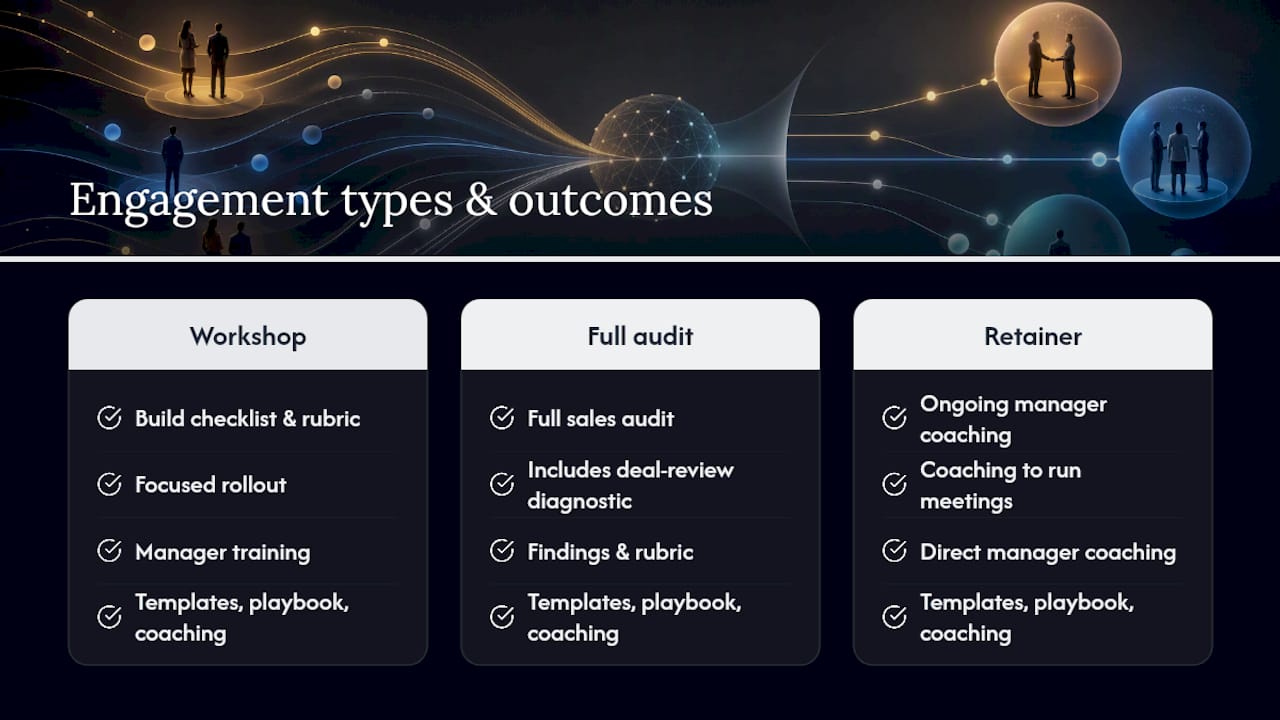
Teams typically engage Sales Label Consulting in one of three ways: a focused workshop to build and roll out a checklist and scoring rubric, a full sales audit that includes deal-review discipline as one diagnostic layer, or an ongoing retainer where managers get direct coaching on running the meetings themselves. Every engagement leaves the team with templates, a facilitation playbook, and hands-on coaching, not just a slide deck nobody opens again.
The conventional wisdom says good managers build trust with their reps and take their word on deal status. That’s backwards. The best managers build trust by verifying everything, consistently and without exception, which is exactly what lets reps stop performing confidence and start reporting reality.
Most forecast disasters trace back to one root cause: a manager who accepted “I feel good about this” as data. The fix isn’t more scrutiny on the reps you already distrust. It’s the same verification standard applied evenly, every deal, every cycle, so nobody feels singled out and nobody gets a pass.
If you take one thing from this checklist, make it the zombie-deal rule. Fourteen days of buyer silence is not a rounding error. It’s the clearest, cheapest signal you have that a deal needs intervention or an exit from your forecast, and most managers wait far too long to act on it.
— Antony
Building a checklist is the easy part. Getting an entire sales team to use it consistently, week after week, without it turning back into a status meeting, is where most managers get stuck. Sales Label Consulting works directly with B2B tech sales leaders to install this exact verification discipline into your CRM, your meeting cadence, and your commit process, not as a one-time template drop, but as a structure your team actually keeps using three months later.
Engagements typically start with a short audit of your current pipeline hygiene, followed by a workshop to build your team’s specific checklist fields and scoring rubric, then coaching to make sure managers run the meetings correctly from week one. If your forecast has been off for more than a quarter, the fastest fix is usually not a new tool, it’s this kind of structural review. Explore sales enablement services built around exactly this kind of rollout, or book a discovery call to walk through your current pipeline and see where the Unknowns are hiding.
For managers who want to go deeper on any piece of this checklist, these sources informed the fields, rubric, and meeting structure covered here:
Subscribe to our Insights: Expert productivity tips in your inbox
You'll receive 1-3 emails per month. Your data stays private, always.

CRO & Co-Founder with Sales Label Consulting

Watch our Sales Mates Podcast
August 30, 2026 - 12 min read
Read article Read articleAugust 29, 2026 - 10 min read
Read article Read articleAugust 28, 2026 - 15 min read
Read article Read articleAugust 27, 2026 - 14 min read
Read article Read article