
What Is a B2B Sales Motion? A 2026 Guide
TL;DR:
- A B2B sales motion is a strategic framework that guides how sales teams engage, nurture, and convert prospects. It is distinct from the sales process, which lists the tactical steps, because the motion aligns these steps with buyer behavior and deal complexity. Effective sales motions are tailored to deal size and complexity, with AI increasingly used to surface signals and improve rep efficiency.
A B2B sales motion is the strategic mechanism a company uses to engage, nurture, and convert prospects. It defines the “how” of selling, not the “what.” Most sales leaders confuse a sales motion with a sales process. The process lists tactical steps. The motion governs how those steps align with buyer behavior, deal complexity, and average contract value. Get this distinction wrong and you’ll run the right plays in the wrong game. Understanding what is a B2B sales motion is the first step toward building a revenue engine that actually scales.
A sales motion is the strategic layer above your sales process. It answers the question: “How should we sell to this type of buyer?” The sales process answers: “What steps do we take?” Both matter, but confusing them is one of the most common and costly mistakes in B2B sales design.
Think of it this way. The sales process is your playbook. The sales motion is your game plan. MEDDIC, Challenger, and SPIN Selling are methodologies that sit inside a motion. They guide how your reps think and communicate, not just what they do next in a CRM stage.

A go-to-market (GTM) strategy sits above all of this. It defines which markets to enter and why. The sales motion sits below GTM and above the process. It translates market strategy into rep behavior. Sales leaders who skip this layer end up with reps who follow steps but can’t adapt when a deal gets complicated.
Real talk: if your reps are “following the process” but still losing deals at the same stage repeatedly, your motion is broken, not your process.
A strong sales motion combines a documented process with an underlying methodology, both calibrated to buyer behavior. The process covers prospecting, qualification, discovery, proposal, and closing. The methodology governs how reps execute each step, whether that’s using MEDDIC to qualify rigorously or Challenger to reframe buyer thinking.
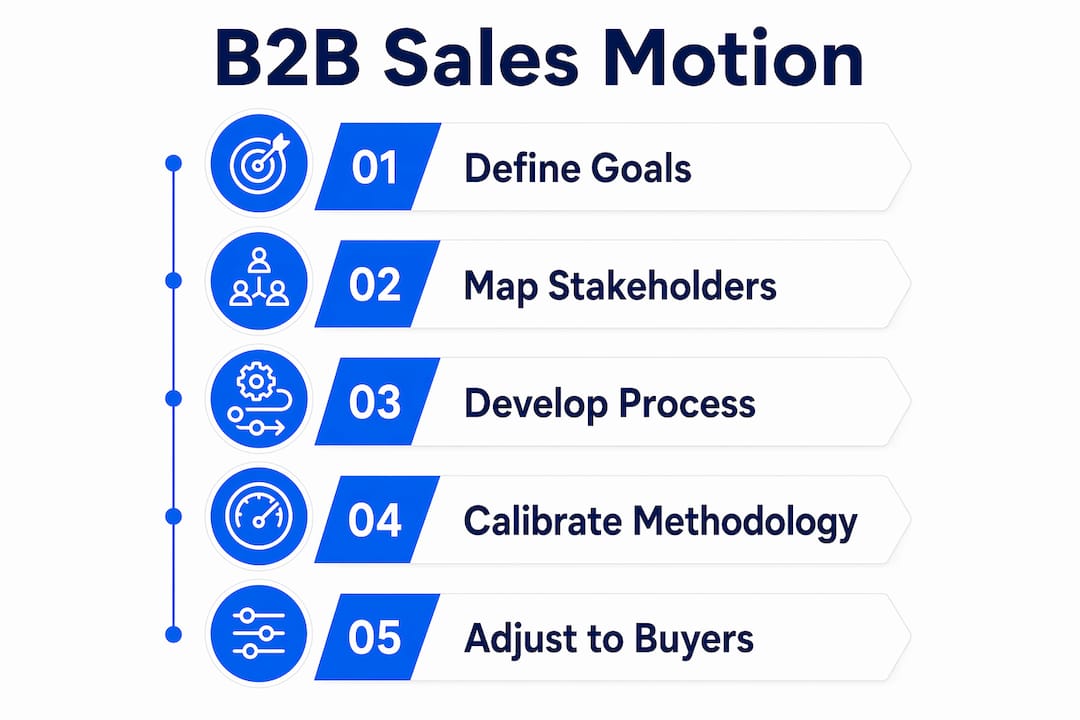
Stakeholder management is where most motions break down in practice. B2B deals rarely involve one decision-maker. Multi-threading across three or more stakeholders increases win rates by up to 30%. That number reflects a real shift in how enterprise buyers make decisions. Committees have grown. Risk aversion has increased. A motion that ignores this reality is already behind.
Key components of a well-built B2B sales motion include:
Pro Tip: Don’t just map stakeholders. Rank them. Your champion is the person who loses something if your deal dies. Find that person in week one, not week eight.
Sales motions segment by ACV and product complexity. This is not optional. Matching the wrong motion to your deal type wastes budget, burns rep time, and confuses buyers.
Sales-led motions suit products with an ACV of $25,000 or more. These deals require heavy education, multi-stakeholder alignment, and consultative discovery. Product-led motions work for simpler products with ACV between $100 and $10,000. The product itself does the selling through trials, freemium access, or self-service onboarding.
| Motion type | Typical ACV | Product complexity | Engagement style |
|---|---|---|---|
| Sales-led | $25K+ | High | Consultative, multi-touch |
| Product-led | $100–$10K | Low to medium | Self-service, trial-driven |
| Inbound | Varies | Medium | Content-driven, rep-assisted |
| Outbound | Varies | Medium to high | Signal-based, rep-initiated |
Inbound motions rely on content and demand generation to pull buyers in. Outbound motions push reps to initiate contact, increasingly triggered by intent signals rather than cold lists. Many mature B2B organizations run hybrid motions, using inbound to generate pipeline and outbound to accelerate or expand it.
The critical insight here: aligning motion type to ACV directly reduces customer acquisition cost. A sales-led motion on a $500 deal destroys unit economics. A product-led motion on a $200K enterprise deal leaves money and relationships on the table.
AI is changing how motions are executed, not what makes them work. 72% of sales leaders in 2026 focus on improving rep skills to meet evolving buyer expectations. That stat tells you something important: the leaders who are winning aren’t replacing reps with AI. They’re using AI to make reps sharper.
Signal-based outbound is the clearest example. Instead of cold lists, reps now trigger outreach based on intent data, job change signals, and product usage patterns. AI surfaces the signal. The rep decides what to do with it. Consultative selling remains critical because AI cannot manage internal complexity, build trust, or navigate a risk-averse buying committee.
Best practices for integrating AI into your sales motion:
Pro Tip: AI is your scout, not your closer. Let it find the signal. Let your rep read the room.
The most expensive pitfall is pipeline noise from poor sales and marketing alignment. When marketing sends leads that don’t match your qualification criteria, reps waste time on deals that were never real. This isn’t a marketing problem or a sales problem. It’s a motion design problem. The fix is shared qualification criteria agreed upon before a lead ever enters the pipeline.
The second pitfall is buying committee bloat. As more stakeholders join a deal, the motion slows unless someone owns internal consensus. Identifying a champion who can navigate risk aversion and build internal buy-in is the difference between a deal that closes and one that stalls indefinitely in “evaluation.”
The third pitfall is missing exit criteria. Here’s what that looks like in practice:
Pro Tip: If your reps can’t tell you why a deal is in a stage, your exit criteria don’t exist. Write them down. Make them non-negotiable.
Start with segmentation. Map your buyer types by industry, company size, and deal size. Then assign a motion type to each segment. Don’t run one motion across all buyers. A mid-market SaaS buyer and an enterprise financial services buyer need different engagement styles, different discovery questions, and different proof points.
Once your motion is mapped, monitor these KPIs to measure effectiveness:
| KPI | What it measures | Action trigger |
|---|---|---|
| Stage conversion rate | Motion effectiveness per stage | Redesign stage if rate drops below baseline |
| Sales cycle length | Buyer friction and qualification quality | Investigate if cycle extends beyond 20% of benchmark |
| Win rate by segment | Motion-to-market fit | Shift motion type if win rate falls below target |
| Rep ramp time | Motion clarity and documentation quality | Improve playbooks if ramp exceeds 90 days |
Iterate quarterly. Buyer behavior shifts. Your motion should shift with it. Sales enablement technology supports this by capturing rep activity data and surfacing patterns that manual review misses. Saleslabelconsulting works with sales leaders to build sales enablement systems that make this iteration repeatable, not heroic.
Most sales motion failures aren’t strategic. They’re structural. Teams know what they should do. They just don’t have a system that makes the right behavior the default behavior.
I’ve seen companies with brilliant GTM strategies and broken motions. The strategy said “enterprise sales-led.” The motion was actually “whoever calls first.” No exit criteria. No champion identification. No multi-threading. Just reps doing their best with no shared framework. The result was a pipeline full of hope and a forecast full of fiction.
The shift that changes everything is treating your sales motion as a living system, not a document. You review it. You test it. You kill what doesn’t work. The teams I’ve seen grow fastest are the ones where the Head of Sales and the RevOps lead sit down monthly and ask: “Where is our motion losing us deals we should be winning?”
AI makes this easier now. But the discipline to ask that question, and act on the answer, is still human. Structure beats heroics every time. Build the system. Then let your reps be great inside it.
— Antony
Sales motion design is where most B2B revenue problems start. Saleslabelconsulting works directly with RevOps leaders, Heads of Sales, and VPs of Sales to audit existing motions, identify where deals stall, and build repeatable systems that produce predictable results.
Whether you need to align your sales process with buyer behavior, tighten your qualification criteria, or integrate AI signals into your outbound motion, Saleslabelconsulting brings the experience to get it done without the guesswork. Our sales enablement practice covers motion design, sales audit, and demand generation. If your pipeline feels unpredictable, that’s a solvable problem. Let’s solve it.
A B2B sales motion is the strategic layer that connects your GTM strategy to rep behavior, and getting it right is the single highest-leverage move a sales leader can make.
| Point | Details |
|---|---|
| Motion vs. process | A sales motion governs how you sell; a sales process lists what steps to take. Never confuse the two. |
| ACV drives motion type | Sales-led motions suit deals above $25K ACV; product-led motions work for deals under $10K ACV. |
| Multi-threading wins deals | Engaging three or more stakeholders increases win rates by up to 30%. |
| Exit criteria are non-negotiable | Every pipeline stage needs measurable exit criteria to prevent bloat and wasted rep time. |
| AI assists, humans close | AI surfaces signals and coaching insights, but consultative selling drives trust and consensus in complex deals. |
A B2B sales motion is the standardized approach a company uses to engage and convert business buyers. It defines how sales teams sell, not just what steps they follow.
A sales motion is the overall strategic framework for engaging buyers. A sales methodology like MEDDIC or Challenger is a set of principles that operates inside that motion to guide rep behavior.
The four main types are sales-led, product-led, inbound, and outbound. The right choice depends on your product’s ACV and complexity.
The most common causes are poor sales and marketing alignment, missing exit criteria, and failure to identify a champion inside the buying committee. Each creates pipeline bloat and lost deals.
Review your sales motion at least quarterly. Buyer behavior shifts, and a motion that matched your market six months ago may already be losing you deals today.
Subscribe to our Insights: Expert productivity tips in your inbox
You'll receive 1-3 emails per month. Your data stays private, always.

CRO & Co-Founder with Sales Label Consulting

Watch our Sales Mates Podcast
September 20, 2026 - 13 min read
Read article Read articleSeptember 19, 2026 - 13 min read
Read article Read articleSeptember 18, 2026 - 10 min read
Read article Read articleSeptember 17, 2026 - 16 min read
Read article Read article