
The Role of Incentives in Sales Teams That Win
TL;DR:
- Effective sales incentives create clarity, align behavior with strategy, and foster sustained motivation beyond short-term rewards. Properly designed programs incorporate transparent goals, fair accessible rewards, and real-time visibility, significantly boosting performance and trust. Regular, agile updates and cultural alignment are essential for long-term success in motivating sales teams.
Most sales leaders treat incentives like a thermostat. Turn up the payout, get more performance. Turn it down, watch the team slow. But that mental model is exactly why so many incentive programs underdeliver. The role of incentives in sales teams goes far beyond reward mechanics. Done right, incentives create clarity, align behavior with strategy, and build the kind of sustained motivation that outlasts any single commission check. Done wrong, they create noise, resentment, and short-term sprints that collapse the moment the SPIFF ends.
| Point | Details |
|---|---|
| Incentives drive more than payouts | Well-designed incentives shape behavior, build trust, and align reps with strategic goals. |
| Clarity beats complexity | Plans with transparent goals and real-time visibility outperform higher-paying but confusing structures. |
| Non-cash rewards hit harder | Non-cash incentives produce a 38.6% performance lift versus 14.6% for cash alone. |
| Self-funded programs last longer | Incentives funded from incremental margin stay defensible and survive budget cycles. |
| Agility is a competitive advantage | Only 12% of companies can update their incentive strategy within two weeks, yet 92% want to. |
Here’s what the research keeps confirming: motivation in sales is not a one-size-fits-all equation. Extrinsic motivation, think commissions, bonuses, and cash rewards, gets reps moving. But intrinsic motivation, the sense of progress, mastery, and purpose, keeps them engaged over time. The most effective incentive programs for sales activate both layers.
The psychological mechanism is straightforward. When reps know exactly what they need to do, understand how their effort maps to reward, and believe the opportunity is genuinely within reach, they perform at a higher level. Sales professionals in 2026 rank clear goals, real earning potential, and fair participation as the top motivators. Not the size of the check.
That last point deserves more attention. Fairness and accessibility matter enormously for sales team motivation. If your top 10% are the only ones with a realistic shot at hitting the incentive, you have not built a motivational program. You have built a reward system for people who were already going to perform. The middle 60% of your team, the group with the most untapped potential, disengage entirely. That is where real performance gains live.
Incentive programs can boost individual and team performance by up to 44%. But that number only materializes when the program is designed with clear, measurable targets and genuine accessibility for all performance tiers.
Pro Tip: When reviewing your current plan, ask this one question: “Can a rep in the bottom quartile look at this plan and see a realistic path to earning something meaningful?” If the answer is no, your incentive is rewarding success rather than creating it.
Not all incentives are created equal. Understanding what each type does and when to deploy it is what separates a thoughtful incentive program from a scattered collection of rewards.
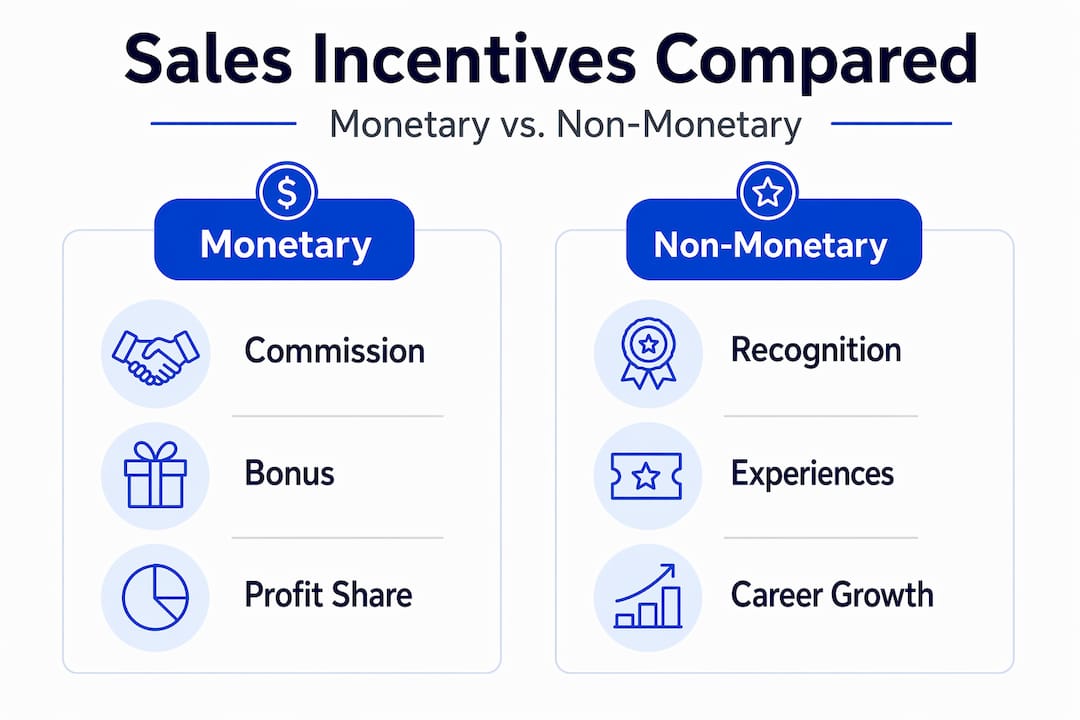
Monetary incentives are the most common. They include:
Non-monetary incentives are where most teams leave serious performance on the table. Non-cash incentive programs produce a 38.6% performance lift compared to just 14.6% for cash. Travel and experiential rewards carry the strongest retention of motivational effect over time. A rep who won a trip to Lisbon will still be talking about it at the next SKO. A $500 bonus check? Forgotten by next month.
Non-monetary options worth building into your program include recognition programs (public and peer-based), experiential rewards like travel or exclusive events, professional development funding, and flexible time off tied to performance.
| Incentive type | Best use case | Motivational staying power |
|---|---|---|
| Commission | Ongoing revenue behavior | Medium |
| Bonus | Quota and milestone attainment | Medium |
| SPIFF | Short-term product or campaign focus | Low (fades fast) |
| Experiential reward | High-performer retention | High |
| Recognition program | Culture and peer motivation | High |
| Development funding | Long-term engagement | Very high |
Personalizing incentives to align with individual roles, career stages, and preferences improves motivation and retention across diverse teams. A senior enterprise rep and a newly ramped SDR do not want the same reward. Designing for that reality is not complicated. It just requires intentionality.
Pro Tip: Run a quick anonymous poll with your team asking what rewards matter most to them personally. The answers will surprise you, and they will cost you far less than a generic bonus program with half the impact.
Good incentive design is part science, part architecture. Here is a practical sequence that works.
Establish your baseline. Know what average performance looks like before you design a reward for exceeding it. Every incremental target should be anchored to real historical data, not optimistic projections.
Fund from incremental margin. Effective incentive programs are self-funded, financed from the margin generated above baseline performance rather than pulled from a fixed budget. This structure protects your program from cuts and makes it financially defensible at the executive level.
Build tiered payout structures. All-or-nothing quota plans leave money and motivation on the table. Tiered payout structures align rewards with incremental margin growth and keep reps engaged across every performance band, not just at the finish line.
Bake in transparency. Reps should be able to see exactly where they stand, in real time. Plans with real-time visibility consistently outperform higher-paying but opaque compensation structures. If your reps are waiting for a monthly statement to understand their earnings, you have already lost a month of motivated selling.
Avoid the complexity trap. Complex payout formulas and shifting targets actively discourage performance. When reps cannot predict what they will earn from a deal, they stop trusting the plan. Distrust kills effort far more effectively than a low payout rate.
Test before you scale. Pilot new structures with a segment of your team before rolling out org-wide. Use what you learn to sharpen the design before everyone is affected.
The goal of a well-designed sales commission model is not just to pay people. It is to signal to every rep what the organization values and to make the path to earning completely legible.
Designing a great incentive program is only half the battle. The other half is making sure you can actually run it, update it, and communicate it fast enough to stay relevant.

Here is the operational reality most organizations do not talk about openly: only 12% of companies can change their incentive strategy within two weeks, despite 92% wanting to. That gap is not a motivation problem. It is a systems problem.
The bottleneck typically lives in three places:
Companies with synchronized planning, implementation, and rep visibility cycles achieve measurably better trust and quota attainment. The fix is not always a new platform. Sometimes it is a process decision: who owns changes, what approvals are required, and how fast reps see the update.
Dynamic, frequent tuning of incentives integrated with sales team coaching and real-time data drives far better outcomes than static quarterly reviews. Think of your incentive program less like an annual contract and more like a living document that responds to what is actually happening in the market.
Pro Tip: Designate one owner for incentive change management who sits at the intersection of finance, sales ops, and rep communication. When a single person can see all three levers, your update time shrinks dramatically.
Incentives do not exist in a vacuum. They are a cultural signal. What you reward tells your team what you actually value, regardless of what your values doc says.
A few principles that separate high-performing incentive cultures from average ones:
The best sales cultures treat motivation as an ongoing conversation, not an annual event. Incentives are one of the most direct ways to have that conversation at scale.
I’ve worked with sales teams at every stage of growth. And the pattern I keep seeing is this: leaders invest real time in designing the incentive plan and almost no time in communicating it or keeping it current.
In my experience, a simpler plan with excellent visibility beats a sophisticated plan that nobody fully understands. I’ve watched reps disengage not because the payout was too low, but because they genuinely could not tell whether they were on track. That ambiguity is a motivation killer. Clarity is free. Use it aggressively.
The other thing I’ve learned: incentives can disengage just as fast as they motivate when they feel rigged or stale. A quota set in Q1 that no longer reflects territory changes by Q3 is not a motivational tool. It is evidence to your reps that leadership is not paying attention. The moment a rep stops trusting the plan, they start hedging their effort.
What actually works is treating your incentive program like you treat your product. Ship it, measure it, update it, get feedback, and iterate. Structure beats heroics every time. The teams I’ve seen consistently win are not the ones with the highest commissions. They are the ones where every rep understands exactly what they are playing for, believes it is achievable, and trusts that the organization will honor the deal.
— Antony
If this article surfaced more questions than answers about your current incentive structure, that is a good sign. It means there is room to get significantly better results from the team you already have.
At Saleslabelconsulting, we work directly with RevOps leaders, VPs of Sales, and Heads of Sales to design incentive programs that are clear, self-funded, and agile enough to keep pace with real market conditions. Our sales enablement consulting practice covers everything from incentive architecture to performance audits and rep coaching frameworks. We also run sales audits that surface exactly where your current incentive structure is leaking motivation and revenue. No generic templates. No off-the-shelf frameworks. Just experienced practitioners who have seen what works and know how to build it for your specific sales motion.
Explore our full range of services or get in touch to talk through your current situation.
Incentives shape behavior, build motivation, and align rep effort with business goals. Their role goes beyond reward delivery — they signal what the organization values and create the conditions for sustained performance.
Both monetary and non-monetary incentives drive results. Non-cash programs like experiential rewards and recognition produce a 38.6% performance lift, compared to 14.6% for cash alone, making a hybrid approach the most effective structure.
Fund it from incremental margin, build tiered payout structures, and give reps real-time visibility into their earnings. Programs built this way are financially sustainable and maintain rep trust over time.
Most fail because of complexity, poor communication, or an inability to update them quickly. Complex formulas and shifting targets erode confidence in the plan, and reps stop trusting what they cannot predict.
More often than most teams do it. Static quarterly reviews rarely keep pace with market changes. Dynamic, frequent tuning integrated with coaching and real-time data consistently outperforms annual or semi-annual plan cycles.
Subscribe to our Insights: Expert productivity tips in your inbox
You'll receive 1-3 emails per month. Your data stays private, always.

CRO & Co-Founder with Sales Label Consulting

Watch our Sales Mates Podcast
September 23, 2026 - 8 min read
Read article Read articleSeptember 22, 2026 - 11 min read
Read article Read articleSeptember 21, 2026 - 8 min read
Read article Read articleSeptember 20, 2026 - 13 min read
Read article Read article