
Why Sales Fail: Key Reasons and How to Fix Them
TL;DR:
- Most sales fail due to broken system design, not individual rep performance or heroics.
- Fixing pipeline stages, aligning sales and delivery, and clarifying value propositions are critical for predictable revenue growth.
Most sales leaders enter 2026 with better tools, bigger teams, and more data than ever before. Yet why sales fail remains one of the most persistent and expensive questions in business. The numbers don’t lie: quota attainment is at historic lows, win rates are shrinking, and sales cycles keep getting longer. The problem isn’t your reps. It’s the system around them. This article breaks down the structural, strategic, and process-level reasons sales organizations miss targets, and gives you a clear path to fix what’s actually broken.
| Point | Details |
|---|---|
| Win rates are at historic lows | Average B2B win rates sit at 21% in 2026, making pipeline quality more critical than ever. |
| Pipeline stages mislead leaders | Most CRM stages track rep activity, not buyer progress, creating false confidence in forecasts. |
| AI accelerates broken systems | Adding AI before fixing your sales fundamentals makes poor results arrive faster, not better. |
| Value proposition gaps cost revenue | Only 4% of companies have a strong, consistent value proposition, directly limiting growth. |
| Structure beats heroics | Fixing process design, margin checkpoints, and sales-delivery alignment drives more predictable revenue than rep coaching alone. |
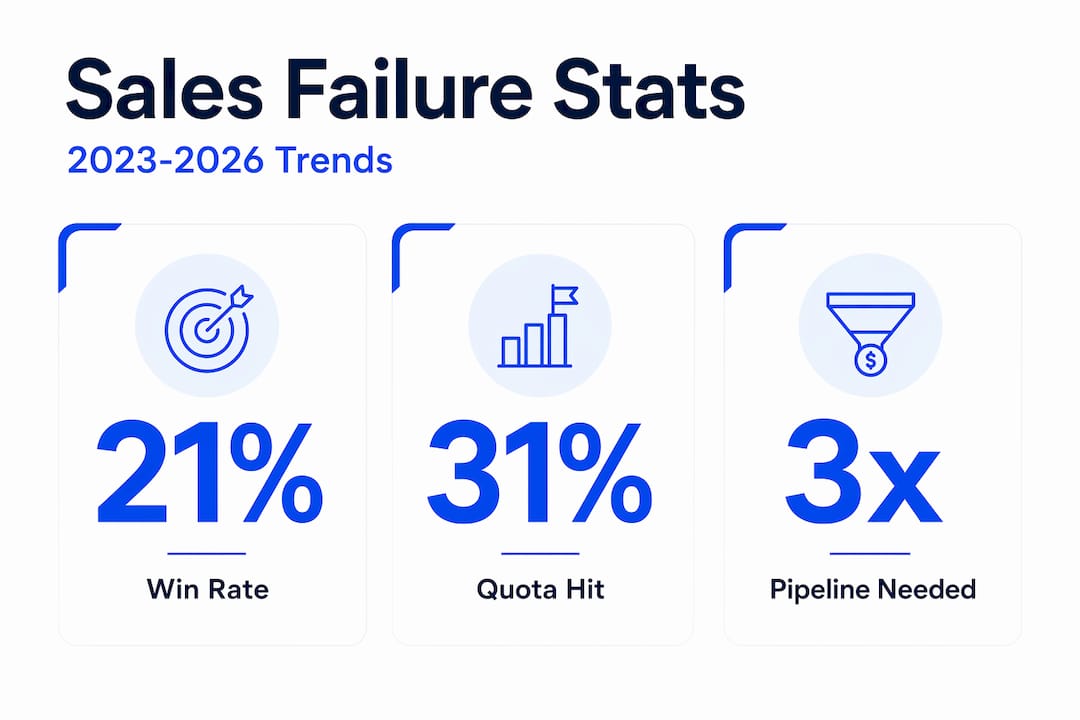
Real talk: the numbers coming out of 2025 and into 2026 should alarm every revenue leader. B2B win rates compressed to about 21%, while the average sales cycle now stretches to 134 days. That’s not a temporary dip. It’s a structural trend.
Quota attainment tells the same story. In 2023, 39% of reps hit quota. By 2025, that number fell to 31%. That means roughly seven out of ten salespeople are missing their numbers, and the gap is widening. Sales cycles have lengthened by 25% since 2024, which creates a cascade effect on forecast accuracy, cash flow, and revenue predictability.
Here’s what the data reveals about the gap between activity and outcomes:
| Metric | 2023 | 2025/2026 |
|---|---|---|
| Average win rate | ~28% | ~21% |
| Quota attainment | 39% | 31% |
| Average sales cycle | ~107 days | ~134 days |
| Executives missing growth targets | 32% | 42% |
The implication is significant. As win rates fall, your pipeline coverage requirement rises. If you used to need 3x pipeline to hit quota, you may now need 5x or more. Yet most teams haven’t adjusted their pipeline build strategies to account for this shift. They’re still chasing the same volume of activities and wondering why revenue isn’t landing.
The gap between what reps do and what actually converts is widening. Understanding long B2B sales cycles and their causes is no longer optional. It’s a survival skill for any revenue leader.
Here’s where most conversations about why sales fail go wrong. Leaders blame reps. They add training, increase call quotas, or swap out talent. None of that fixes a broken pipeline design.
The most common structural problem? CRM pipeline stages based on rep activities rather than buyer milestones. Stage names like “Proposal Sent” or “Demo Completed” tell you what the rep did. They tell you nothing about where the buyer actually is in their decision process. That distinction matters enormously for forecast accuracy.

Effective pipeline design requires stages defined by verifiable buyer confirmations. Not “we sent a proposal” but “the economic buyer confirmed budget and timeline in writing.” That’s a buyer milestone. It’s objective, confirmable, and directly tied to deal momentum.
Here are the most damaging structural failures Saleslabelconsulting sees in sales audits:
Pro Tip: Involve your top two or three performers in redesigning pipeline stages. Their buy-in creates peer pressure for adoption across the team, and their pattern recognition often produces more accurate stage definitions than any consulting framework.
One comparison worth making: a rep-activity pipeline versus a buyer-milestone pipeline isn’t just a semantic difference. It’s the difference between a dashboard that feels good and one that actually predicts revenue.
| Pipeline type | Stage example | What it measures |
|---|---|---|
| Rep activity based | “Proposal Sent” | What the rep did |
| Buyer milestone based | “Budget confirmed by economic buyer” | Where the buyer actually is |
AI is everywhere in sales right now. And it’s creating a new category of reasons for sales failure that nobody wants to talk about honestly. Only 12% of organizations have fully integrated AI into sales workflows, yet almost every team is experimenting with some form of automation or AI-assisted outreach.
The problem isn’t the technology. The problem is the sequence. AI merely accelerates existing sales systems. If your system is broken, AI makes the broken parts happen faster. More noise, more unqualified outreach, more activity that doesn’t convert.
70% of companies misuse AI as activity multipliers rather than tools that improve decision quality. The result is tool sprawl, overwhelmed prospects, and sales teams that are busier but less effective. Only about 1% of organizations report measurable revenue outcomes from their AI sales tools. That number should give every VP of Sales pause.
What works? AI earns its place after you’ve fixed the fundamentals. Here’s where it actually adds value:
Pro Tip: Before adding any new AI tool, ask one question: “What disciplined process does this tool depend on to produce accurate outputs?” If you can’t answer that clearly, the tool will generate noise, not revenue.
For a candid look at AI in sales technology, including where it genuinely helps and where it hurts, that’s a conversation worth having before your next tool purchase.
Here’s a sales strategy pitfall that sits squarely in leadership territory, not rep territory. 42% of global B2B executives missed growth targets in 2025, and one of the top contributing factors was the absence of a clear, differentiated value proposition.
The data from Bain’s research is stark. Companies with clear value propositions achieved 19% revenue growth. Those without averaged 12%. That’s a 7-point gap that compounds over time and creates the kind of structural underperformance that no amount of rep training can fix.
Only 4% of companies have a strong, consistent value proposition that holds up across all buyer conversations and market conditions. That means 96% of your competitors, and possibly your own team, are winging it at the moment of truth in the sales conversation.
Why does this happen? A few reasons that come up repeatedly in sales audits:
The fix starts upstream. Your value proposition needs to be shaped by what your best customers say, tested in discovery calls, and refined based on where deals stall or lose. It’s not a marketing exercise. It’s a sales operations discipline.
Knowing the common sales mistakes is only useful if you do something with that knowledge. Here’s a prioritized sequence for sales leaders who want to build a system that produces predictable outcomes rather than heroic quarters followed by painful misses.
Pro Tip: Run a simple experiment: pick five recently lost deals and trace exactly which pipeline stage the deal stalled in. You’ll almost always find a pattern, and that pattern tells you where to focus your structural fix.
I’ve seen this pattern more times than I can count. A sales team has one or two rainmakers who consistently hit quota. Leadership celebrates them, builds comp plans around their results, and assumes the system is working. It’s not. The heroics are masking the structural failures underneath.
In my experience, the most uncomfortable truth in sales leadership is that the system, not the individual, determines outcomes at scale. You can’t hire your way out of a broken pipeline design. You can’t train your way past a value proposition that doesn’t differentiate. And you absolutely cannot AI your way out of a process that has no buyer validation built into it.
What I’ve seen actually work is leaders who are willing to look at their pipeline with honest eyes. Not the pipeline that feels good to present on a board call, but the pipeline where they ask: “Does this deal reflect a real buyer commitment, or a rep’s optimism?” That question alone changes everything.
The teams that succeed are the ones that build cross-functional discipline around the sales process. Sales, delivery, and finance are all looking at the same data, asking the same questions, and catching margin problems before they become client problems. Structure beats heroics. Every time.
The discomfort of confronting structural pipeline issues is real. But it’s far less uncomfortable than explaining to your board why you missed revenue targets for the third consecutive quarter.
— Antony
If this article surfaced patterns you recognize in your own organization, you’re not alone. Most sales teams we work with at Saleslabelconsulting have some version of these issues running silently beneath the surface.
Saleslabelconsulting works with RevOps leaders, Heads of Sales, and VPs of Sales to diagnose exactly where pipeline and margin leaks are occurring. Our sales enablement for predictable revenue program walks your team through a structured rebuild of pipeline design, qualification standards, and sales-delivery alignment. If you want to understand where deals are dying before they close, our sales audit process surfaces those answers quickly. For teams that need additional frontline capacity during a transformation, sales outsourcing in Portugal offers a proven model worth exploring. Let’s build something that actually holds.
Quota attainment dropped to 31% in 2025, driven by longer sales cycles, compressed win rates, and pipeline stages that don’t reflect real buyer progress. The core issue is usually structural, not individual performance.
The most frequent are pipeline stages based on rep activity rather than buyer milestones, absence of margin checkpoints before proposal stage, and value propositions that don’t clearly differentiate from competitors.
70% of companies misuse AI as an activity multiplier rather than a decision-quality tool. When underlying processes are weak, AI scales the problems, not the results.
Start by auditing your pipeline for buyer-validated milestones, add margin checkpoints at the proposal stage, and fix the sales-delivery handoff. A B2B sales methodology built around buyer behavior consistently outperforms volume-based approaches.
Companies with a clear value proposition grow revenue at 19% compared to 12% for those without one, according to Bain research. A weak or generic value proposition leaves reps without a credible answer to “why you” in every competitive deal.
Subscribe to our Insights: Expert productivity tips in your inbox
You'll receive 1-3 emails per month. Your data stays private, always.

CRO & Co-Founder with Sales Label Consulting

Watch our Sales Mates Podcast
September 21, 2026 - 8 min read
Read article Read articleSeptember 20, 2026 - 13 min read
Read article Read articleSeptember 19, 2026 - 13 min read
Read article Read articleSeptember 18, 2026 - 10 min read
Read article Read article