
What is sales productivity? Boost results with proven strategies
TL;DR:
- Sales reps spend only about 28-30% of their time on selling activities.
- Measuring sales productivity by activity alone is ineffective; focus on revenue relative to input.
- Hidden issues like non-selling tasks and unrealistic quotas significantly impair sales efficiency.
Most sales leaders assume their teams are working hard enough. And they probably are. The uncomfortable truth is that sales reps spend only 28-30% of their time actually selling. The rest goes to admin, reporting, internal meetings, and tasks that don’t move deals forward. That’s not a motivation problem. It’s a productivity problem. Sales productivity isn’t about effort. It’s about how much revenue your team generates relative to the time and resources invested. This article breaks down what sales productivity really means, how to measure it, what’s silently killing it, and what you can do about it right now.
| Point | Details |
|---|---|
| Productivity is not just activity | True sales productivity measures results relative to effort, not just tasks completed. |
| Measure what matters | Use metrics like revenue per rep and quota attainment to diagnose and boost efficiency. |
| Beware non-selling time | Much of a sales rep’s day is lost to admin tasks, so focus improvement here first. |
| Quotas can harm or help | Unrealistic quotas trigger system gaming and stress—review targets regularly to avoid this. |
| Smart strategies beat busyness | Leaders who streamline processes and prioritize value-driving work see the best returns. |
Here’s where most teams go wrong. They treat sales productivity as a synonym for sales activity. More calls, more emails, more demos. But activity is just motion. Productivity is motion that leads somewhere.
Sales productivity measures output relative to input. You’re asking: for every hour of selling time, every dollar of tooling, every rep we hire, how much revenue do we actually generate? That’s a fundamentally different question than “how busy is my team?”
Sales performance, by contrast, is typically about outcomes at a point in time: quota attainment, closed ARR, win rates. Performance tells you what happened. Productivity tells you how efficiently it happened. Both matter, but conflating them leads to classic sales mistakes that scale badly.
For tech companies specifically, this distinction is critical. You’re often dealing with longer sales cycles, multiple stakeholders, and consultative selling that requires preparation, research, and relationship-building. Measuring productivity purely by call volume misses the point entirely.
Real talk: A rep making 80 calls a week but closing nothing is not productive. A rep making 20 highly targeted calls and closing 3 enterprise deals is. Don’t reward motion. Reward results.
Here are the most common misconceptions about sales productivity we see in mid-sized tech teams:
If your sales strategy examples are built around activity metrics alone, you’re optimizing for the wrong thing. Structure beats heroics, and clarity beats volume.
Understanding what sales productivity is paves the way for measuring it effectively. The good news is that there are clear frameworks. The bad news is that most teams only track half of them.
The core metrics that matter in a tech sales environment include revenue per rep, quota attainment rate, average sales cycle length, win rate, and deal margin. Each tells a different story. Revenue per rep shows capacity. Quota attainment shows alignment between targets and reality. Sales cycle length reveals process efficiency. Win rate reflects qualification discipline. Margin shows whether you’re discounting your way to closed deals.
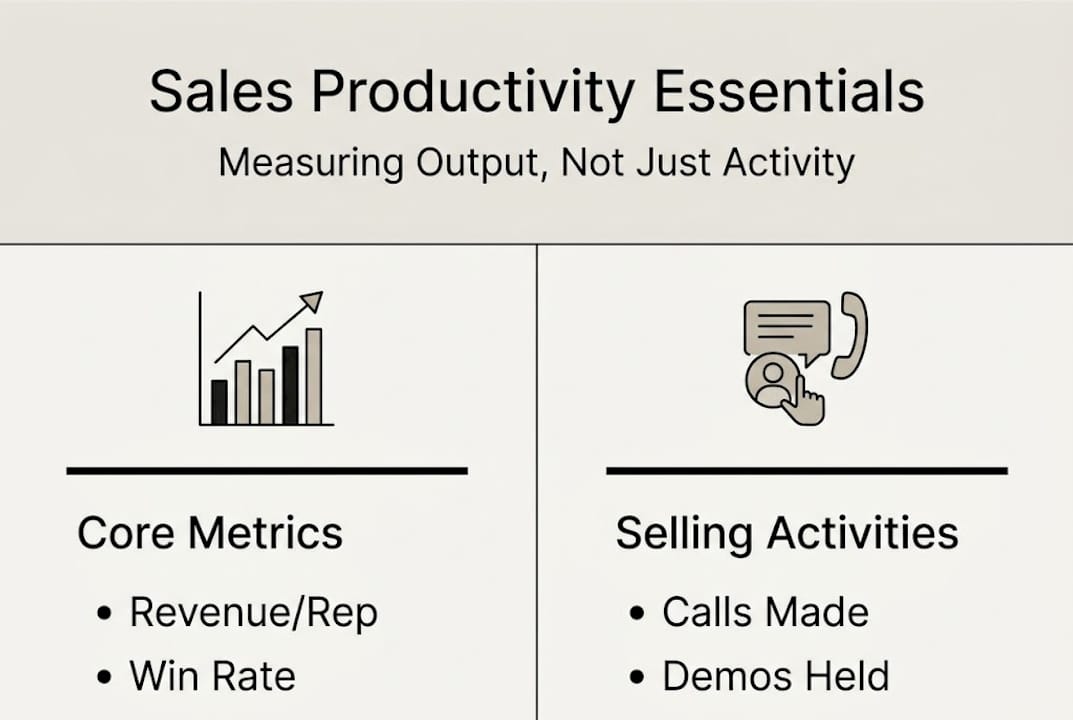
Here’s a quick benchmark snapshot to calibrate where your team stands:
| Metric | Benchmark | High Performer |
|---|---|---|
| Global quota attainment | 43% of reps | 70%+ |
| Reps hitting 100% quota | 28% | 50%+ |
| Deal margin vs. peers | Baseline | 2.5x higher |
| Time spent selling | 28-30% | 40-50% |
Those numbers are sobering. If fewer than 3 in 10 reps are hitting full quota globally, your challenge isn’t unique. But it is solvable.
To calculate sales productivity in a way that’s actually useful, follow these steps:
Productivity frameworks matter most as your team scales. What works with 5 reps breaks at 20. Formalizing your sales operation activities early prevents the chaos of reactive management later. And a structured sales performance review process gives you the data to coach, not just evaluate.
Pro Tip: Don’t let KPIs become a scoreboard that reps learn to game. Pair every quantitative metric with a qualitative check. Is the rep building real pipeline or just filling fields in the CRM? Context always matters.
While measurement matters, real-world productivity is often compromised by hidden issues rarely discussed in leadership meetings. Let’s name them.
First, the time problem. Over 50% of a typical sales rep’s week goes to activities that aren’t selling. CRM updates, internal reporting, chasing approvals, attending non-essential meetings, and formatting proposals. These tasks feel necessary. Many are. But they compound into a massive productivity drain.

| Selling activities | Non-selling activities |
|---|---|
| Discovery calls | CRM data entry |
| Product demos | Internal status meetings |
| Negotiation | Report generation |
| Stakeholder follow-up | Proposal formatting |
| Closing conversations | Compliance documentation |
Second, the quota problem. When quotas are unrealistic, reps don’t just underperform. They adapt in ways that hurt the business. Unrealistic quotas lead to gaming, including unauthorized account poaching, inflated pipeline entries, and short-term deal manipulation that damages customer relationships. This isn’t a character flaw. It’s a predictable response to a broken system.
Third, the AI trap. Everyone’s adding AI tools right now. But without proper implementation, AI often adds tasks rather than removing them. Reps end up reviewing AI outputs, correcting errors, and managing prompts on top of their existing workload. We’ve seen this play out repeatedly. Check out how to build AI sales workflows that actually reduce burden instead of adding to it.
Here are the hidden productivity killers we see most often:
The fix often starts with simplification. Fixing classic sales issues like these doesn’t require a massive overhaul. Sometimes a single process change unlocks hours of selling time per rep per week.
Pro Tip: Run a one-week time audit with your reps. Ask them to log every activity in 30-minute blocks. The results will surprise you and give you a clear, immediate action list.
With pitfalls exposed, here’s how sales leaders can turn those insights into measurable productivity gains. These aren’t theoretical. They’re the moves that consistently work in mid-sized European tech environments.
Start by mapping your buyer journey to your selling activities. Every stage of the customer’s decision process should have a corresponding rep action. If your reps are doing things that don’t map to a buyer stage, ask why. Often, it’s habit or internal politics, not customer need.
Next, apply Pareto thinking. Identify the 20% of admin tasks that consume 80% of non-selling time. Automate, delegate, or eliminate them. This alone can recover 5 to 8 hours of selling time per rep per week. That’s not a small number across a team of 10.
Here are the highest-impact actions you can take right now:
On the AI front, be selective. AI’s impact in sales is real, but only when tools are chosen to solve specific problems, not to look innovative. And when it comes to outreach, optimizing outreach for tech leaders means fewer, better-targeted touches, not more volume.
Pro Tip: Schedule a quarterly time audit for every rep on your team. Productivity isn’t a one-time fix. It drifts back toward admin-heavy patterns without regular recalibration.
Here’s the contrarian view we hold after working with dozens of tech sales teams across Europe: the obsession with activity metrics is one of the most expensive mistakes a sales leader can make.
When you optimize for calls made and emails sent, you train your team to optimize for calls made and emails sent. Not for revenue. Not for relationships. Not for strategic selling. You get a team that’s exhausted and underperforming, convinced they’re doing everything right because the dashboard looks busy.
The research backs this up. Better-performing teams don’t do more. They do less, but with sharper focus and better preparation. In the European tech context especially, where solution selling and long-term relationships drive ARR, volume approaches often actively damage trust with buyers who expect depth over frequency.
The real differentiator is skill development paired with systemic improvement. Coaching a rep to run a better discovery call is worth more than 20 extra cold emails per day. Fixing a broken handoff between BDR and AE recovers more pipeline than any outreach campaign. Staying current on strategic IT sales trends helps you lead with insight, not just effort. Structure beats heroics. Always.
If you’ve read this far, you already know that sales productivity isn’t fixed by working harder. It’s fixed by working smarter, with the right systems, the right coaching, and the right frameworks in place.

At Sales Label Consulting, we work with RevOps leaders, Heads of Sales, and VPs across European tech companies to build exactly that. From step-by-step sales enablement programs that create predictable revenue, to sales enablement best practices that your team can actually implement, to staying ahead with 2026 sales enablement trends shaping B2B growth. If your team is ready to move from theory to action, let’s talk about what a tailored program looks like for your stage and market.
Sales productivity is how effectively a sales team turns effort and resources into actual sales results. It’s about output quality, not just activity volume.
Research shows reps spend just 28-30% of their time on actual selling. The majority of the workweek goes to admin, reporting, and non-selling tasks.
Common metrics include revenue per rep, quota attainment, win rates, and time spent selling. Global quota attainment sits at just 43%, making benchmarking essential for context.
AI can increase productivity significantly, but AI intensifies workload when poorly deployed. The key is implementing it to solve specific friction points, not just to add capability.
Keeping quotas realistic and transparent is the foundation. Unrealistic quotas lead to gaming behaviors that damage pipeline integrity, so regular quota reviews tied to market conditions are non-negotiable.
Subscribe to our Insights: Expert productivity tips in your inbox
You'll receive 1-3 emails per month. Your data stays private, always.

CRO & Co-Founder with Sales Label Consulting

Watch our Sales Mates Podcast
October 11, 2026 - 7 min read
Read article Read articleOctober 10, 2026 - 8 min read
Read article Read articleOctober 9, 2026 - 7 min read
Read article Read articleOctober 8, 2026 - 10 min read
Read article Read article