
90 Day Win Loss Playbook for B2B Sales Leaders
Win-loss analysis is a structured program that turns every closed deal, won or lost, into intelligence your team can act on. Done right, it lifts win rates, sharpens forecast accuracy, and stops reps from repeating the same losing patterns quarter after quarter. The rest of this guide gives you the actual process: what to capture, who to interview, which metrics matter, and how to turn findings into battlecards your reps will use.
TL;DR:
- Conduct buyer interviews within two weeks of a loss deal to ensure fresh insights and focus on actual reasons rather than assumptions.
- Use a fixed taxonomy and structured rep self-report forms to enable consistent pattern detection across at least 200 deals per quarter.
- Incorporate call transcripts, email evidence, and market context into analysis to triangulate findings and avoid misleading conclusions.
- Update battlecards and sales scripts monthly based on coded interview patterns, assigning owners and measuring impact with one change at a time.
- Focus on ongoing, disciplined processes rather than one-off reviews to prevent data drifting into distrust and ensure continuous improvement.
Win-loss analysis is the practice of systematically studying closed deals, won, lost, and no-decision, to find the real reasons buyers chose what they chose. That last category matters more than most teams realize: a prospect who goes silent and never picks anyone is telling you something different than one who picked a competitor, and lumping the two together muddies your data.
This is not a deal review. A deal review is one rep talking to one manager about one opportunity, usually right after it closes, usually with a story that flatters the rep. Win-loss analysis is a program, not a meeting. It pulls from four separate signal layers, and each one catches something the others miss:
A complete win-loss program draws on all four layers together, then treats deeper buyer interviews as an additive layer on top of continuous capture rather than a replacement for it.
Most teams treat loss reasons as a box to check in the CRM. That box is usually wrong. CRM loss-reason dropdowns get filled out fast, by reps who are already moving to the next deal, and they routinely misrepresent what actually happened. Win-loss analysis fixes that by triangulating what the rep says against what the buyer says and what the call transcripts show.
The payoff shows up in three places at once. Companies that run sustained win-loss programs tend to see win-rate improvements and sharper product decisions, because wins get studied with the same rigor as losses instead of being high-fived and forgotten.
The beneficiaries reach past the sales floor:
Continuous capture beats a once-a-quarter scramble, every time. When you interview reps and buyers as deals close, you catch details while they’re still sharp. Wait a quarter, and everyone’s memory has already smoothed over the mess into a tidier story.
Timing inside that continuous rhythm still matters. Interview lost buyers within roughly two weeks of the decision, while the reasoning is still fresh and the relationship hasn’t gone cold. Give won deals more room, 30 to 60 days out, once the buyer has actually started using what they bought and can speak to whether the pitch matched reality.
Sampling rules keep the whole exercise honest:
Here’s the actual operating sequence. Skip a step and the whole program gets shakier.
Pro Tip: Build your rep self-report form with dropdown fields only, no free text for the primary reason. Free text feels thorough but it’s unusable at scale once you’re trying to count 200 closed deals.
Buyers open up to a neutral third party in a way they never will to the rep who just lost their business, or the one who just won it and might read too much into a compliment. That’s why the interviewer shouldn’t be anyone with a stake in the outcome.
Keep the script short, roughly 20 to 25 minutes, and built around laddering questions that dig past the first, socially acceptable answer. Ask about their buying process, not a verdict on your product. “Walk me through how your team evaluated vendors” gets you further than “what did you think of our demo.” A small incentive, a gift card or a donation to a cause they name, meaningfully lifts response rates without turning the conversation transactional.
On volume: aim for a practical number of interviews per quarter as a working operational target across a mid-size sales team. That’s enough to spot recurring language and real patterns. A smaller sample of 8 to 12 interviews gives you directional color, useful for a gut check, but not enough for a claim you’d put in a board deck. If you want statistically defensible numbers, plan for a deeper, ongoing sample and code it the same way every time.
Win rate alone tells you almost nothing. A win rate of 28% could be strong or weak depending entirely on your deal size, your segment, and what “normal” looks like for your sales motion. You need it sitting next to other numbers before it means anything.
| Metric | What it reveals | Compare against |
|---|---|---|
| Win rate | Overall conversion of qualified pipeline | Historical trend, top-performer rate |
| Pipeline velocity | Speed of deals moving stage to stage | Historical average by segment |
| Stage conversion rate | Where deals stall or drop | Industry benchmark, prior quarter |
| Pipeline coverage ratio | Whether pipeline volume supports the target | Target threshold (often 3x to 4x quota) |
| No-decision share | Deals lost to inertia, not a competitor | Historical baseline |
Pipeline velocity, stage conversion, and coverage ratio round out win rate into a real diagnostic. A dropping win rate paired with rising pipeline coverage often means marketing is filling the top of funnel with worse-fit leads, not that reps suddenly got worse at selling.
Never trust a metric shift on its own. If stage conversion drops at the demo stage, cross-check it against your buyer interviews before you conclude the product demo is broken. It might be broken. It might also be that your team started chasing a segment that never converts well at that stage, and the interviews will tell you which one it is.
A win-loss report nobody reads changes nothing. The goal is artifacts reps open every week, not a quarterly PDF that lives in a shared drive.
That last rule sounds almost too simple, and that’s the point. Programs that try to fix five things at once can never tell you which fix actually worked. Ship one change, watch loss-reason share or stage conversion for a month, then move to the next fix. Our internal work on pipeline optimization follows the same logic: small, measured, attributable changes beat big rewrites nobody can trace back to a result.
Pro Tip: Print the current month’s “one change” on a single page and pin it in whatever channel your reps live in. If they can’t name the current change, it isn’t operational yet, it’s just a document.
Most programs don’t fail loudly. They fail by drifting into a state where nobody trusts the data, and then nobody bothers running it anymore.
The usual failure modes: drawing conclusions from eight interviews and presenting them as company-wide truth, letting the cadence slip from monthly to “whenever someone remembers,” and taking a rep’s stated loss reason at face value because it’s easier than checking the call recording.
Triangulating buyer interview, rep report, and call evidence together is the single most reliable safeguard against optimizing for the wrong reason, because each layer catches what the other two are inclined to smooth over.
Consulting firms have built programs for B2B tech teams that needed loss reasons they could actually act on, not just log. The checklist that holds up in practice: a five-field rep self-report on every closed deal, buyer interviews within two weeks of a loss and 30 to 60 days after a win, a taxonomy that stays fixed for a full year, and a named owner for every recurring theme.
A 90-day starter plan looks like this: weeks 1 to 2, build the rep self-report form and taxonomy; weeks 3 to 8, run interviews and code themes as they come in; weeks 9 to 12, ship the first battlecard update and measure the shift. Our sales process checklist walks through the same kind of staged rollout for teams tightening their process end to end.
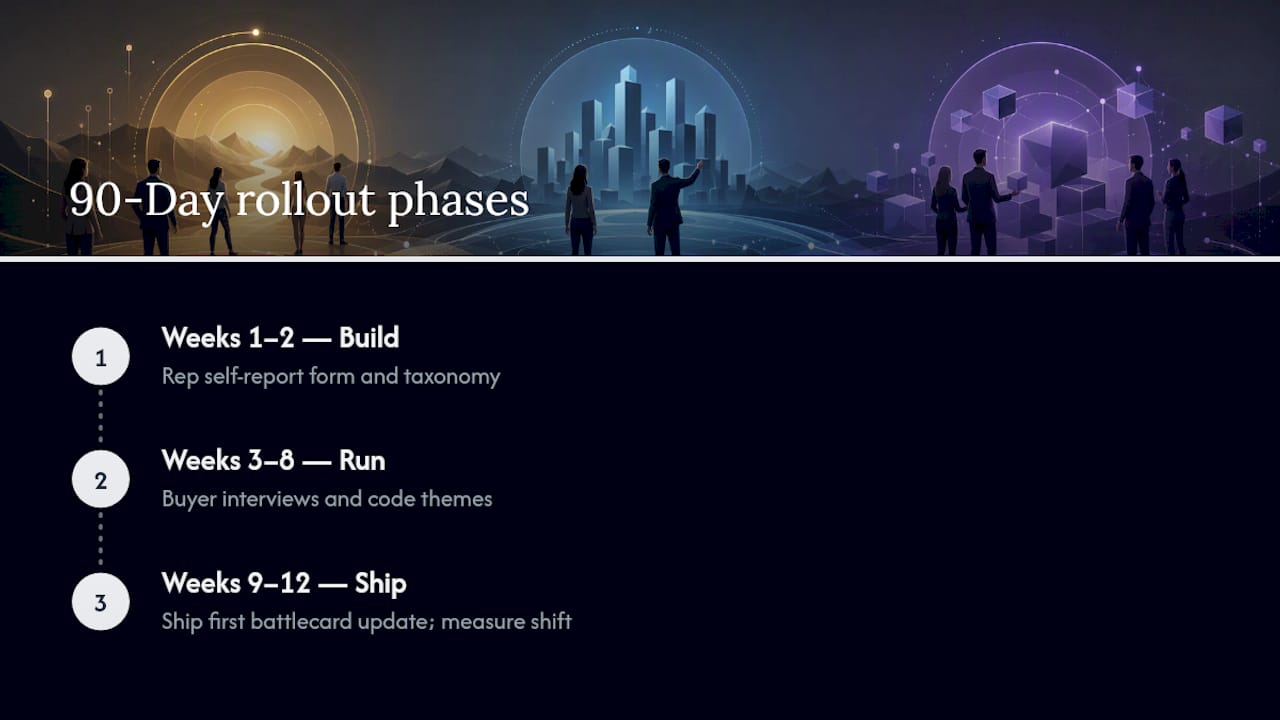
Three moves matter more than anything else in the first quarter. First, standardize rep self-report capture on every closed deal, no exceptions, starting this week. Second, run ten buyer interviews before you touch a single battlecard, you need real evidence before you edit anything reps rely on. Third, update exactly one battlecard based on what you heard, and leave the rest alone for now.
Measure success narrowly: track whether your top loss-reason category shifts in share over the next quarter, or whether reps are actually opening the updated battlecard. Adoption of one artifact beats a beautiful report nobody reads.
— Antony
Standing up a win-loss program on top of a full sales calendar is where most of this stalls, not the concept, the execution. Operational scaffolding, rep self-report forms, interview cadences, coded taxonomies, and battlecard update cycles can be built to help a RevOps or Head of Sales team get a working program in weeks instead of a stalled initiative that never survives the first busy quarter.
A typical engagement starts with a sales audit to map where your current loss reasons are getting lost in translation, then moves into sales enablement work to turn findings into scripts and battlecards your reps actually open. Deliverables in the first 90 days may include a standardized capture form, a fixed taxonomy, and at least one shipped artifact update tied to a measurable metric. If your loss reasons still live in a CRM dropdown nobody trusts, start with a sales audit and get a clear picture of what’s actually happening in your pipeline before you build anything on top of it.
Subscribe to our Insights: Expert productivity tips in your inbox
You'll receive 1-3 emails per month. Your data stays private, always.

CRO & Co-Founder with Sales Label Consulting

Watch our Sales Mates Podcast
September 6, 2026 - 10 min read
Read article Read articleSeptember 5, 2026 - 8 min read
Read article Read articleSeptember 4, 2026 - 9 min read
Read article Read articleSeptember 3, 2026 - 9 min read
Read article Read article