
Prove ABM Pipeline in 90 Days: Program Design for Sales & RevOps
The winning model is simple to state and hard to fake: a tiered, account-first program built on one locked account list, SLAs both teams actually own, and pipeline velocity as the single shared metric. Everything else, from ICP scoring to channel sequencing, exists to feed that structure. Get the tiers, the playbook, and the 90-day proof point right, and scale comes easy.
TL;DR:
- Develop a clear operational playbook with documented SLAs, signal-response protocols, and synchronized channel sequencing to ensure consistent execution across teams.
- Focus on account-level metrics such as engagement scores, pipeline velocity, and deal size lift, rather than traditional lead-based KPIs like MQLs, to accurately measure success.
- Reassess your ABM program at least every 90 days, using pipeline velocity and engagement trends to identify and fix strategy or process issues early.
- Establish weekly account standups and a single owner for the playbook to maintain alignment, accountability, and continuous improvement across sales and marketing teams.
Before you sign off on any ABM proposal, run it against this list. If a section is missing, the program isn’t ready to fund.
Skip governance and you get a beautiful playbook nobody follows past week three. That’s the most common failure mode we see, and it has nothing to do with tooling.
Your ideal customer profile needs to score three signal types together: firmographic fit (industry, revenue band, headcount), technographic fit (the stack they run, integration compatibility), and behavioral intent (content consumption, hiring signals, competitor displacement moments). Fit alone tells you who could buy. Intent tells you who’s likely to buy soon. ZoomInfo’s ABM playbook treats merging these two signal types as the step that turns a generic list into a prioritized one.
Resist the urge to build a massive list on day one. Tier 1 work is genuinely one-to-one, which means capacity, not ambition, should set your account count. Twenty to forty Tier 1 accounts is plenty for most B2B tech teams starting out.
Pro Tip: Pull the last 20 deals you closed and reverse-engineer which signals actually preceded them. A signal that looks good in a vendor’s case study might mean nothing for your business.
Tier structure isn’t a naming exercise. It’s a budget allocation decision disguised as strategy.
Sales typically owns the outreach cadence and account intelligence at Tier 1, while marketing owns asset production across all three tiers and increasingly owns execution alone at Tier 3. The most common budgeting mistake is over-investing in Tier 2 or 3 because it feels safer to spread resources thin than to commit hard to a short Tier 1 list.
Pro Tip: Watch for tier creep. If your Tier 1 list balloons past what sales can genuinely personalize, you’ve quietly turned it into Tier 2 with better branding.
A strategy deck isn’t a playbook. A playbook is the document your BDRs, AEs, and marketers actually open when a signal fires. DemandScience’s framework for operationalizing ABM covers six areas your documentation needs: account selection rules, engagement models by tier, signal-response protocols, content inventory, handoffs, and escalation paths.
Concrete SLAs prevent the whole thing from decaying into “someone should probably reach out.” A workable Tier 1 example: executive intro within 5 business days of a qualifying signal, BDR outreach within 24 hours, and a custom asset deployed within 7 days.
Channel sequencing matters as much as channel selection. A common working order:
Synchronize timing across teams. A cold outbound email landing the same week as a warm ad sequence looks coordinated. Landing it three weeks off looks like two departments who’ve never met.
Assign a single playbook owner, run weekly account-level standups on your Tier 1 list, and treat the document as living. Update it the moment a signal-response rule or content asset changes, or it stops being true within a quarter.
Retire the MQL. In an account-based motion, a single marketing-qualified lead tells you almost nothing about whether the account is moving toward a deal. The metrics that matter operate at the account level.
Review account engagement and pipeline velocity weekly in standups; save ACV lift and win-rate comparisons for monthly QBRs where you have enough closed data to matter. When auditing your pipeline, separate influenced pipeline (accounts that saw ABM touches) from sourced pipeline (accounts ABM identified first). Practitioner research on ABM programs that miss ROI points to exactly this confusion as the reason so many dashboards look great while revenue doesn’t move.
Prove it fast or fix it fast. Here’s the sequence:
Pro Tip: If your Tier 1 accounts haven’t shown any stage movement by day 60, don’t wait for day 90 to intervene. Fix the SLA or the signal, not the whole strategy.
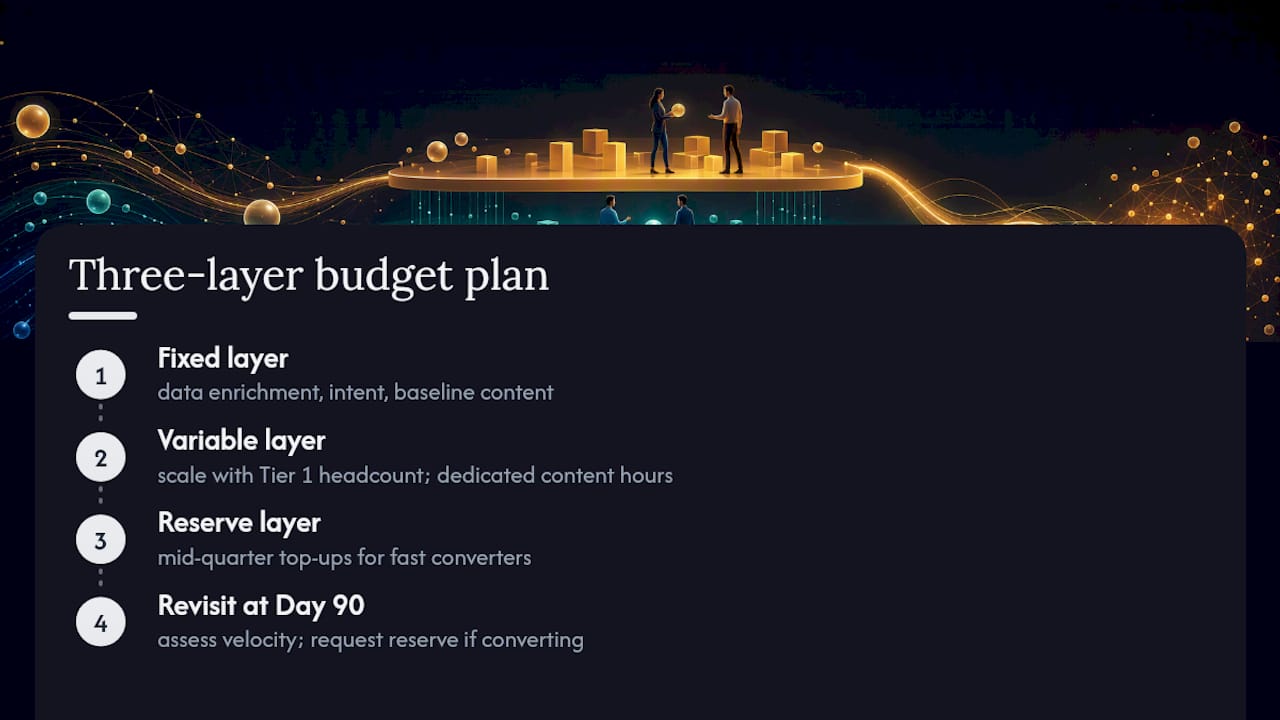
The launch budget gets approved easily. The renewal budget is where programs die, mostly because leaders never planned past the pilot. Build your budget in three layers from the start: a fixed layer (data enrichment, intent tools, a content production baseline), a variable layer tied to Tier 1 headcount (the more true one-to-one accounts you run, the more content and executive time you need), and a reserve layer for the accounts that convert faster than expected and deserve more investment mid-quarter.
Most teams underfund the second layer. They budget for the launch sprint and assume ongoing content production will just happen inside existing marketing capacity. It won’t, not at the personalization level Tier 1 requires. Plan for dedicated content hours per Tier 1 account, not a shared pool everyone assumes someone else is filling.
Resource planning also means headcount timing, not just dollars. A BDR assigned to 15 Tier 1 accounts with a 24 hour outreach SLA needs enough calendar space to actually hit it. If your current team is stretched across a broader pipeline, either shrink the Tier 1 list or add capacity before launch, not after the SLA starts slipping.
Revisit the budget at the day-90 QBR alongside your pipeline velocity numbers. If Tier 1 is converting well, that’s your evidence to request the reserve layer for Tier 2 expansion. If it isn’t, that’s your evidence to hold the line rather than throwing more spend at a structure that isn’t working yet.
Personalization has to scale down as your tier number goes up, or your content team burns out by month two. Tier 1 accounts deserve genuinely bespoke assets: a one-pager referencing their specific tech stack, a case study from a comparable company, an executive video addressed by name. That level of effort is sustainable for twenty to forty accounts. It is not sustainable for two hundred.

Tier 2 personalization should work at the cohort level. Group accounts by shared attributes, whether that’s industry vertical, company size, or a specific pain point your product solves, and build one strong asset per cohort instead of one per account. Tier 3 personalization leans on templated content with dynamic fields: account name, industry benchmark data, or a relevant integration mentioned automatically rather than hand-written.
Content alignment between sales and marketing matters more than content volume. If a BDR is sending a generic outbound email while marketing runs a highly personalized ad campaign to the same account, the account experiences two different companies talking to them. Build a shared content calendar by account or cohort so both teams reference the same messaging arc at the same time.
One overlooked lever: ask your sales team which content actually gets referenced in live conversations. Marketing often keeps producing assets that look sharp in a review meeting but never come up on a call. A quarterly check on which pieces sales actually uses will tell you where to keep investing and where to quietly stop.
ABM fails politically before it fails operationally. Sales teams that have run a volume-based motion for years often see account-based work as slower and more labor-intensive, and at the start, it usually is. RevOps leaders who skip the internal sell find themselves running a program on paper that nobody executes in practice.
Start buy-in with the people whose daily work changes most: your AEs and BDRs assigned to Tier 1 accounts. Show them the SLA structure and how it protects their time rather than adding to it. A clear signal-response rule means they’re not guessing when to reach out. That’s a relief, not a burden, once they see it in action.
Executive buy-in needs a different argument: capacity discipline. Leaders sometimes want a broad account list because it feels like more coverage. Make the case directly that a shorter, well-resourced Tier 1 list produces better pipeline velocity than a sprawling list nobody can personalize properly. TechTarget’s analysis of common ABM headwinds points squarely at misaligned goals and unclear ownership as recurring blockers, and both are buy-in problems before they’re execution problems.
Run the weekly account standup as the buy-in mechanism itself. When sales and marketing sit in the same room reviewing the same ten accounts every week, alignment stops being a values statement and becomes a habit.
ABM isn’t a separate motion running parallel to your existing marketing and sales strategy. It’s a resourcing decision about which accounts get concentrated investment versus which get broader, lighter-touch coverage. Treat it as an island program and you’ll end up with two GTM strategies competing for the same budget and the same sales attention.
The cleanest integration point is your existing pipeline stages. Rather than inventing new stage definitions for ABM accounts, map Tier 1 and Tier 2 accounts onto the pipeline stages your RevOps team already tracks, and layer account engagement scoring on top as an additional qualification signal. This keeps your forecasting model intact while still giving you the account-level visibility ABM requires.
Outbound and demand generation should feed the same account list rather than running separate targeting logic. If your demand gen team is generating inbound interest from accounts that aren’t on your ABM list, that’s either a sign your ICP needs revisiting or a sign demand gen is casting too wide a net relative to what sales can follow up on with the SLA rigor Tier 1 accounts require.
The same logic applies to your outbound playbook: the account-based sales development motion your BDRs run should reference the same tiers and the same signal thresholds as your marketing plays, not a separate cadence built independently. One account list, one set of tier definitions, multiple teams executing against it.
A program frozen at its day-90 design will underperform within two quarters. Buying signals shift, competitors change their positioning, and the accounts that responded well to your Tier 1 messaging in Q1 might need a different angle by Q3. Build the feedback loop into your governance cadence from the start rather than treating optimization as a separate initiative you’ll get to later.
The simplest feedback loop runs off your weekly standups: track which signal-response rules actually preceded stage movement and which ones triggered outreach that went nowhere. If a signal type consistently fails to predict engagement, drop its weight or remove it entirely rather than letting it clutter your scoring model. Abmatic’s iterative framework treats quarterly reassessment of signal weights and content performance as a standard step, not an optional add-on.
Monthly QBRs are where you catch structural drift: tier creep, SLA slippage, or a content library that’s gone stale relative to what accounts are actually asking about. Bring pipeline velocity trends into every QBR and ask a blunt question: is the trend line moving in the direction that justifies the resourcing this program consumes? If not, that’s your cue to tighten the account list or rework the playbook before the next quarter, not after another two quarters of flat results.
The programs that stall almost never fail on strategy. They fail on the handshake between sales’ active coverage list and marketing’s target list. Fix that overlap before buying another platform. Weekly standups, one playbook owner, and a ruthless pipeline audit catch more revenue than any new tool. In our Bank PUMB engagement, tightening exactly that governance layer, not adding technology, is what moved the needle.
— Antony
Most ABM proposals stall at the strategy deck. Sales Label Consulting runs the full arc: audit your current account coverage, build the playbook, pilot it against a locked Tier 1 list, then scale once pipeline velocity proves the model works.
The engagement produces what most internal teams never get around to documenting: a jointly owned account list, concrete SLAs your BDRs and AEs actually follow, and a measurement dashboard built around pipeline velocity instead of MQL counts. Clients typically see faster movement through the pipeline on Tier 1 accounts and a repeatable operating model their team can run without outside help once the pilot proves out.
If your current ABM effort looks more like a strategy document than an operating system, start with a sales enablement audit built for predictable revenue and get a straight read on where your coverage gaps actually are.
Subscribe to our Insights: Expert productivity tips in your inbox
You'll receive 1-3 emails per month. Your data stays private, always.

CRO & Co-Founder with Sales Label Consulting

Watch our Sales Mates Podcast
October 24, 2026 - 8 min read
Read article Read articleOctober 23, 2026 - 10 min read
Read article Read articleOctober 22, 2026 - 9 min read
Read article Read articleOctober 21, 2026 - 9 min read
Read article Read article