
Why Sales Playbooks Matter for IT Sales Leaders
TL;DR:
- A sales playbook is a documented system that captures proven sales behaviors to ensure consistent performance and predictable revenue. Building it from real deal data after 10–20 closed deals and updating it quarterly improves team scaling, coaching, and pipeline accuracy. Neglect and over-complexity are common pitfalls, but embedding the playbook into daily workflows keeps it effective.
A sales playbook is a documented execution system that captures proven sales behaviors, enabling faster rep ramp-up, consistent coaching, and predictable revenue growth. For IT sales leaders, this distinction matters more than it sounds. Most teams treat a playbook as a reference document. The ones winning deals treat it as the operating system their entire sales motion runs on. Understanding why sales playbooks matter is the difference between a team that scales and one that stays dependent on a few top performers.
A sales playbook is not a training manual. It’s the codified version of what your best reps do when they close deals. According to Sybill AI, structured playbooks correlate with higher win rates, faster ramp, and more predictable pipeline movement. Teams relying on rep intuition alone consistently underperform against teams running a defined playbook.

The real talk here: most IT sales teams don’t have a playbook problem. They have an execution problem disguised as a talent problem. When deals stall or reps give inconsistent demos, the instinct is to hire better people. The actual fix is capturing what your best people already do and making it repeatable.
A playbook also shifts management from gut feel to data. Sybill AI describes this as moving from impressions to data-driven coaching, where managers can evaluate why deals won or lost based on defined plays. That’s the kind of coaching clarity that actually changes rep behavior.
The most effective playbooks are built from patterns in actual closed-won deals, not theory. That’s the foundation. Everything else flows from real deal data.
Allston Labs identifies the core playbook components every IT sales team needs:
Format matters as much as content. Allston Labs is direct: playbooks longer than 20 pages reduce adoption. Reps stop referencing them during live deals. The target is 10–20 pages, tight enough to actually use.
Pro Tip: Build your objection library directly from call recordings. Pull the exact language prospects use, not the polished version you think they use. Reps recognize the real thing immediately.
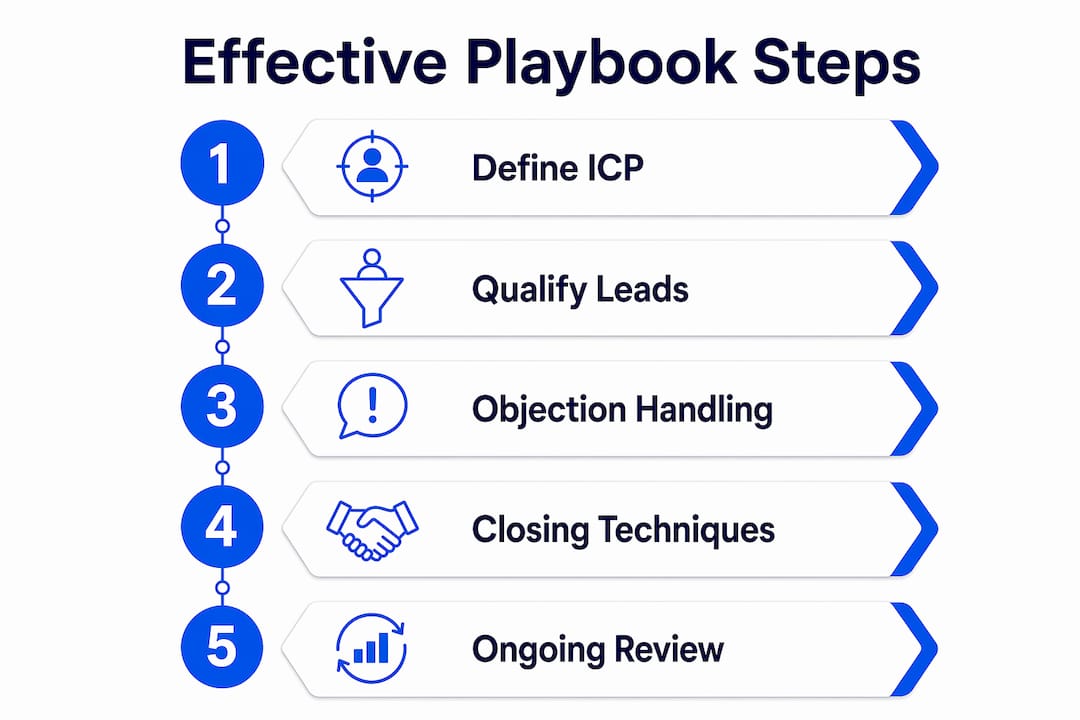
This is where the importance of sales playbooks becomes undeniable for IT companies. Founder-led sales works until it doesn’t. The moment you need to hire your second or third rep, you face a brutal reality: the knowledge that closes deals lives in one person’s head.
Outsales frames this precisely. Sales playbooks extract tacit expert knowledge from top performers and convert it into standards the whole team can execute. That’s not just an onboarding benefit. It’s a structural shift in how your sales org operates.
“A sales playbook is the critical tool for transferring founder knowledge into scalable sales team processes, bridging the gap from individual hero sales to systematized growth.” — Outsales
The benefits of this transition show up in four concrete ways:
The scalable sales motion you’re building depends on capturing what works before the founder moves into a different role. Wait too long and that knowledge walks out the door.
Most playbooks fail for one of three reasons. Knowing them in advance saves you months of wasted effort.
Building too early. Allston Labs is clear: building before closing 10–20 deals produces a document based on untested theory. Pattern recognition requires actual patterns. If you haven’t closed enough deals across multiple ICP variants, you’re writing fiction.
Making it too long or too rigid. A 40-page playbook is a shelf document. Reps don’t open it mid-call. Overly rigid scripts also backfire. Reps need a framework, not a teleprompter. The best playbooks give structure with room for judgment.
Neglecting it after launch. Outsales identifies neglect as the most common failure point. A playbook written in Q1 2025 and never updated is actively misleading your reps by Q3. Markets shift. Products change. ICPs evolve. Your playbook has to keep up.
Pro Tip: Assign a playbook owner, not just a creator. Someone on your team should be responsible for quarterly reviews, rep feedback collection, and version control. Without ownership, the playbook dies.
The fix for all three pitfalls is treating the playbook as a living system. Outsales recommends using AI tools to surface play guidance in real time rather than relying on static PDFs. Tools that prompt reps during live calls or deal reviews keep the playbook active in daily workflow, not buried in a shared drive.
Building a playbook that actually gets used requires discipline on both the front end and the back end. Here’s the practical framework.
Before you write a single word:
While you’re building:
After launch:
| Maintenance action | Recommended cadence |
|---|---|
| Full playbook review | Quarterly |
| Objection library update | After every major product change |
| ICP refinement | After every 10 new closed-won deals |
| Rep feedback collection | Monthly |
| Win/loss analysis integration | Ongoing |
Allston Labs recommends quarterly updates to reflect market, product, and ICP changes. That cadence keeps the playbook relevant without creating a constant revision burden. Use your sales playbook checklist to track what needs updating each quarter.
The IT sales teams that get this right don’t just have better playbooks. They have better conversations, shorter sales cycles, and reps who actually know what to do when a deal goes sideways.
Sales playbooks are execution systems, not documents. IT sales teams that build them from real deal data, keep them concise, and update them quarterly consistently outperform teams that rely on individual rep intuition.
| Point | Details |
|---|---|
| Playbooks are execution systems | Build from closed-won deal patterns, not theory or assumptions. |
| Ideal length is 10–20 pages | Longer playbooks reduce rep adoption and live-deal reference. |
| Start after 10–20 closed deals | Early playbooks built on untested theory produce ineffective guidance. |
| Neglect is the top failure cause | Assign a playbook owner and schedule quarterly reviews without exception. |
| Embed into daily workflow | AI tools that surface guidance in real time outperform static PDF playbooks. |
Here’s the uncomfortable truth I’ve seen repeatedly: most IT sales leaders know they need a playbook. They just keep waiting for the “right time” to build one. That time never comes on its own.
The teams I’ve worked with that made the fastest progress shared one trait. They stopped treating the playbook as a project and started treating it as infrastructure. You wouldn’t run your CRM without a defined pipeline stage structure. Your playbook deserves the same level of permanence.
The other thing I’d push back on is the idea that playbooks constrain good sellers. The best reps I’ve seen actually love a tight playbook. It removes the cognitive load of figuring out what to do next. They can focus on reading the prospect instead of remembering the process. Structure doesn’t kill creativity. It frees it up.
One more thing worth saying directly: a playbook without coaching integration is just a document. The real value shows up when managers use it as a coaching reference during deal reviews. When a rep loses a deal, the question isn’t “what happened?” It’s “which play broke down and why?” That shift in conversation changes everything about how your team improves. If you want to see what that looks like in practice, the IT sales team mastery guide covers the coaching and structure side in depth.
— Antony
Saleslabelconsulting works directly with RevOps leaders, Heads of Sales, and VPs of Sales at IT companies to build sales playbooks that actually get used. Not shelf documents. Not theoretical frameworks. Execution systems built from your real deal data, calibrated to your ICP, and embedded into your team’s daily workflow.

If your team is scaling past founder-led sales or you’re seeing inconsistent results across reps, the playbook is usually where the fix starts. Saleslabelconsulting’s sales enablement for predictable revenue program walks you through the full build, from ICP definition to quarterly review cadence. You get a playbook your reps will actually reference, and a process for keeping it current as your market evolves.
A sales playbook is a documented execution system that captures proven sales behaviors, including ICP definitions, qualification criteria, discovery questions, demo flows, and objection responses. It gives sales reps a repeatable framework for closing deals consistently.
IT sales teams use playbooks to transfer founder or top-rep knowledge into a format the whole team can execute. This reduces ramp time, improves coaching consistency, and creates more predictable pipeline movement.
The ideal length is 10–20 pages. Playbooks longer than 20 pages see lower adoption because reps stop referencing them during live deals.
Build your first playbook after closing 10–20 deals across multiple ICP variants. Building earlier produces a document based on untested theory rather than real deal patterns.
Sales playbooks should be reviewed and updated quarterly to reflect changes in your market, product, and ICP. Neglect is the most common reason playbooks become obsolete and stop driving results.
Subscribe to our Insights: Expert productivity tips in your inbox
You'll receive 1-3 emails per month. Your data stays private, always.

CRO & Co-Founder with Sales Label Consulting

Watch our Sales Mates Podcast
October 15, 2026 - 9 min read
Read article Read articleOctober 14, 2026 - 7 min read
Read article Read articleOctober 13, 2026 - 10 min read
Read article Read articleOctober 12, 2026 - 11 min read
Read article Read article