
Why Sales Training Is Crucial for Revenue Leaders
Sales leaders across Europe know the pressure to grow revenue while keeping their teams sharp and motivated. The challenge is not just hiring skilled reps, but giving them a structured approach to build real competence and confidence. Effective sales training empowers salespeople with new knowledge and skills, leading to measurable improvements in performance and revenue. Discover practical methods to ensure your training translates into stronger results and aligns with your broader RevOps strategy.
| Point | Details |
|---|---|
| Continuous Learning is Key | Sales training should be ongoing, helping salespeople apply learned techniques in real-world situations to drive revenue. |
| Customized Training Methods | Use a mix of training formats to cater to different learning styles and experience levels, ensuring effective knowledge retention. |
| Align Training with Business Goals | Directly map sales training initiatives to revenue goals, focusing on skills that address specific challenges faced by the team. |
| RevOps Integration | Ensure sales training aligns with the broader RevOps strategy, fostering collaboration and consistency across sales, marketing, and customer success teams. |
Sales training is far more than checking a box on your onboarding checklist. It’s a structured approach to building competence in your team—teaching them the techniques, product knowledge, and customer mindset they need to actually close deals and retain clients.
At its core, sales training aims to empower salespeople with new knowledge and skills to improve competence, capacity, and performance. But here’s where most leaders get it wrong: they treat training as a one-time event. Real training creates what researchers call “transfer of learning”—meaning your team applies what they learned back on the job, where it actually drives revenue.
Think of it this way. You can teach someone every objection-handling technique in the book, but unless they practice it with real prospects, it doesn’t stick. Effective sales training bridges that gap between knowledge and real-world application.
Here’s what modern sales training actually encompasses:
The purpose goes deeper than just teaching tactics. Quality training boosts employee performance, increases productivity, builds confidence in your reps, and ultimately fosters customer loyalty. For a mid-sized tech company, that translates directly to shorter sales cycles, higher close rates, and lower churn.
Here’s the real talk: your reps can’t execute a strategy they don’t understand. They can’t confidently pitch a solution if they don’t deeply grasp the market problem. They can’t build trust with prospects if they lack the communication framework to do it. Sales training fills those gaps systematically.
The difference between companies that grow predictably and those that stumble often comes down to this—do they treat sales training as a one-time cost, or as a continuous competitive advantage?
Pro tip: Map your sales training directly to your revenue goals. If your challenge is improving deal size, focus training on upsell techniques and value-based selling. If it’s shortening sales cycles, invest in discovery and qualification skills. Always connect training back to the business outcome you’re chasing.
There’s no one-size-fits-all approach to sales training. Your team learns differently depending on their experience level, learning style, and the complexity of what you’re teaching. The best programs combine multiple formats to maximize retention and application.
Let’s break down the primary methods revenue leaders use today:
Instructor-led training remains the gold standard for building foundational knowledge. A skilled trainer can read the room, answer questions in real time, and adapt the pace based on your team’s understanding. It’s especially effective for onboarding new reps or introducing major methodology changes.
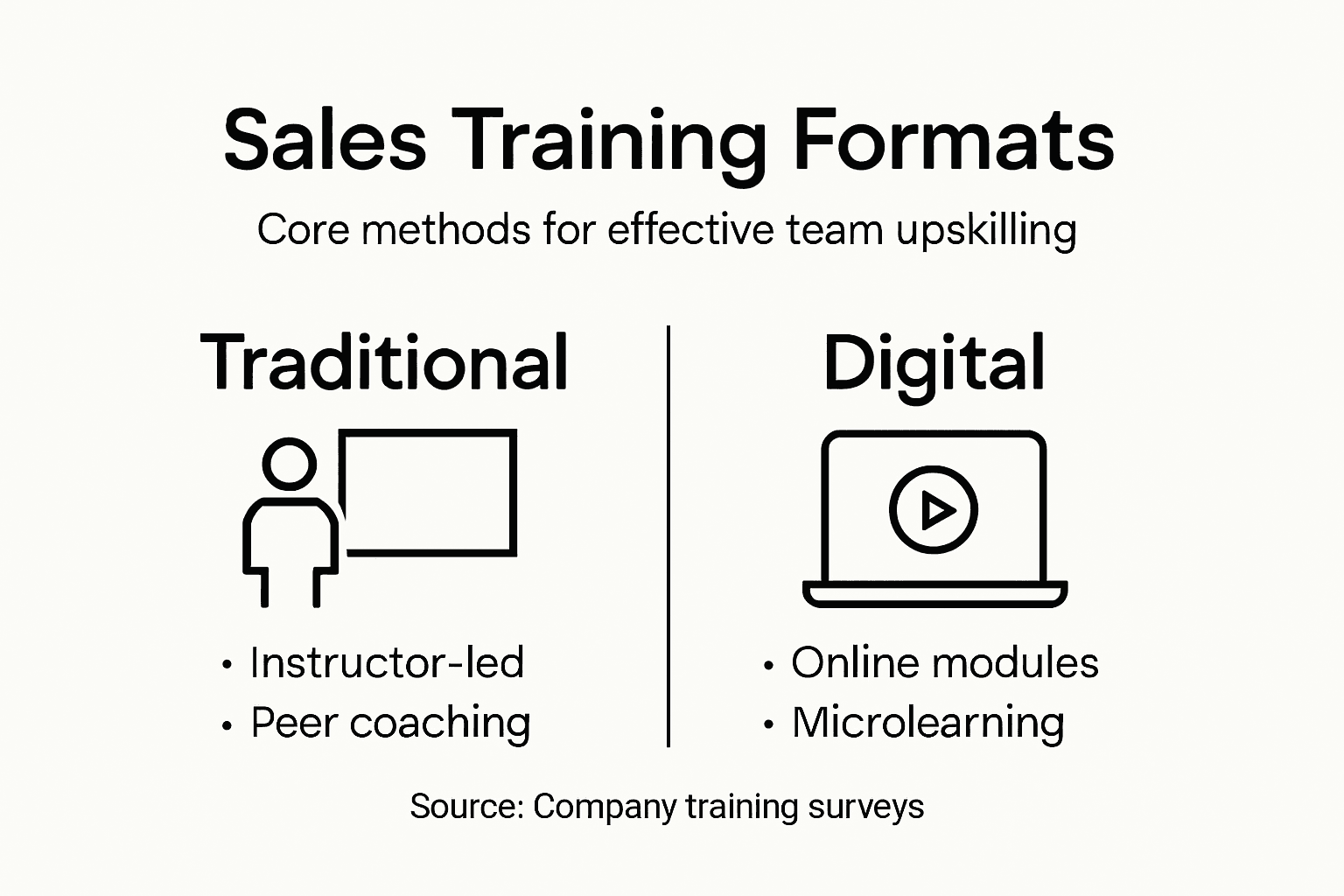
Self-paced online modules work well for flexible, just-in-time learning. Your reps can review product updates, refresh objection-handling techniques, or learn new tools whenever they need it—without blocking calendar time. This format scales easily across distributed teams.
Role-playing and simulations drive real behavioral change. When your team practices discovery calls with peers or coaches, they build muscle memory. This is where learning actually transfers to the sales floor. Effective sales training methods emphasize this hands-on practice component heavily.
Peer-to-peer coaching leverages your top performers. Pair high achievers with struggling reps for regular one-on-ones focused on specific skills. It builds team cohesion and gives struggling reps personalized attention that group training can’t provide.
Microlearning fits modern attention spans. Short, focused videos or modules on single topics (handling price objections, using a specific CRM feature) work better than lengthy courses. Your team consumes them between calls and actually remembers the content.
Here’s a comparison of popular sales training methods and their best use cases:
| Method | Ideal For | Key Advantages |
|---|---|---|
| Instructor-led Training | Onboarding, complex concepts | Real-time feedback, customization |
| Self-paced Modules | Continuous learning, quick updates | Flexibility, easy scalability |
| Role-playing/Simulations | Skill application, confidence building | Safe practice, behavioral change |
| Peer Coaching | Improving weak areas, team bonding | Personalized, builds trust |
| Microlearning | Reinforcement, focused topics | High retention, minimal disruption |
Here’s what actually works in practice:
The most effective training programs don’t rely on a single format. They layer methods together, starting with understanding, moving to practice, then reinforcing through real-world application.
The format you choose depends on your goals. Building new competency? Go instructor-led plus role-play. Maintaining skills? Microlearning works. Fixing specific gaps? Peer coaching and targeted modules.
Pro tip: Measure which formats actually stick by tracking metrics after training. Did call quality improve after role-play sessions? Are reps using the techniques from microlearning modules? Use data to double down on what works and eliminate what doesn’t for your specific team.
Sales training isn’t a soft skill investment—it directly impacts your bottom line. When your team has the right knowledge and techniques, they close deals faster, handle objections better, and build stronger customer relationships. The numbers prove it.

Sales training increases sales effectiveness across multiple dimensions. Your reps improve close rates because they understand buyer psychology and can position solutions more convincingly. They shorten their ramp-up time, meaning new hires contribute sooner. They upsell and cross-sell more confidently because they know the full product picture.
Here’s what measurable improvements look like in practice:
The revenue impact compounds. Let’s say you have ten reps closing 50 deals monthly at 25% close rate. That’s 125 total deals. With training that improves close rates to 30%, you’re hitting 150 deals—a 20% revenue boost without adding headcount.
But there’s more happening beneath the surface. Employee training and development significantly impact organizational efficiency by improving skills, knowledge, and motivation. Your team members who feel competent perform better. They stay longer. They mentor others. They take ownership of their numbers instead of waiting for luck.
Well-trained teams don’t just hit targets—they exceed them consistently because they understand the strategy, master the execution, and stay motivated.
At mid-sized tech companies, we consistently see trained teams outpace untrained teams by 40-60% in annual quota achievement. That’s not hypothetical. That’s what happens when salespeople understand your solution, can articulate value, and actually know how to navigate the buying process.
Team results extend beyond revenue too. Your top performers spend less time in firefighting mode. Your struggling reps have frameworks instead of frustration. Your manager has coaching conversations instead of performance management crisis meetings.
The best part? This compounds year after year. Each generation of reps starts more competent than the last because they learn from documented processes, recorded calls, and peer coaching.
Below is a summary of measurable business impacts from effective sales training:
| Result Area | Typical Measured Outcome | Strategic Benefit |
|---|---|---|
| Close Rate | 5-15% improvement | Higher revenue per rep |
| Sales Cycle Length | 30-45% reduction | Quicker revenue recognition |
| Rep Ramp Time | Faster onboarding to productivity | Lower turnover, lower costs |
| Customer Retention | Noticeably improved loyalty | Long-term revenue growth |
| Team Performance Gap | 40-60% quota outperformance | Competitive advantage |
Pro tip: Track three metrics after rolling out training: win rate improvement, average sales cycle length, and new rep ramp-time to first closed deal. These three numbers tell you exactly where training is working and where your team needs reinforcement.
Most sales training programs fail not because the content is weak, but because leaders make predictable mistakes during design and execution. Knowing what to avoid saves months of wasted effort and budget.
The biggest mistake? Running training without clear objectives. You can’t measure success if you don’t define what success looks like. Are you improving close rates? Shortening ramp time? Fixing a specific skill gap? Start there, then build backward.
Common mistakes causing training failure include undefined objectives and lack of customization. One-size-fits-all programs don’t work because your senior reps don’t need the same content as new hires. Your inside sales team has different needs than your enterprise hunters.
Here are the pitfalls that derail training programs:
Another critical error: front-loading all training upfront. Your new rep gets buried in information week one, forgets most of it by week three. Spread training across the first 90 days instead. Teach discovery this week, objection handling next week, closing techniques the week after.
Training fails when it’s disconnected from the actual sales environment. Your reps need to practice with real scenarios, real objections, and real account situations they’ll face on day one.
Missing reinforcement is silent killer. Training content degrades quickly if you don’t revisit it. Monthly skill drills, recorded call reviews, and peer coaching sessions keep techniques fresh and top-of-mind.
Don’t assume your training translates into behavior change. Some reps will ignore new techniques because “that’s not how I’ve always done it.” You need accountability structures—manager coaching, peer accountability, or performance metrics tied to training.
Lastly, skipping the quiet reps. Introverts in group training often stay silent and leave confused. Build one-on-one coaching time into your program for individuals who need personalized attention.
Pro tip: Before rolling out training, pilot it with five high-performers and five struggling reps. Their feedback shows you exactly what’s unclear, what feels disconnected from reality, and where you need more practice time before full team deployment.
Sales training in isolation doesn’t drive the results you need. It has to connect directly to your RevOps strategy—the integrated approach that aligns sales, marketing, and customer success around predictable revenue growth.
Here’s the disconnect most leaders miss: you train your reps on closing techniques, but they’re not using the same data framework as your marketing team. You teach discovery methodology, but it doesn’t align with how your customer success team structures accounts. The result? Misaligned messaging, poor handoffs, and revenue leakage.
RevOps adopts an end-to-end approach that integrates people, processes, and technology across sales, marketing, and customer success to optimize revenue. When your sales training reinforces this integration instead of working against it, everything clicks.
Think about what this means in practice. Your reps need training on:
Without this alignment, your training becomes theater. Reps learn techniques that work against your broader revenue machine instead of powering it.
Effective sales training in a RevOps environment teaches reps to think like business owners, not just deal-closers—understanding how their actions impact the entire revenue cycle.
Your sales team structure directly influences what training sticks. If you’ve organized by territory, segment, and title, your training needs to reflect that structure. If your RevOps function owns certain processes, your training can’t contradict those processes.
Start by mapping your RevOps strategy first. What metrics drive revenue? How do teams hand off work? What data systems matter? Then design training backward from those realities.
The companies that nail this have reps who speak RevOps language, execute RevOps processes, and drive RevOps outcomes. They’re not just trained—they’re integrated into a functioning revenue machine.
Pro tip: Involve your RevOps leader in designing sales training from day one. Have them audit your curriculum to ensure it reinforces cross-functional processes, data discipline, and the metrics that actually matter to revenue growth.
The article highlights crucial challenges like ineffective one-time training, misaligned skills, and lack of real-world application that stall revenue growth. If you are struggling with lengthy sales cycles, inconsistent close rates, or unmotivated reps, it is time to rethink your approach. Sales Label Consulting specializes in turning these challenges into competitive advantages by aligning your sales training with your RevOps strategy and business outcomes.
Discover how our expert consulting in Sales Enablement and Sales Audit empowers sales leaders and teams to confidently apply proven methodologies, build practical skills, and reinforce behavior with ongoing coaching. Don’t wait for missed targets to carry on; visit Sales Label Consulting and schedule a consultation today to start driving predictable, error-free revenue growth.
Sales training aims to empower salespeople with the knowledge and skills they need to improve their competence, capacity, and performance in closing deals and retaining clients.
Effective sales training can lead to higher close rates, faster sales cycles, improved customer retention, and better overall team performance, directly contributing to increased revenue.
The most effective sales training methods include instructor-led training, self-paced online modules, role-playing, peer coaching, and microlearning, as each addresses different learning styles and needs.
You can measure the effectiveness of sales training by tracking metrics such as win rates, average sales cycle length, and the ramp-up time for new reps to their first closed deal.
Subscribe to our Insights: Expert productivity tips in your inbox
You'll receive 1-3 emails per month. Your data stays private, always.

CRO & Co-Founder with Sales Label Consulting

Lets book a free call
September 21, 2026 - 8 min read
Read article Read articleSeptember 20, 2026 - 13 min read
Read article Read articleSeptember 19, 2026 - 13 min read
Read article Read articleSeptember 18, 2026 - 10 min read
Read article Read article