
Opportunity Scoring: Prioritize Pipeline for Sales Leaders
Opportunity scoring assigns every active deal a number from 0 to 100 based on its likelihood to close, so you and your team know exactly where to spend time, which deals to weight in your forecast, and when a manager needs to step in. As defined by Saber’s revenue glossary, it combines explicit qualification criteria with behavioral engagement signals and predictive analytics to produce a dynamic score that updates as deals evolve. Your immediate next step: run a data readiness check on your CRM and tag a pilot cohort of 100 active deals to score this quarter.
Why this matters right now:
Opportunity scoring works when it’s built on clean data, multi-signal inputs, and CRM-native delivery that reps actually use every day.
| Point | Details |
|---|---|
| Minimum data rule | You need at least 40 closed-won and 40 closed-lost deals before training a predictive model. |
| Forecast accuracy lift | Deal-level scoring can improve forecast accuracy by roughly 15–25% when used to weight pipeline. |
| Signal discipline | Limit your initial model to 5–7 core signals to preserve interpretability and rep adoption. |
| Score delivery | Push scores into your CRM natively; scores living outside the CRM reduce adoption and trust. |
| Saleslabelconsulting | Offers fixed-scope scoring audits and eight-week pilots for B2B tech teams, with CRM-native delivery. |
Most B2B tech pipelines carry a quiet lie: stage progression looks like momentum, but it often isn’t. A deal sitting in “Proposal Sent” for six weeks isn’t progressing. Opportunity scoring exposes that gap by measuring deal health across multiple signals, not just CRM stage.
The real talk: Deal-level scoring can improve forecast accuracy by roughly 15–25% when used to weight pipeline and identify at-risk deals early. That’s the difference between a forecast your CFO trusts and one you’re defending every Monday.
Scoring converts subjective pipeline reviews into repeatable prioritization. Reps stop chasing the deals they like and start working the deals most likely to close. Senior resources, whether that’s a VP joining a call or a solutions engineer doing a demo, get deployed where they’ll actually move the needle. And when a score drops, you get a coachable moment with data behind it, not a vague “I think this one’s slipping.”
A multi-signal approach is what makes this work. Single-signal scoring, like relying only on email opens or deal size, creates blind spots that kill adoption fast.
Opportunity scoring works because it pulls from multiple signal categories simultaneously. Limit your initial framework to 5–7 core signals to keep the model interpretable and prevent reps from tuning it out.
| Signal Category | Example CRM Fields / Data Points | Why It Predicts Outcomes |
|---|---|---|
| Stakeholder coverage | Number of contacts, economic buyer identified | Deals with no economic buyer rarely close |
| Budget confirmation | Budget field, procurement stage reached | Unconfirmed budget = high churn risk |
| Timeline clarity | Close date set, next step date populated | Vague timelines signal low urgency |
| Engagement velocity | Email replies, meeting cadence, days since last touch | Slowing engagement predicts stall or loss |
| Competitive position | Competitor field populated, win/loss notes | Known competition allows targeted response |
| Trigger events | Job change, funding round, tech stack signal | Buyer-side change creates urgency |
| CRM hygiene | Required fields complete, stage age | Data gaps = scoring gaps |
Pro Tip: Pull engagement velocity from your email sequencing tool or calendar integration, not just manual CRM activity logs. Manual logs are notoriously incomplete and will skew your scores.
For pipeline management context, opportunity scoring operates on active deals already in your pipeline. It’s a different instrument than lead scoring, which qualifies inbound contacts before they become opportunities.
Three model types cover most B2B tech scenarios, and the right one depends on your data maturity.
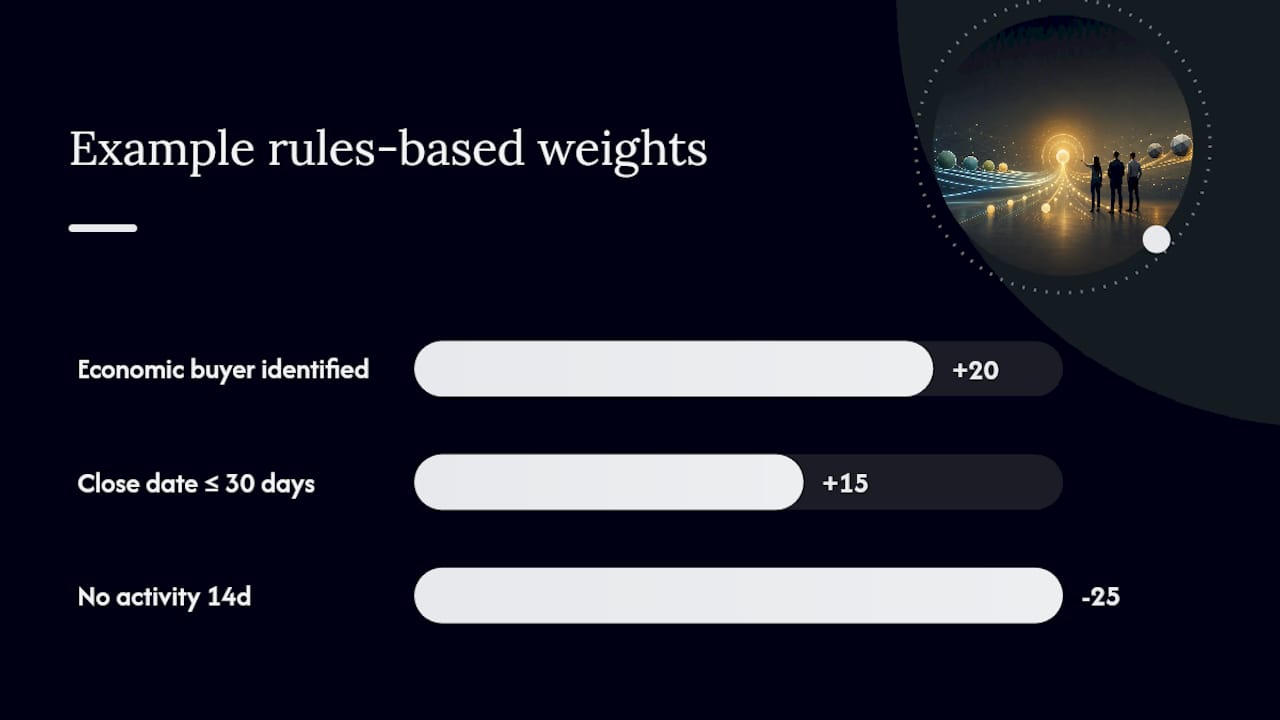
Rules-based thresholds assign points manually: economic buyer identified = +20, close date within 30 days = +15, no activity in 14 days = -25. Fast to build, easy to explain, and a solid starting point when you have fewer than 40 closed-won or 40 closed-lost deals in your CRM history.
Hybrid rules + ML layers a trained model on top of your rules to catch patterns your manual weights miss. This is where most mid-market B2B tech teams land after 6–12 months of data collection.
Fully predictive ML trains entirely on historical outcomes. It’s powerful but requires clean, sufficient data and ongoing monitoring to catch model drift.
Microsoft Learn’s configuration guidance is explicit: a predictive model needs at least 40 closed-won and 40 closed-lost opportunities within your chosen timeframe to train reliably. Below that threshold, start with rules-based scoring and collect data in parallel.
Explainability is non-negotiable regardless of model type. Microsoft’s predictive scoring surfaces the top positive and negative reasons behind each score so sellers can act on specific issues, not just a number. If your model can’t tell a rep why a deal scored 34, the rep won’t trust it. Adoption dies.
Validation checklist before going live:
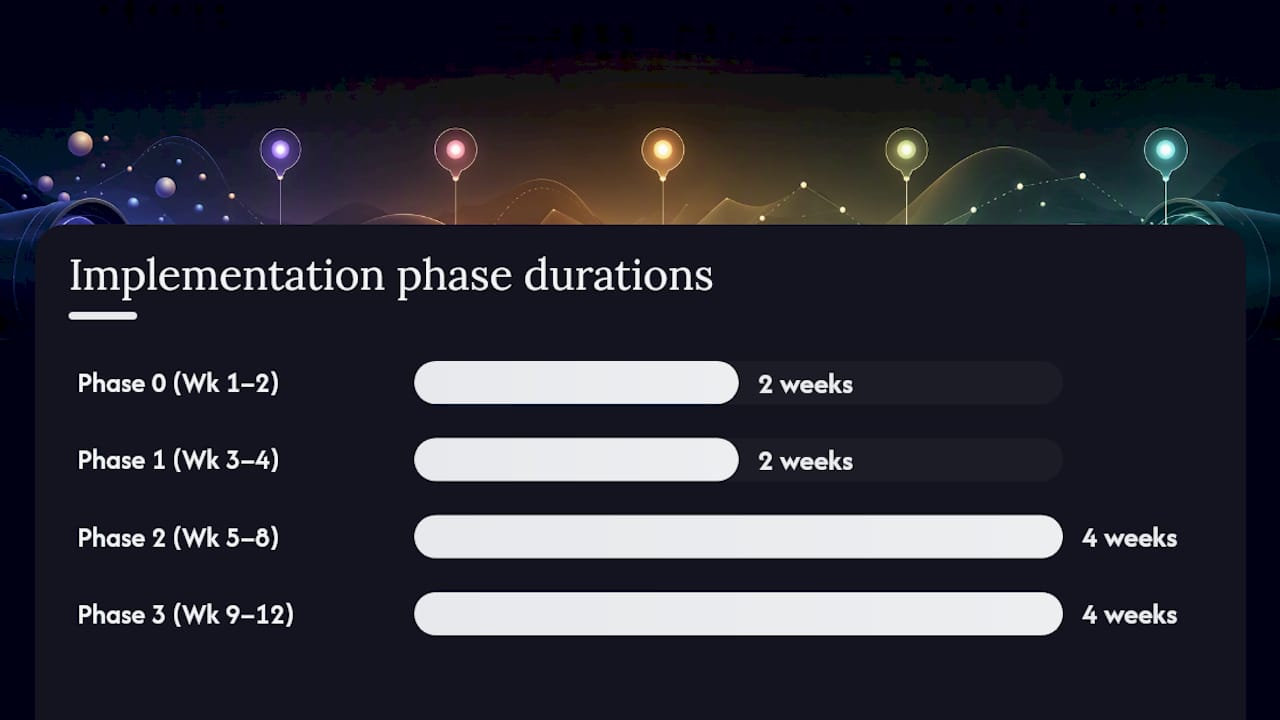
A realistic end-to-end rollout runs 8–12 weeks for a rules-based pilot and 16–20 weeks for a full ML model. Here’s the phased breakdown:
| Phase | Owner | Key Output |
|---|---|---|
| Data audit | RevOps | Field completion report, gap list |
| Signal design | RevOps + Sales leadership | Scoring rubric, pilot segment |
| Model build | Data engineering or vendor | Trained model, validation report |
| CRM integration | RevOps + IT/Product | Live scores in CRM, alert rules |
| Monitoring | RevOps | Monthly drift report, recalibration log |
A hybrid AI approach that combines ML with domain expertise and incremental deployment helps overcome both data gaps and cultural resistance. Ship a scrappy rules-based version first. Let reps use it. Then upgrade.
Scores are only valuable if they change behavior. Here’s the operational playbook.
Rep workflow: Sort your daily pipeline view by score descending. Deals scoring below 40 get a diagnostic review before any new outreach. Deals scoring above 70 get priority scheduling for next steps.
Manager intervention triggers: A score drop of 15 or more points in seven days is your signal to review. Pull the top negative reasons from the score card, then run a rescue play: re-engage the economic buyer, address the competitive threat, or reset the timeline.
Score bands map directly to forecast categories. Deals scoring 70–100 go into “Commit,” 40–69 into “Best Case,” and below 40 into “Pipeline” with a flag for at-risk review. This replaces stage-based probability with evidence-based weighting.
For score-driven coaching triggers, managers should review the category breakdown of score drops weekly. Drops driven by engagement signals point to rep activity problems. Drops driven by CRM hygiene signals point to process compliance issues. Different diagnosis, different fix.
Calibrate signal weights quarterly. B2B buyer behavior shifts faster than annual review cycles can catch.
Real talk: most B2B tech teams underestimate the data work and overestimate the model work. Here’s how to decide.
Build in-house when you have a dedicated RevOps engineer, clean CRM data, and 6+ months to iterate. Total cost: engineering time plus tooling, typically $30,000–$80,000 annually depending on stack complexity.
Buy a vendor solution when you need speed-to-value and your CRM is Salesforce, HubSpot, or Dynamics. Vendor tools offer CRM-native delivery, pre-built signal libraries, and managed refresh cadences. Evaluate on: explainability of scores, data sources included, refresh frequency (near real-time beats daily for fast-moving pipelines), and integration effort.
Hire a consultant when you need a fast audit, data remediation, or change management support for rollout. Consultants are especially valuable for the Phase 0 data readiness work that most teams skip and then regret.
Vendor checklist before you sign:
For lead scoring context that contrasts with opportunity scoring data requirements, note that lead scoring typically needs larger historical conversion volumes. Opportunity scoring focuses on active-deal signals, which makes it accessible earlier in your data maturity journey.
The pattern we see most often in scoring engagements: teams have the data, they just haven’t connected it. A CRM with 200 closed deals, a sequencing tool with full engagement history, and a calendar integration with meeting data. Three systems, zero unified score. The first fix is always integration, not modeling.
One anonymized engagement stands out. A 40-person B2B SaaS team was carrying $2.1M in pipeline they called “Best Case.” After a two-week data audit and a rules-based scoring pilot, $680,000 of that pipeline scored below 35. The sales leader pulled those deals into a separate review, ran rescue plays on 12 of them, and closed three within 45 days. The rest were disqualified, which tightened the forecast and freed up rep capacity for deals that actually had momentum.
The lesson: you don’t need a perfect model to get value. You need honest data and a willingness to act on what the scores tell you.
Scoring your pipeline shouldn’t take six months of internal debate. Saleslabelconsulting runs fixed-scope scoring engagements for B2B tech teams: a two-week data readiness audit, an eight-week pilot with a rules-based or hybrid model, and optional ongoing advisory to monitor drift and recalibrate quarterly. We work inside your existing CRM, so there’s no new dashboard for reps to ignore.
What you get: a scored pilot cohort, a validated signal rubric, CRM-native score delivery, and a manager playbook for interventions and forecasting. No six-month retainer required to get started.
Ready to see where your pipeline actually stands? Book a scoring audit and we’ll tell you within two weeks whether your data is ready and which deals deserve your team’s attention right now.
Subscribe to our Insights: Expert productivity tips in your inbox
You'll receive 1-3 emails per month. Your data stays private, always.

CRO & Co-Founder with Sales Label Consulting

Watch our Sales Mates Podcast
October 2, 2026 - 11 min read
Read article Read articleOctober 2, 2026 - 11 min read
Read article Read articleSeptember 30, 2026 - 10 min read
Read article Read articleSeptember 29, 2026 - 13 min read
Read article Read article