
B2B Sales Methodology: Driving Predictable Revenue
Every sales leader has seen talented teams lose momentum because each rep follows a different playbook. In fast-moving European tech markets, that unpredictability puts targets and growth at risk. A strong B2B sales methodology provides structure that turns sporadic wins into consistent results, laying the groundwork for steady pipeline and reliable revenue. This article unpacks the essentials of creating a repeatable, adaptable sales process proven to align teams and drive sustainable growth.
| Point | Details |
|---|---|
| Structured Sales Methodology | A B2B sales methodology provides a systematic approach to engaging prospects, building trust, and closing deals consistently. |
| Focus on Relationship Building | Prioritize understanding buyer challenges and nurturing genuine relationships over transactional sales tactics for better outcomes. |
| Data-Driven and Adaptive Frameworks | Utilize data to define ideal customer profiles and select channels strategically, adapting your approach to meet buyer needs effectively. |
| Continuous Improvement and Follow-Up | Regularly review pipeline progress, document objections, and establish consistent follow-up practices to avoid lost opportunities. |
A B2B sales methodology is a structured, repeatable framework that guides how your sales team engages buyers from initial contact through closed deal. It’s not just a qualification checklist or a random collection of tactics—it’s your playbook for consistently winning deals.
At its core, a sales methodology answers critical questions: How do you identify the right prospects? How do you build trust and uncover real business challenges? How do you construct compelling value cases? How do you manage and review deals systematically?
A proactive, repeatable framework for creating, qualifying, advancing, and closing deals distinguishes itself from basic sales tools by its strategic focus on driving measurable, consistent results.
Here’s what separates a true methodology from scattered sales tactics:
Mid-sized tech firms operate in a unique space. You’re beyond startup chaos but not yet enterprise-sized with massive sales departments. Your sales team is lean, which means every deal matters.
Without a clear methodology, your team relies on individual heroics—one star performer closes deals while others struggle. That approach doesn’t scale. When that person leaves, so does your revenue predictability.
A solid methodology flattens performance across your team. New hires onboard faster. Experienced reps become more efficient. Your pipeline becomes more stable.
Relationship-building and digitalization form the foundation of modern B2B sales, creating the framework where trust enables deeper business conversations.
Your methodology should emphasize:
This approach works especially well in the European market, where long-term business relationships and trust-based selling resonate more than aggressive tactics.
A methodology transforms sales from an art form into a disciplined, repeatable process that your entire team can execute consistently.
Why does all this connect to predictable revenue? Because methodology eliminates randomness. When you have a clear framework, you can forecast with confidence. You know how long deals take, where they stall, and what moves them forward.

Your sales leaders gain visibility into the pipeline. Your finance team can project cash flow. Your board sees growth built on process, not luck.
That’s the difference between hoping for revenue and engineering it.
Pro tip: Start by documenting how your top performer closes deals. Map their steps, language, discovery questions, and objection handling. That’s the foundation of your methodology—then standardize it across the team.
The B2B sales landscape has shifted dramatically. Gone are the days when one rigid framework fit every deal. Today’s successful teams use adaptive, hybrid approaches that blend data, automation, and genuine human connection.
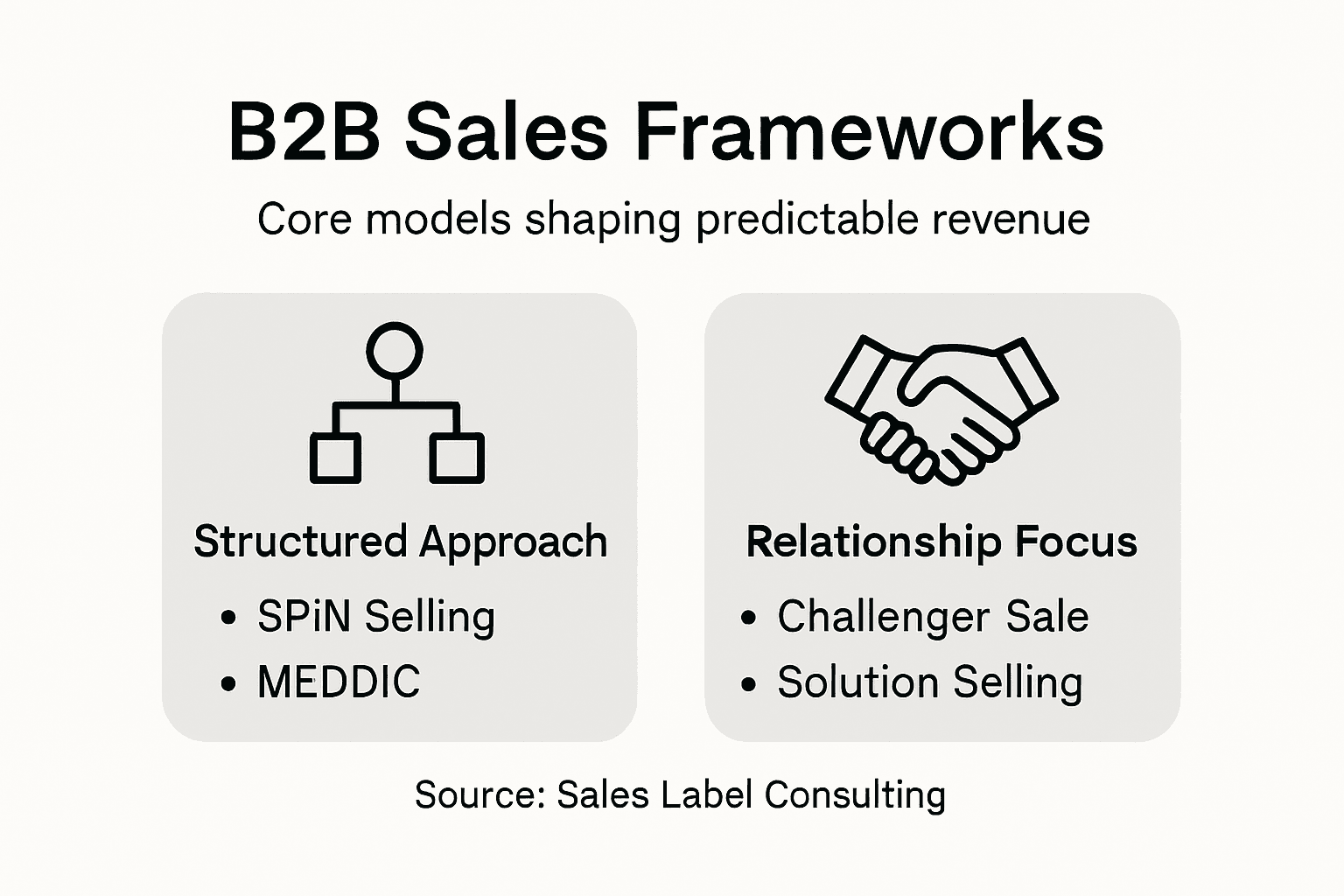
Your methodology needs to reflect how modern buyers actually operate. They’re more autonomous, digitally savvy, and skeptical of traditional sales pitches. They’re researching solutions independently before ever talking to a salesperson.
Most winning B2B strategies fall into one of these categories—though the best teams mix elements from multiple approaches:
Here’s how the four core B2B sales frameworks differ:
| Framework | Buyer Engagement | Sales Team Role | Best Fit For |
|---|---|---|---|
| Product-Led Growth | Self-service, digital | Guidance if requested | Simple, scalable products |
| Sales-Led Growth | Personalized, direct | End-to-end management | Complex solutions |
| Hybrid Growth | Buyer chooses path | Support as needed | Varied deal sizes |
| Account-Based Selling | Custom campaigns | Team collaboration | Enterprise/high-value |
Modern B2B sales strategies require data-driven, automated approaches addressing complex multi-stakeholder buying processes. This means moving beyond gut feel into measurable, repeatable tactics.
Your framework should include:
Here’s the reality: effective sales strategies blend data-driven tools with personalized outreach, maintaining genuine human connection while leveraging automation. AI and automation handle the heavy lifting—prospecting, initial outreach, scheduling—freeing your reps for consultative conversations.
Your top performers aren’t just executing a script. They’re uncovering real problems, asking sharp questions, and building trust. The framework supports that work, it doesn’t replace it.
The winning frameworks today are those that respect buyer autonomy while providing clear structure for your sales team to add value at every stage.
There’s no universal “best” methodology. Your choice depends on your product, customer base, and sales team capacity. A bootstrapped SaaS startup might lean product-led. An enterprise software firm needs account-based selling.
Most European tech firms benefit from hybrid models that adapt to deal complexity. Simple, low-touch deals flow through product-led channels. Complex, multi-stakeholder deals get sales intervention and account-based tactics.
The key is choosing consciously, not defaulting to whatever you’ve always done.
Pro tip: Map your top five deals closed in the last quarter against each framework. Which tactics actually drove the win? Build your methodology around what’s proven in your market, not industry theory.
Not all sales methodologies deliver the same results. The difference between a mediocre approach and a high-impact one comes down to specific traits that separate consistent winners from the rest.
These traits aren’t fancy or complicated. They’re grounded in how real deals actually close in the B2B world.
B2B deals involve multiple decision-makers with different priorities. The CFO cares about ROI and risk. The technical lead worries about implementation. The business owner wants competitive advantage.
Strategic use of sales influence tactics and adaptive communication tailored to diverse buyer characteristics drives consistent results. Your approach can’t be one-size-fits-all.
High-impact teams:
Transactional sales feel fast until they don’t. Deals stall. Prospects ghost. Competitors swoops in.
Relationship-based selling creates momentum. When buyers trust you, they share challenges candidly. They loop you into conversations early. They advocate for you internally.
Your methodology should emphasize genuine connection over speed to close. That doesn’t mean moving slowly—it means moving purposefully.
High-impact B2B sales teams build trust before asking for commitments, creating deals that close faster and stick longer.
Your team has access to incredible tools. LinkedIn research. Intent data. Automation platforms. Account-based marketing software.
The trap is over-automating. Sending personalized emails to 500 prospects at once isn’t personalization—it’s spam at scale.
High-impact approaches use digital tools strategically:
Opportunities don’t close themselves. They need movement. High-impact teams track deal progress systematically, spotting when deals are stalling before they die.
This means clear stage definitions, regular pipeline reviews, and willingness to walk from deals that don’t fit. It’s uncomfortable but necessary.
Pro tip: Record your top three closed deals from the last six months. Map exactly when each moved between stages and what action caused that movement. That’s your high-impact sales playbook. Document it, train it, repeat it.
Even solid methodologies fail when teams fall into predictable traps. Understanding these pitfalls isn’t just about knowing what not to do—it’s about building guardrails into your process.
Your sales team likely encounters these mistakes regularly. Recognizing them early saves deals and credibility.
Spending weeks qualifying a prospect who’ll never buy is the fastest way to blow your pipeline. Yet teams do this constantly, chasing revenue instead of fit.
Common B2B sales pitfalls include targeting the wrong prospects without proper ideal customer profiling. When you don’t clearly define who you serve, you waste effort on mismatched deals.
The fix is ruthless clarity:
Your reps have great products. They know the features. They’re eager to explain everything. That impulse kills deals.
Key mistakes include dominating conversations without listening and offering too much free information prematurely. Prospects disengage when you talk at them instead of understanding their world.
Rep instinct is to pitch. Your methodology should enforce discovery first. Ask questions about their challenges, timelines, and decision criteria before positioning solutions.
Active listening wins deals faster than any pitch.
The sales reps who ask the best questions close the most deals. Your methodology should make discovery non-negotiable.
You’ve already earned trust with existing customers. Yet many teams focus exclusively on new logos while current customers feel abandoned.
This creates two problems: you lose expansion revenue, and unhappy customers stop referring. That’s doubly expensive.
Build customer engagement into your sales process:
B2B deals need time. Buyers need to align their team, review budgets, and build consensus. Pushing too hard creates resentment and kills momentum.
Your methodology should include patience benchmarks. Some deals need three months. Some need six. Forcing a close timeline that doesn’t match buyer reality backfires.
Speed matters. But not more than fit.
Prospects don’t respond to one email. They’re busy. Multi-threaded conversations work better than hoping for replies from a single contact.
Does your process include systematic follow-up cadences? Weekly check-ins from multiple people? Documentation of what’s been said and when?
Weak follow-up leaves money on the table.
Below is a summary of common B2B sales pitfalls and their consequences:
| Pitfall | Common Cause | Business Impact |
|---|---|---|
| Targeting wrong prospects | Vague customer profiles | Wasted resources, poor pipeline |
| Talking more than listening | Pitch-focused reps | Lost engagement, fewer closes |
| Neglecting current clients | Chasing only new business | Missed growth, churn risk |
| Rushing the process | Unrealistic timelines | Buyer pushback, stalled deals |
| Inconsistent follow-up | Lack of systematized cadence | Lost opportunities, no closure |
Pro tip: Audit your last 10 lost deals. For each one, map exactly where the misstep happened: wrong prospect, talking too much, neglected relationship, rushed timing, or poor follow-up. You’ll spot your team’s most costly pattern. Fix that pattern first.
The article highlights the critical challenge of building a structured, repeatable B2B sales methodology that drives predictable revenue instead of relying on individual heroics or guesswork. If you are struggling with inconsistent sales performance, unclear deal qualification, or managing complex multi-stakeholder buying processes, you are not alone. Many European tech leaders face the need to standardize relationship building, value discovery, and adaptive communication while balancing automation and personalization.
At Sales Label Consulting, we specialize in empowering sales leaders—RevOps, Heads of Sales, and VPs of Sales—to conquer these exact challenges. Through our expert Sales Audit, Sales Enablement, and Demand Generation consulting, we help you document your top-performing sales plays, eliminate pipeline bottlenecks, and embed a high-impact methodology that enables confident forecasting and long-term growth.
Take control of your sales process today and transform unpredictable revenue into a steady engine of growth.
Don’t wait for randomness to determine your success. Visit Sales Label Consulting now to start building a repeatable, measurable B2B sales framework that aligns your entire team and drives consistent results.
A B2B sales methodology is a structured framework that guides sales teams in engaging buyers from initial contact to closing the deal, ensuring a repeatable process for driving consistent results.
A sales methodology is crucial for tech firms as it helps standardize processes, improves onboarding for new hires, flattens performance across teams, and ensures predictable revenue generation.
Choosing the right B2B sales methodology depends on your product, customer base, and sales team capacity. Analyze your top deals to identify which approach—such as product-led growth or account-based selling—fits your business best.
Common pitfalls include targeting the wrong prospects, talking more than listening during pitches, neglecting existing customers, rushing the sales process, and inconsistent follow-up practices. Identifying and avoiding these issues can enhance your sales effectiveness.
Subscribe to our Insights: Expert productivity tips in your inbox
You'll receive 1-3 emails per month. Your data stays private, always.

CRO & Co-Founder with Sales Label Consulting

Lets book a free consultation
October 11, 2026 - 7 min read
Read article Read articleOctober 10, 2026 - 8 min read
Read article Read articleOctober 9, 2026 - 7 min read
Read article Read articleOctober 8, 2026 - 10 min read
Read article Read article