
Sales Pipeline Optimization Strategies for Predictable Revenue
Every sales leader knows the struggle of trying to improve accuracy and efficiency in a complex pipeline. With limited visibility and inconsistent data, it becomes tough to identify bottlenecks and predict future revenue. By focusing on comprehensive data visibility and regular pipeline reviews, you can uncover key metrics that drive better forecasting and consistent performance. This article provides practical techniques tailored for European IT companies to boost pipeline reliability and support more predictable growth.
| Key Point | Explanation |
|---|---|
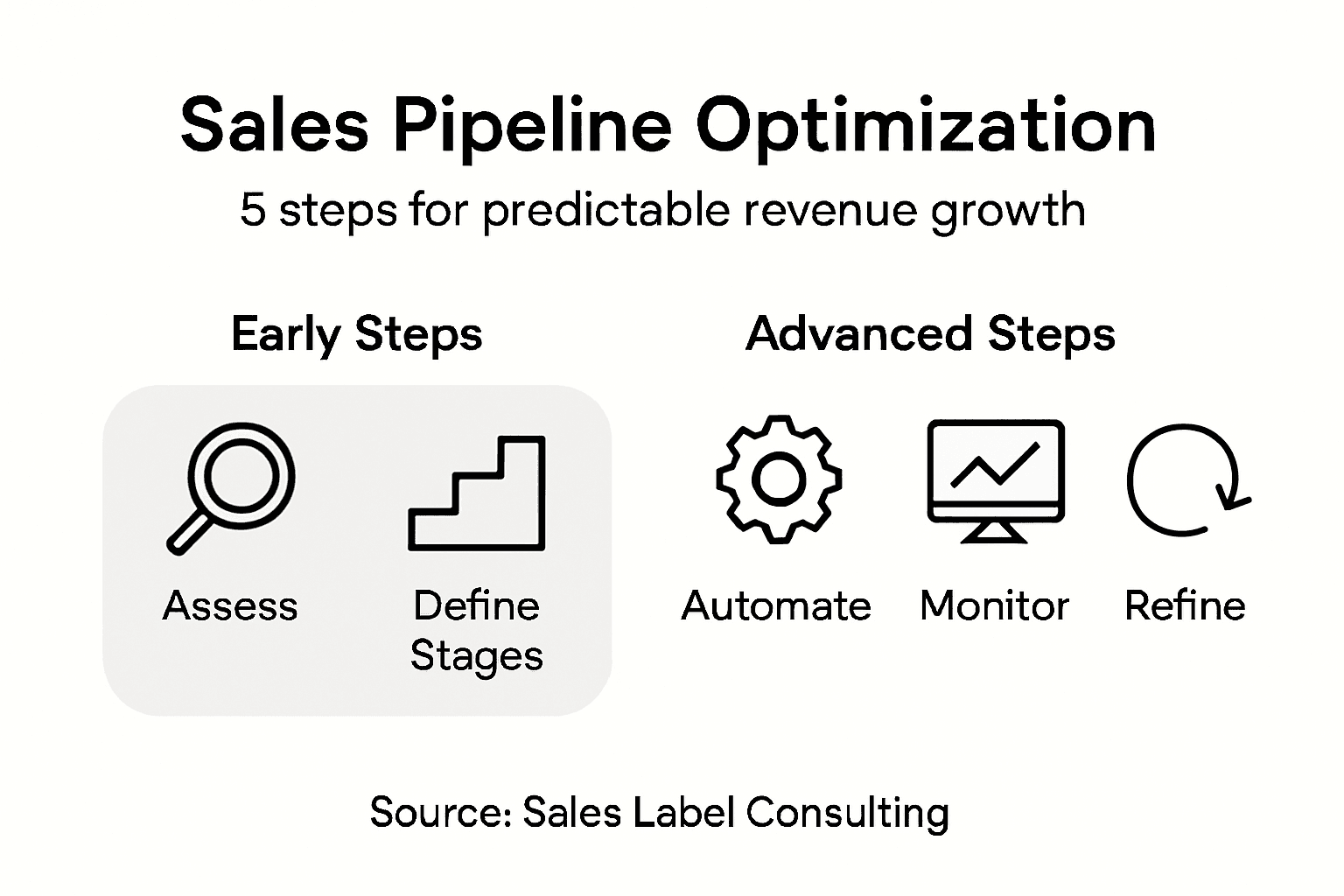
| 1. Assess Pipeline Health Regularly | Evaluate metrics like qualified leads, win rates, and deal size to identify weaknesses and optimize sales processes. |
| 2. Define Clear Sales Stages | Establish structured stages based on buyer actions to improve tracking accuracy and systematic revenue generation. |
| 3. Automate Sales Processes | Integrate CRM, marketing tools, and analytics to streamline workflows, enhance data consistency, and reduce manual errors. |
| 4. Monitor Key Performance Metrics | Track pipeline velocity, conversion rates, and sales cycle length to make proactive adjustments and boost revenue potential. |
| 5. Validate and Refine Continuously | Regularly assess lead quality, deal progression, and alignment with market shifts for ongoing pipeline accuracy and effectiveness. |
Understanding your sales pipeline’s health is crucial for predictable revenue generation. By analyzing key metrics and identifying potential bottlenecks, you can strategically optimize your sales processes and improve conversion rates.
To effectively assess pipeline health, focus on these critical evaluation dimensions:
Sales pipeline health insights reveal that comprehensive data visibility enables more accurate forecasting and resource allocation. Regular pipeline reviews help identify potential leakage points and performance gaps.
Some strategic techniques for thorough pipeline assessment include:
Healthy pipelines demonstrate consistent deal flow, accurate data tracking, and well-distributed lead quality across different segments.
Pro tip: Implement a quarterly pipeline audit to proactively identify and address potential performance issues before they significantly impact revenue generation.
Defining clear and measurable sales stages is fundamental to building a predictable revenue engine. Establishing precise pipeline stages provides a structured approach to tracking sales opportunities and understanding potential revenue generation.
When creating your sales stages, focus on developing a streamlined process that captures critical buyer interactions:
Key considerations for defining effective sales stages include:
A well-defined sales pipeline transforms sporadic sales efforts into a systematic, predictable revenue generation process.
Pro tip: Regularly review and refine your sales stages to ensure they remain aligned with evolving customer buying behaviors and market dynamics.

Automation and integration are critical for transforming your sales pipeline into a predictable revenue generation system. Modular enterprise software frameworks enable seamless data flow and intelligent decision-making across your sales ecosystem.
Key integration strategies for your sales technology stack include:
Effective automation requires a systematic approach:
Successful sales automation transforms manual processes into intelligent, data-driven revenue generation engines.
Pro tip: Select automation tools that offer robust API capabilities and flexible integration options to future-proof your sales technology infrastructure.
The following table outlines typical technologies and their contributions to sales pipeline integration:
| Technology Type | Integration Role | Business Outcome |
|---|---|---|
| CRM System | Centralizes lead data | Unified opportunity view |
| Marketing Automation | Syncs campaigns | Nurtured, qualified leads |
| Analytics Dashboard | Provides insights | Real-time performance tracking |
| Communication Tools | Streamlines outreach | Faster client responses |
Tracking the right performance metrics is crucial for understanding and optimizing your sales pipeline’s effectiveness. Sales pipeline performance metrics provide actionable insights that help identify bottlenecks and predict revenue outcomes with greater accuracy.
Key performance metrics to monitor consistently include:
Implementing a robust monitoring strategy involves several critical steps:
Consistent metric tracking transforms data into a strategic roadmap for sales optimization.
Pro tip: Develop a standardized dashboard that displays real-time performance metrics, allowing instant visibility into pipeline health and potential improvement areas.
Validating and refining your sales pipeline is an ongoing process that ensures continuous improvement and accuracy. Sales pipeline validation involves structured reviews that assess deal quality, buyer commitment, and strategic alignment with revenue goals.
Key strategies for effective pipeline validation include:
A systematic validation approach involves these critical steps:
Effective pipeline validation transforms raw data into actionable strategic intelligence.
Pro tip: Create a standardized deal review checklist that objectively scores opportunities based on multiple performance indicators to streamline your validation process.
Here’s a summary of how each step optimizes your sales pipeline:
| Step | Main Focus | Key Benefit | Example Impact |
|---|---|---|---|
| Assess pipeline health | Identify weaknesses | Prevent revenue leaks | Bottleneck detection |
| Define sales stages | Structure process | Improve tracking accuracy | Faster lead progression |
| Implement automation | Streamline workflow | Reduce manual errors | Consistent data entry |
| Monitor metrics | Measure performance | Proactive adjustments | Identify slow stages |
| Validate/refine pipeline | Continuous improvement | Align with market shifts | Better forecast accuracy |
The challenge of maintaining a healthy sales pipeline while achieving consistent revenue growth often feels overwhelming. This article highlights critical pain points such as identifying bottlenecks, defining measurable sales stages, and implementing automation that many sales leaders face daily. If you strive to improve pipeline velocity and win rates but struggle with manual errors and fluctuating forecasts, you are not alone.
At Sales Label Consulting, we specialize in empowering RevOps, Heads of Sales, and VPs of Sales to overcome these exact challenges. Our expertise in sales enablement, sales audit, and demand generation ensures your sales pipeline is not only optimized but continually refined for sustained success. By aligning your sales process with proven strategies for pipeline health assessment and data-driven validation, you gain the confidence to forecast revenue accurately and avoid costly leaks.
Are you ready to transform your sales operations with methods tailored to your unique market dynamics and buyer behaviors
Take the first step toward predictable, error-free revenue by partnering with us today. Visit Sales Label Consulting to learn how our consulting services can architect your sales pipeline for maximum efficiency and growth. Don’t wait until pipeline inefficiencies cost you deals plan your strategic sales transformation now.
To assess sales pipeline health, focus on metrics such as the number of qualified leads, win rates, average deal size, and pipeline velocity. Regularly analyze these metrics to identify bottlenecks and optimize your processes for better revenue outcomes.
To define effective sales stages, limit yourself to five or fewer stages based on buyer actions rather than internal tasks. Establish clear entry and exit criteria for each stage to ensure consistent measurement across your sales team.
Consider integrating a Customer Relationship Management (CRM) system, marketing automation software, and reporting analytics tools. Select solutions that offer API capabilities to streamline your sales processes and improve data accuracy.
Monitor your sales pipeline metrics regularly, ideally on a monthly basis. This allows you to quickly identify trends and make data-driven adjustments, potentially improving your conversion rates by 15–25%.
To validate and refine your sales pipeline, conduct regular qualification assessments and deal progression tracking. Implement a standardized review process to cleanse opportunities and align your pipeline with realistic revenue forecasts.
To establish a quarterly pipeline audit, set aside dedicated time for in-depth reviews of your pipeline metrics and processes. Analyze your results, identify areas for improvement, and implement changes to boost pipeline health and predictability.
Subscribe to our Insights: Expert productivity tips in your inbox
You'll receive 1-3 emails per month. Your data stays private, always.

CRO & Co-Founder with Sales Label Consulting

Let's have a free consultation call
October 21, 2026 - 9 min read
Read article Read articleOctober 20, 2026 - 9 min read
Read article Read articleOctober 19, 2026 - 10 min read
Read article Read articleOctober 18, 2026 - 10 min read
Read article Read article