
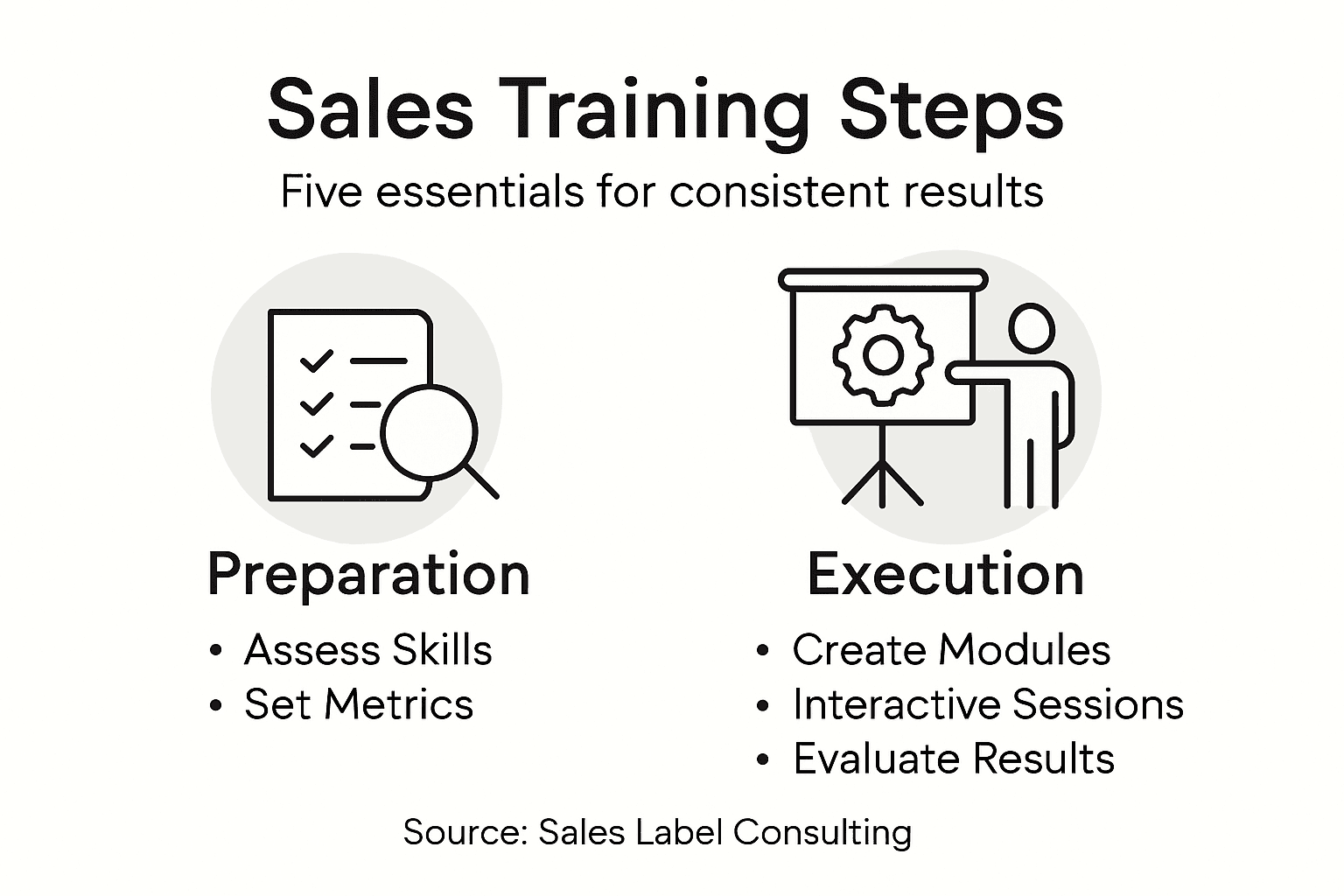
Master the Effective Sales Training Process for Consistent Results
Every Sales Leader knows the frustration of inconsistent results across even the most experienced teams. When your company spans multiple countries in the European Union, ensuring everyone meets the same standards becomes even more complex. Structured sales training offers a proven path to building stronger teams, closing skill gaps, and driving sustainable growth. Discover how a focus on quantitative performance metrics and clear development objectives helps turn everyday challenges into measurable success.
| Key Point | Explanation |
|---|---|
| 1. Assess Team Capabilities | Conduct a thorough evaluation of your sales team’s skills and performance using various assessment methods to identify gaps. |
| 2. Establish SMART Training Objectives | Create specific, measurable, achievable, relevant, and time-bound objectives to ensure targeted skill development. |
| 3. Design Tailored Training Modules | Develop training content that addresses identified weaknesses while incorporating varied learning formats for engagement. |
| 4. Implement Interactive Training Sessions | Transform passive training into engaging experiences through roleplays, group discussions, and practical applications. |
| 5. Continuously Evaluate Training Effectiveness | Use systematic data collection to assess training impact and make ongoing adjustments for improvement. |
Assessing your sales team’s capabilities is a critical first step toward creating a strategic and effective training process. This phase will help you understand your team’s current performance levels, identify skill gaps, and develop targeted development strategies.
To conduct a comprehensive capabilities assessment, leverage multiple evaluation methods. Strategic capability assessment tools provide objective insights into team performance and skill maturity. Start by implementing these key approaches:
Your assessment should focus on both quantitative performance metrics and qualitative skill evaluations. This dual approach ensures you capture a holistic view of your team’s capabilities. Pay special attention to areas like communication skills, product knowledge, negotiation techniques, and customer relationship management.

Here’s a summary of common capability assessment methods and their business impact:
| Assessment Method | Main Advantage | Business Impact |
|---|---|---|
| Performance Reviews | Uncover individual strengths | Inform targeted skill training |
| Sales Pipeline Analysis | Identify conversion barriers | Boost closure rates |
| Standardized Skill Surveys | Measure skill consistency | Guide recruitment strategies |
| One-on-One Interviews | Reveal nuanced team challenges | Enable tailored coaching plans |
| Historical Data Review | Track long-term team progress | Shape future sales strategy |
The most effective assessments combine data-driven insights with personalized evaluation techniques.
Using diagnostic tools from professional organizations can help you benchmark your team against industry standards and identify precise development opportunities.
Pro tip: Create a standardized assessment template that can be consistently applied across your sales team to ensure fair and comprehensive evaluation.
Establishing precise training objectives and metrics is crucial for creating a targeted and effective sales development program. This step transforms your initial team capability assessment into a strategic roadmap for skill enhancement and performance improvement.
Learning objectives should be specific and measurable to ensure meaningful skill development. Focus on creating objectives that address the key performance gaps identified during your initial assessment. Consider developing objectives across these critical dimensions:
When crafting objectives, use the SMART framework to ensure clarity and actionability. Each objective should be Specific, Measurable, Achievable, Relevant, and Time-bound. This approach allows you to track progress systematically and validate the effectiveness of your training interventions.
Effective training objectives bridge the gap between current performance and desired organizational outcomes.
Training effectiveness requires comprehensive evaluation that goes beyond simple knowledge tests. Implement pre and post-training assessments to measure actual skill transfer and performance improvements in real-world sales scenarios.
Pro tip: Design your training metrics to directly link learning outcomes with tangible business results, such as increased conversion rates or improved customer satisfaction scores.
Creating effective sales training modules requires a strategic approach that addresses your team’s specific skill gaps and performance objectives. The goal is to develop a learning experience that transforms identified weaknesses into measurable strengths.
Effective training design centers on understanding learner needs and creating highly targeted content. Break down your training modules into these critical components:
Each training module should follow a structured learning progression that moves from foundational knowledge to advanced application. Start with baseline skill assessments, introduce core concepts through multiple learning modalities, and create opportunities for hands-on practice and feedback.
Successful training modules bridge theoretical knowledge with real-world sales performance requirements.
Consider incorporating diverse learning formats such as video tutorials, role-playing exercises, interactive workshops, and digital simulations to accommodate different learning styles and keep participants engaged. Ensure each module includes clear performance metrics and mechanisms for tracking individual and team progress.
Pro tip: Build flexibility into your training modules, allowing for personalized learning paths that can be adjusted based on individual sales representative performance and evolving organizational needs.
Transforming sales training from passive lectures to engaging, dynamic learning experiences is crucial for achieving meaningful skill development. The key is creating an environment where participants actively participate, collaborate, and internalize new strategies.
High-quality training emphasizes interactive participant engagement through carefully designed learning techniques. Implement these core strategies to maximize training effectiveness:
Each training session should balance theoretical knowledge with practical application. Break complex concepts into digestible segments, allowing participants to practice skills immediately after introduction. Use techniques that encourage active participant involvement such as live demonstrations, immediate feedback loops, and hands-on skill practice.
Interactive training transforms passive attendees into engaged learning participants.
Consider diversifying your training delivery methods to accommodate different learning preferences. Some representatives might excel with visual demonstrations, while others prefer kinesthetic learning experiences. Blend multimedia presentations, group discussions, individual exercises, and digital learning platforms to create a comprehensive and adaptable training environment.
Pro tip: Design training sessions with built-in flexibility, allowing spontaneous adjustments based on real-time participant engagement and learning dynamics.
Evaluating your sales training program’s effectiveness is not a one-time event, but a continuous improvement cycle that transforms raw performance data into actionable insights. This crucial step ensures your training remains dynamic, relevant, and aligned with evolving organizational goals.
Training effectiveness requires systematic data collection to measure real impact. Implement a comprehensive evaluation strategy that captures multiple dimensions of training performance:
Design your evaluation process to capture quantitative and qualitative insights. Use standardized assessment tools that measure knowledge transfer, skill application, and behavioral transformation in real-world scenarios. Compare pre-training baseline metrics with post-training performance to demonstrate tangible improvements.
Continuous evaluation transforms training from a static event into a dynamic learning journey.
Employ a mix of data collection methods, including participant self-assessments, manager observations, performance reviews, and direct sales outcome measurements. This multi-angle approach provides a comprehensive understanding of training effectiveness and identifies specific areas for future refinement.
Compare post-training evaluation methods and their benefits:
| Evaluation Method | Data Type | Benefit |
|---|---|---|
| Participant Surveys | Qualitative | Capture satisfaction and insights |
| Performance Tracking | Quantitative | Measure skill improvements |
| Behavioral Observation | Qualitative | Detect real-world changes |
| ROI Calculations | Quantitative | Show monetary impact on business |
Pro tip: Create a rolling evaluation system where feedback is continuously collected and integrated, allowing for real-time adjustments to your training approach.
Mastering the effective sales training process requires tackling key challenges like skill gaps assessment, setting clear objectives, delivering interactive sessions, and continuously evaluating results. If you find these steps overwhelming or struggle to convert training into consistent sales growth, you are not alone. Many sales leaders seek targeted support to ensure their teams develop relevant skills and deliver predictable, error-free results.
At Sales Label Consulting, we specialize in empowering sales departments and leaders such as RevOps, Heads of Sales, and VPs of Sales to confidently overcome these hurdles. Our consulting services in Sales Enablement, Sales Audit, and Demand Generation leverage extensive entrepreneurial tech experience to craft tailored strategies that address your unique team needs and training objectives.
Take control of your sales training process today to transform learning into measurable business impact. Visit Sales Label Consulting to discover how our expert guidance can help you diagnose capability gaps, design targeted training modules, and continuously refine your approach for sustained success.
To assess your sales team’s capabilities, conduct individual performance reviews, analyze sales pipeline metrics, and use standardized skill assessment surveys. Start by gathering both quantitative and qualitative data about your team’s performance and skills to identify gaps.
Effective training objectives should be specific and measurable, addressing the key performance gaps identified in your initial assessment. Use the SMART framework—ensuring objectives are Specific, Measurable, Achievable, Relevant, and Time-bound—to maintain clarity and track progress.
Tailored training modules should include skill-specific learning objectives, interactive learning experiences, and practical application scenarios. Ensure each module builds progressively, allowing participants to practice new skills with immediate feedback.
Deliver interactive training sessions by incorporating role-playing exercises, collaborative problem-solving activities, and structured group discussions. Engage participants actively to enhance their learning experience and help them apply new strategies effectively.
To evaluate your sales training program, implement a strategy that captures immediate feedback, tracks performance metrics, and assesses long-term skill retention. Combine qualitative insights from participant surveys with quantitative data from performance reviews to measure overall impact.
After evaluating the training results, refine your training process based on the insights gathered. Continuously collect feedback and apply adjustments to ensure the training remains effective and aligned with your team’s needs.
Subscribe to our Insights: Expert productivity tips in your inbox
You'll receive 1-3 emails per month. Your data stays private, always.

CRO & Co-Founder with Sales Label Consulting

Book a free consultation
September 24, 2026 - 8 min read
Read article Read articleSeptember 23, 2026 - 8 min read
Read article Read articleSeptember 22, 2026 - 11 min read
Read article Read articleSeptember 21, 2026 - 8 min read
Read article Read article