
Master Sales Strategy Review Steps for Predictable Success
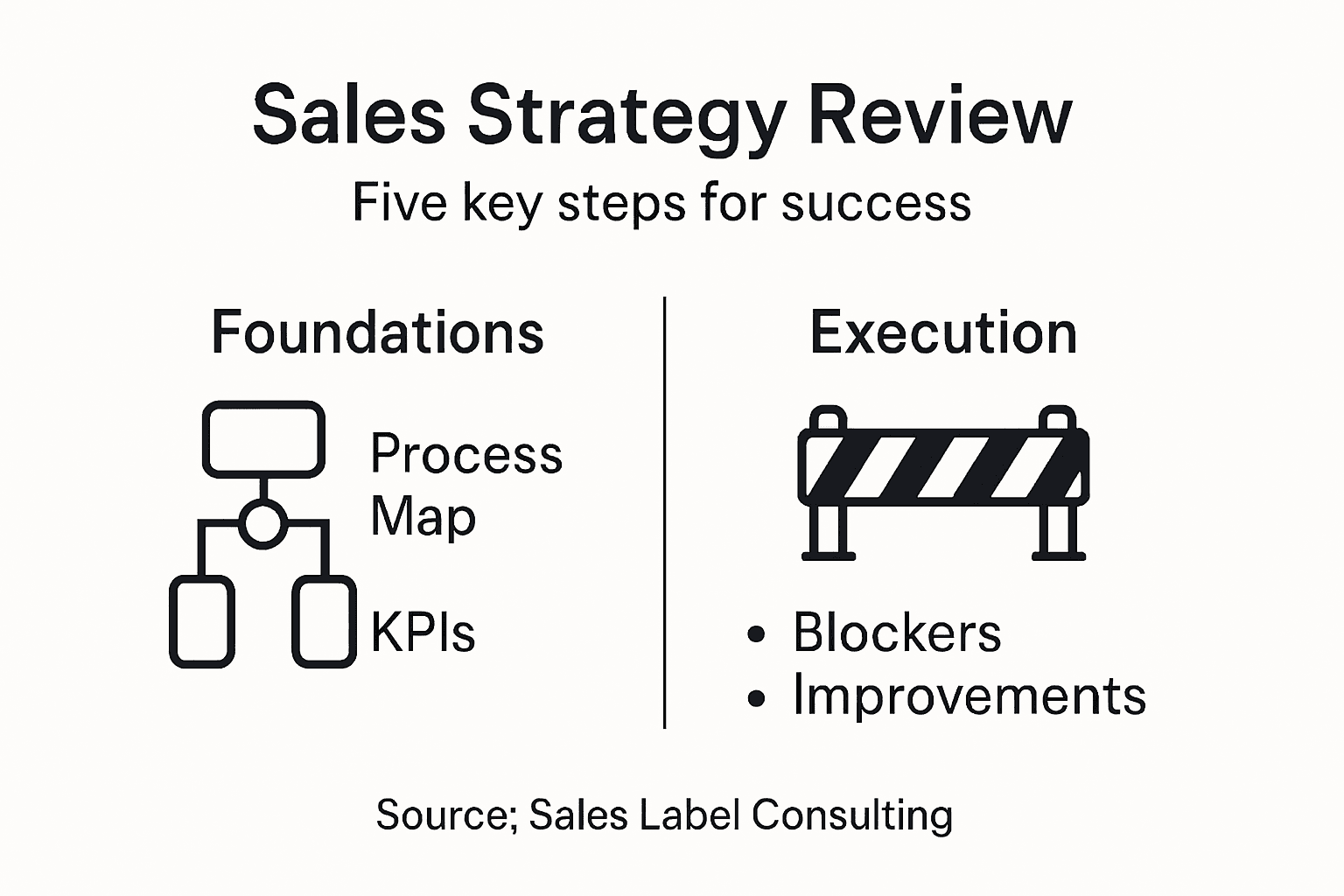
Every Sales Leader in a European tech company has reached a point where growth hits a wall and past tactics stop delivering results. The real challenge is understanding why processes stall and where to invest your team’s energy for true improvement. Taking a structured, honest look at your current sales operations is the first step toward building a system that delivers repeatable success. A robust assessment will reveal where your process works, where it breaks down, and what needs to change.
| Key Insight | Explanation |
|---|---|
| 1. Assess Current Processes | Understand your existing sales processes to identify strengths and weaknesses. This forms a foundation for future improvements. |
| 2. Define Key Metrics | Establish clear performance metrics that align with strategic goals, helping to measure success and guide decisions effectively. |
| 3. Identify Roadblocks | Listen to your sales team to uncover execution obstacles. Addressing these challenges is crucial for improving overall performance. |
| 4. Implement Strategic Changes | Make targeted improvements based on identified roadblocks, ensuring changes are measured and evaluated for effectiveness. |
| 5. Validate Effectiveness | Regularly review KPIs against benchmarks to ensure your strategies are working and adjust accordingly to stay aligned with goals. |
You can’t improve what you don’t understand. Before making changes to your sales operation, you need a clear picture of how things actually work today. This assessment forms the foundation for everything that follows, so let’s get it right.
Start by mapping your current sales activities from lead to close. Who are you selling to? What problems do they face? How does your team currently identify and approach prospects? Understanding customer needs and challenges helps you see where your process works and where it breaks down. Write down each step, the people involved, and the tools being used.
Next, examine your sales organizational structure and how your team executes. Is everyone following the same process, or does each rep do their own thing? Inconsistency kills predictability. Sales methodology assessment ensures consistency across diverse selling situations, so evaluate whether your current approach actually scales. Look at your win rates, sales cycle length, and where deals typically stall.
Then run a competitive analysis. What are competitors doing that you’re not? How are buyer expectations changing? Your sales approach that worked two years ago might not resonate today. Take time to identify gaps between your current process and what the market demands.
Finally, define your existing sales goals and metrics clearly. Are targets based on revenue, activity, or growth? Document what success looks like right now. This baseline becomes your measuring stick for improvement.
Below is a comparison of sales process assessment steps and their value:
| Assessment Step | Key Focus Area | Why It Matters |
|---|---|---|
| Map activities | Identify workflow stages | Reveals points of breakdown |
| Analyze structure | Team roles & consistency | Highlights areas needing standardization |
| Competitive analysis | Market positioning | Identifies industry process gaps |
| Set goals & metrics | Establish baseline | Provides foundation for improvements |
Pro tip: Involve your frontline reps in this assessment instead of just asking leadership. Your salespeople know where the real friction points are, and their input makes the transition to new processes smoother.
Numbers tell the story of your sales operation. Without clear metrics, you’re flying blind. This step is about identifying which measurements actually matter and setting them up to drive better decisions across your team.
Start by connecting metrics to your strategic goals. What does success look like for your sales organization this year? Are you focused on revenue growth, market expansion, or improving efficiency? Key Performance Indicators are critical, quantifiable measures of progression toward strategic goals. Every metric you track should ladder up to one of your primary objectives. If a number doesn’t influence a decision, it probably shouldn’t be on your dashboard.
Then distinguish between leading and lagging indicators. Lagging indicators tell you what already happened, like closed deals or revenue. Leading indicators predict future performance, like meetings booked or proposal sent. You need both. Leading indicators help you course correct before the quarter ends, while lagging indicators confirm whether your efforts paid off.
Here’s a summary of the two main types of performance metrics and their significance:
| Metric Type | Description | Example Metrics | Business Impact |
|---|---|---|---|
| Leading Indicators | Predict future outcomes and trends | Meetings booked | Enable proactive adjustments |
| Lagging Indicators | Measure past results and achievements | Closed revenue | Validate strategy effectiveness |
Next, ensure your metrics are actually achievable and relevant. Effective KPIs must be specific, measurable, and time-bound to enable alignment across organizational levels. Avoid vanity metrics that look impressive but don’t drive behavior. For a European mid-market sales team, focus on metrics like conversion rates by stage, sales cycle length, quota attainment, and pipeline velocity. Make each metric clear enough that a rep understands exactly what they need to do to influence it.
Finally, establish clear ownership. Who tracks this metric? Who owns improving it? Assign accountability so these numbers become active tools, not just reports gathering dust.
Pro tip: Set up a simple dashboard your team reviews weekly, not monthly. Real-time visibility keeps everyone aligned and lets you spot problems early when you can still fix them.
You’ve assessed your processes and defined your metrics. Now comes the hard part: understanding what’s actually stopping you from executing well. Roadblocks are everywhere, and most teams don’t take time to identify them clearly.

Start by listening to your team. What frustrates your reps? What slows down deal progression? Strategy execution often fails due to lack of leadership alignment, resource constraints, and communication breakdowns. Your salespeople experience these obstacles daily. Conduct brief one-on-ones or a team workshop where people can speak openly about friction points without fear of repercussion. You’ll hear things like “I spend three hours a week updating the CRM” or “I don’t understand what marketing considers a qualified lead.”
Next, examine your resource allocation. Do you have enough support staff, technology, or training budget? Are your best reps stretched across too many accounts? Sometimes a roadblock isn’t about strategy, it’s simply about being understaffed or under-tooled. Look at where your team spends time and whether that time actually generates revenue.
Then identify any resistance to change or misalignment within leadership. Overcoming organizational hurdles requires leadership to communicate vision clearly and build consensus. If your VP of Sales wants to focus on enterprise while your VP of Marketing is driving SMB campaigns, that misalignment will tank execution. Get leadership aligned first, or your roadblock fix will fail.
Finally, prioritize which roadblocks to tackle first. Not every obstacle needs solving immediately. Choose the ones that impact the most people or slow the biggest opportunities. Start there.
Pro tip: Document your roadblocks in a simple spreadsheet with impact (high, medium, low) and effort to fix. This clarity makes it easier to build buy-in when you propose solutions to leadership.
You’ve identified your roadblocks. Now it’s time to act. The key is being intentional about what you fix and how you roll it out. Half-hearted implementations waste time and create cynicism on your team.
Start with your highest-impact roadblock. If reps spend too much time on admin work, automate it. If there’s confusion about lead qualification, clarify and document your definition. Targeted improvements in sales strategy involve refining approaches based on customer insights and sales performance analysis. Each fix should directly connect to the metrics you defined earlier. If you can’t measure whether an improvement worked, it probably isn’t worth the effort.
Next, establish clear accountability and communicate the change. Who owns rolling this out? What’s the timeline? Successful strategy execution relies on establishing accountability, improving communication, and aligning resources. Tell your team why this change matters, not just what’s changing. A rep who understands that a new sales process reduces admin time by 30 percent will buy in faster than one who’s just told to do things differently.
Then pilot the improvement with a smaller group before rolling it out organization-wide. Let your most adaptable reps test it for two weeks. Get their feedback. Does it actually work? What unexpected issues came up? Adjust based on reality, not theory.
Finally, monitor progress against your KPIs weekly. Are conversion rates improving? Is cycle time shrinking? If the improvement isn’t moving the needle after a reasonable period, adjust course quickly. Bad improvements that linger kill momentum.
Pro tip: Celebrate the first visible win from your improvement, even if it’s small. Public recognition of progress builds momentum and shows the team that change actually works.
You’ve implemented improvements and gathered data. Now you need to honestly assess whether your strategy is actually working. This is where many leaders get uncomfortable because the answer might be no.
Start by reviewing your KPIs against your baseline from Step 2. Are you moving the needle on conversion rates, cycle time, or pipeline velocity? Validating strategy effectiveness requires defining relevant KPIs to measure progress and enables evaluation of impact on business performance. Don’t just look at one metric. A strategy might improve win rates but extend your sales cycle, which isn’t ideal. Look at the full picture.
Next, benchmark your performance against your competitors and your own historical performance. How do your metrics compare to industry standards? Are you gaining ground or losing it? This context matters because improving by 10 percent might be excellent in a declining market or disappointing in a growing one.
Then incorporate feedback loops from your team and customers. What are reps saying about the new process? Are customers noticing improvements in how you sell to them? Measuring strategic performance includes benchmarking against competitors and incorporates feedback loops for ongoing improvement. Sometimes the numbers look good but your team is burned out, or customers feel rushed. That’s a validation failure too.
Finally, decide what to do next. Is the strategy working? Double down and scale it. Is it partially working? Refine it further. Is it not working? Be honest about pivoting to something different. Sticking with a failed approach wastes more time than admitting the mistake early.
Pro tip: Run your validation analysis monthly, not quarterly. Faster feedback loops let you catch problems early and adjust before they compound into bigger issues.
Navigating the complex steps of mastering your sales strategy review requires more than just understanding processes and metrics. If you are struggling with assessing your sales execution roadblocks, defining key performance indicators, or validating the effectiveness of your improvements, you are not alone. Many sales leaders face challenges like inconsistent processes, unclear accountability, and misaligned goals that slow momentum and create frustration.
At Sales Label Consulting, we specialize in turning these pain points into actionable, measurable results. With deep expertise in Sales Enablement, Sales Audit, and Demand Generation, we empower Heads of Sales, VPs, and RevOps leaders to implement targeted improvements that drive real change. Our entrepreneurial tech experience ensures your team gains clarity, alignment, and confidence to deliver predictable, error-free sales outcomes.
Ready to move beyond the theory and accelerate your sales transformation? Visit Sales Label Consulting to explore our proven consulting services. Discover how our tailored sales audit and enablement strategies can help you streamline workflows, accurately track KPIs, and overcome execution roadblocks effectively. Start mastering your sales strategy today and build a foundation for continuous growth and success!
Begin by mapping your current sales activities from lead to close. Document each step, the people involved, and the tools you use to get a clear understanding of your workflow and identify areas for improvement.
Identify metrics that align with your strategic sales goals, like revenue growth or market expansion. Ensure these metrics are specific, measurable, and time-bound to facilitate effective tracking and decision-making within your team.
Start by gathering feedback from your sales team on the challenges they face. Conduct one-on-ones or workshops to understand their frustrations, then analyze resources and leadership alignment to identify and prioritize key roadblocks that need addressing.
Monitor the progress of your improvements against established KPIs weekly. Assess whether the changes are moving the needle on performance metrics like conversion rates and cycle times, and be ready to make adjustments if necessary.
Review your KPIs against your initial baseline to determine if you’re achieving your sales goals. Benchmark your performance against industry standards and incorporate feedback from your team and customers to ensure your strategy is truly effective.
Acknowledge and celebrate early successes from implemented changes, even if they are minor. Public recognition of progress boosts team morale and reinforces the value of moving towards a more effective sales process.
Subscribe to our Insights: Expert productivity tips in your inbox
You'll receive 1-3 emails per month. Your data stays private, always.

CEO & Co-Founder with Sales Label Consulting Firm
We are ready to assist you in sales audit phase
October 11, 2026 - 7 min read
Read article Read articleOctober 10, 2026 - 8 min read
Read article Read articleOctober 9, 2026 - 7 min read
Read article Read articleOctober 8, 2026 - 10 min read
Read article Read article