
Sales Cycle Stages: Transforming Tech Sales Results
Sales leaders across European tech firms know the frustration of stalled deals and rollercoaster forecasts. The secret to improvement is not a one-size-fits-all process but a dynamic approach that matches your unique market and product. A sales cycle is a deliberate series of steps that require strategic management, from prospecting to closing. This article uncovers why rigid templates fall short and how understanding your true sales cycle can drive better results and dependable forecasts.
| Point | Details |
|---|---|
| Understanding Sales Cycles | A sales cycle is a flexible framework that adapts to unique market dynamics, rather than a rigid formula. |
| Segmenting Sales Data | Different deal sizes and sales channels require distinct approaches; analyzing performance by segment improves forecasting and pipeline management. |
| Critical Touchpoints in B2B Sales | Effectively managing touchpoints with multiple stakeholders is essential to maintaining momentum in complex sales processes. |
| Data-Driven Forecasting | Reliable sales forecasts depend on defining pipeline stages based on actual buyer actions, eliminating reliance on assumptions. |
Let’s cut through the noise here. A sales cycle is fundamentally the step-by-step process with planned interactions to convert prospects into paying customers. But here’s what most sales leaders get wrong: they treat their sales cycle like a rigid formula instead of a flexible framework that adapts to their unique market.
The stages everyone talks about are prospecting, lead qualification, presentation, negotiation, and closing. Sound familiar? These frameworks exist for a reason, but they’re not gospel. Your cycle might look completely different depending on your product complexity, deal size, and customer buying behavior. A three-month enterprise deal moves nothing like a two-week SMB sale.
One massive myth is that all prospects move through stages at the same pace. They don’t. Some deals stall in negotiation for months while others accelerate through qualification in days. The length and complexity of your cycle depends heavily on the product, service, and customer behavior, which is why cookie-cutter approaches fail so badly in EU tech sales.
Another debunked assumption: the stages are always linear. Reality is messier. Prospects circle back, stakeholders change their minds, budget pivots. Your sales process needs breathing room for this chaos. When you understand the distinction between leads, prospects, and sales opportunities, you realize that stage progression isn’t about moving everyone forward equally, it’s about moving the right deals forward.
Here’s what actually matters: effective management of the sales cycle helps sales teams prioritize efforts, identify roadblocks, and optimize performance to drive revenue growth. But that only works if you’re measuring what’s real, not what fits a template.
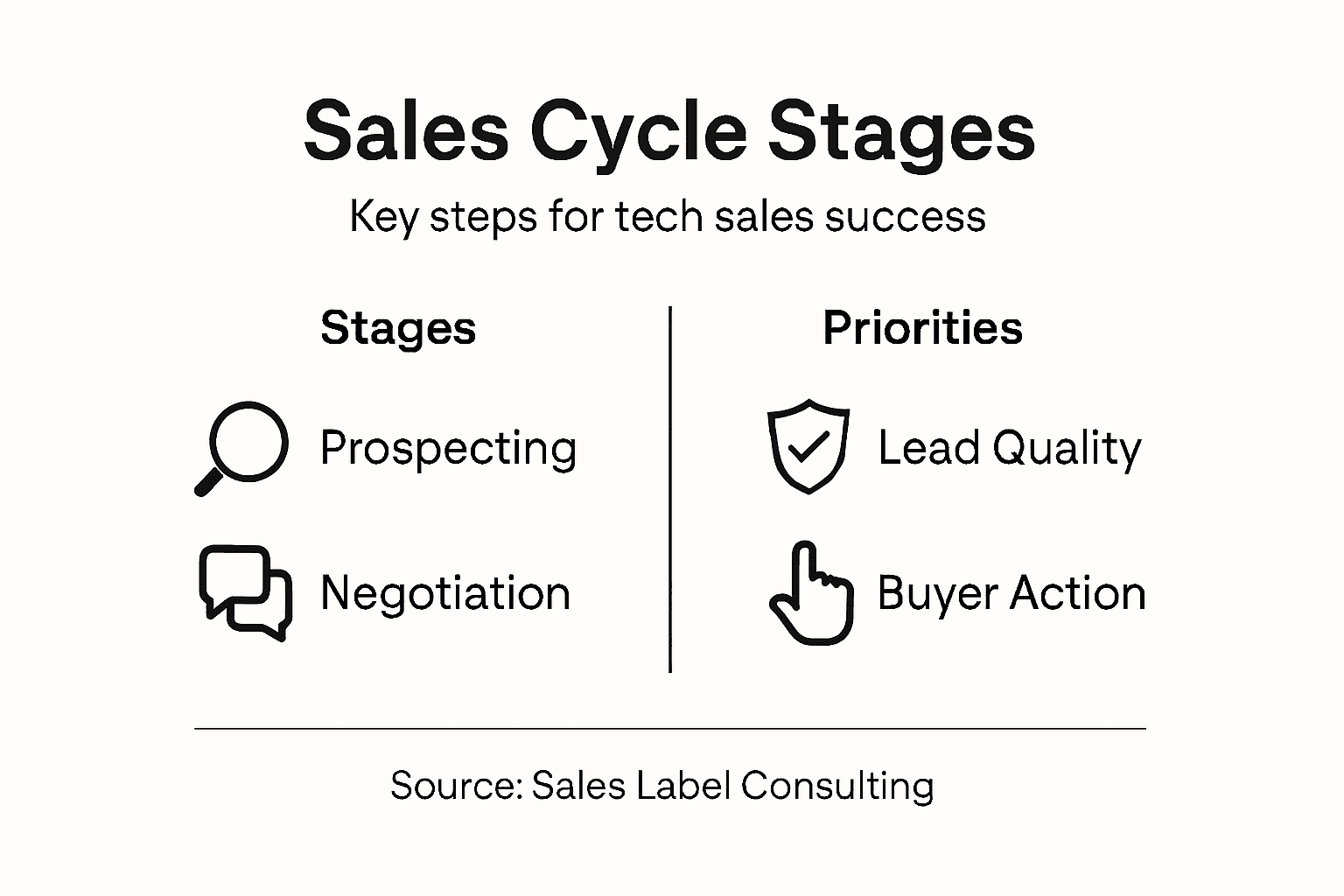
Pro tip: Map your actual sales cycle by reviewing your last 20 closed deals and noting how long each truly spent in each stage. This real data beats any generic framework and reveals where your actual bottlenecks live.
Not all sales cycles are created equal. The reality is that sales cycle lengths vary dramatically across industries, and pretending yours fits a standard template is where most sales leaders go wrong.
Take technology and software sectors. You’re looking at 90 to 121 days on average. But flip to pharmaceuticals or non-profits, and you’re staring at cycles exceeding 150 days. Your deal size, buyer complexity, and even your pricing model all influence how long prospects actually take to close. This isn’t academic. It changes your forecast accuracy and pipeline planning entirely.

Company size matters more than most realize. Larger organizations typically run longer sales cycles because more stakeholders need approval, more rounds of security reviews happen, and budget cycles feel endless. A mid-market deal in the EU might drag through procurement processes that a startup never encounters.
Here’s what’s shifted recently: enterprise sales cycles increased by 36% in 2023, with overall averages up 24% across industries. Usage-based pricing models saw the biggest extensions. This trend forces you to recalculate your pipeline-to-quota coverage ratios. If your cycle just grew by a third, your pipeline needs to grow proportionally or you’ll miss quota.
Your sales channel matters too. Inbound approaches tend to compress timelines because leads come pre-warmed. Outbound demands more relationship-building and takes significantly longer. When you’re managing sales teams across different company sizes, these channel differences become critical to understand.
The real trap: applying one cycle length to all deals. Your enterprise deals move differently than your mid-market ones. Your inbound leads behave differently than your cold outreach. Stop averaging. Start segmenting.
Here’s a look at how key factors influence sales cycle length and complexity across industries:
| Factor | Impact on Cycle Length | Example Industry | Business Implication |
|---|---|---|---|
| Deal Size | Larger deals take longer | Enterprise Software | Requires deeper forecasting |
| Buyer Complexity | More stakeholders slow process | Pharmaceuticals | Demands tailored outreach |
| Pricing Model | Usage-based adds negotiation | SaaS | Extends legal reviews |
| Company Size | Larger firms have longer cycles | Non-Profit | More approval layers |
| Sales Channel | Inbound is typically faster | Tech | Higher conversion rates |
Pro tip: Segment your pipeline by deal size, sales channel, and industry, then calculate actual cycle lengths for each segment separately. This granular view reveals where you’re really stalled and where you can compress timelines most effectively.
B2B tech sales aren’t about single moments of magic. They’re about orchestrating a series of critical touchpoints where you demonstrate value repeatedly. Managing B2B customer journeys requires strategic coordination across digital and physical touchpoints to keep prospects engaged through long, complex sales processes.
Here’s what separates winners from average performers: they know which touchpoints matter most. Early discovery calls set expectations. Product demos build confidence. Security reviews and proof-of-concepts eliminate risk. Executive presentations secure budget approval. Each one serves a purpose. Each one moves deals forward or stalls them entirely.
The buying center complicates everything. You’re not selling to one person. You’re selling to multiple stakeholders with different priorities, different concerns, and different timelines. The procurement director cares about cost. The IT security lead cares about vulnerabilities. The CFO cares about ROI. Your touchpoints need to address all of them without falling apart.
Now here’s where automation enters the game. Automated touchpoints in early sales stages nurture relationships and optimize interaction efficiency, but they work best when combined with human effort. Your sales team handles high-touch moments. Automation handles the follow-ups, the reminder emails, the content sequences between meetings. The combination accelerates movement through your pipeline.
Consider your actual tech sales flow. Initial outreach happens via email or LinkedIn. Then a discovery call. Then a product walkthrough. Then a technical evaluation period. Then procurement questions. Then negotiation. Each transition is a touchpoint. Each requires someone on your team ensuring nothing falls through the cracks.
When you’re identifying the right moments to engage prospects using sales triggers, you’re essentially mapping your most critical touchpoints and timing them perfectly against buyer behavior.
To clarify how B2B tech sales touchpoints drive deal progress, here’s a summary table:
| Touchpoint | Stakeholder Focus | Business Value | Measure of Success |
|---|---|---|---|
| Discovery Call | Decision-Maker | Sets expectations | Agreed next steps |
| Demo/Walkthrough | User & IT | Builds product confidence | Confirmed interest |
| Security Review | IT Lead | Reduces risk | Issues resolution |
| Proof-of-Concept | Technical Stakeholder | Validates solution fit | Positive performance data |
| Executive Presentation | Finance/Budget Holder | Secures financial backing | Budget commitment |
Pro tip: Map every touchpoint in your sales process, assign owners, and establish clear success criteria for each one, then audit quarterly to ensure nothing important gets skipped or delayed.
Most sales leaders are lying about their forecasts. Not intentionally, but they’re guessing anyway. The difference between chaos and predictability comes down to one thing: stage-based forecasting that links deal progress to validated close probabilities. Stop relying on gut feel. Start relying on data.
Here’s the brutal truth. If your pipeline stages don’t reflect actual buyer actions, your forecasts are fiction. When you define a stage as “qualified lead,” you’re defining a verifiable moment where something happened. A discovery call occurred. A prospect submitted a requirements document. A budget conversation happened. These aren’t opinions. They’re facts.
Accurate forecasting demands rigor. Each pipeline stage must represent real buyer commitment, not wishful thinking. Progress through stages becomes an objective indicator of what’s actually happening in your deal. No more “stuck in review” nonsense. Either they took action or they didn’t.
The technology piece matters too. Advanced statistical and machine learning models improve forecasting accuracy across complex sales environments, but they’re only as good as your data inputs. Garbage in, garbage out. If your team isn’t tracking actual stage progression, no algorithm saves you.
Why does this matter for your European tech sales team? Longer cycles mean more time for deals to shift. More stakeholders mean more complexity. Currency fluctuations and regulatory changes add variables your gut can’t process. Data-driven forecasting helps you see signals earlier and adjust resource allocation before quarters go sideways.
The real win is predictable revenue. When your board knows what’s coming, when your team knows what to focus on, when you allocate resources against actual probability instead of hope, everything changes. You reduce reliance on subjective judgment and improve sales management effectiveness.
Pro tip: Audit your pipeline definitions right now and ensure each stage requires documented buyer action, then backtest your close probability estimates against your actual historical close rates for each stage.
Your sales cycle isn’t failing because your team lacks hustle. It’s failing because of hidden problems nobody talks about. Poor communication, inefficient lead qualification, weak follow-up, lack of training, and fragmented data collectively erode sales effectiveness. These aren’t character flaws. They’re structural issues that compound over time.
Start with communication. Your sales team doesn’t talk to marketing. Marketing doesn’t talk to RevOps. RevOps doesn’t understand what SDRs actually encounter in the field. When information doesn’t flow freely, deals slip through cracks. Prospects get contacted by multiple people saying different things. Your buyer experience becomes a mess.
Lead qualification is where most teams hemorrhage deals. You’re spending energy on prospects who’ll never buy while letting real opportunities languish. Without clear qualification criteria, your team treats all leads equally. The startup with no budget gets the same attention as the enterprise ready to sign. That’s a math problem, and math always wins.
Follow-up is another killer. One email doesn’t close deals. One call doesn’t move prospects. Yet most sales organizations treat follow-up as optional. Prospects get contacted once, hear nothing, and assume you don’t care. Consistent follow-up isn’t annoying. It’s professional. It’s the difference between deals that move and deals that die.
Training creates accountability. When your team understands why they qualify leads a certain way, why they follow up on a specific cadence, why they document conversations, compliance improves dramatically. Untrained teams make decisions randomly. Trained teams make decisions systematically.
Your data infrastructure might be your biggest liability. When customer information lives in three different systems, nobody has a complete picture. Your AE doesn’t know what your SDR said last week. Your success team can’t see the negotiation terms. Fragmented data breeds inconsistent decisions and repeated mistakes.
Pro tip: Run a sales process audit this quarter: map every step, identify where deals actually stall most, then assign one owner to fix that bottleneck before moving to the next one.
You can’t transform your sales cycle without transforming what enables it. Effective sales enablement integrates data-driven training, content management, coaching, and technology adoption to reinforce winning behaviors. This isn’t about buying flashy tools. It’s about systematically building capabilities that stick.
Start by understanding what your team actually needs. Most organizations guess. They buy training packages nobody uses. They create collateral that sits in a folder. They implement technology that adds friction instead of removing it. Without a clear audit of your current state, you’re throwing resources at invisible problems.
Conducting a sales enablement audit reveals gaps in alignment between sales and marketing, sales collateral quality, training effectiveness, technology usage, and overall performance. This systematic review is how you identify what’s actually broken versus what you think is broken. Your team might say they need better CRM training when they really need better sales collateral. An audit tells you the difference.
Demand generation feeds your sales cycle. Without consistent pipeline flow, even a perfect sales process produces zero results. When sales and marketing alignment breaks down, demand generation becomes random. One team builds awareness while the other pursues leads nobody qualified. Your European tech market demands precision here. You can’t waste time on unqualified volume.
The real transformation happens when these three pieces work together. Enablement gives your team the skills and tools to execute. Audit identifies where execution breaks down. Demand generation ensures you have enough qualified opportunities to work. Each one depends on the others.
When you assess your sales team’s performance and identify improvement areas, you’re really assessing enablement effectiveness, audit readiness, and demand generation quality simultaneously.
Pro tip: Schedule a two-hour audit this month with your Head of Sales and RevOps lead, focusing on one critical gap that’s costing you deals, then build a 90-day plan to fix it before tackling the next one.
Understanding your sales cycle’s true length and complexity is critical for European tech teams struggling with unpredictable forecasts and stalled deals. The article highlights key challenges like navigating multiple stakeholders, managing critical touchpoints, and avoiding common pitfalls that slow your progress. If your sales funnel feels fragmented or your team is overwhelmed by longer enterprise sales cycles, you are not alone. You need a tailored approach that goes beyond generic templates and superficial fixes.
At Sales Label Consulting, we specialize in transforming your sales process with targeted Sales Enablement and thorough Sales Audit solutions that uncover bottlenecks and empower your team to close deals faster and with more confidence. Our expert demand generation strategies ensure you have a steady flow of qualified leads perfectly aligned with your actual sales cycle stages. Don’t wait for your next quarter to slip away. Act now to build predictable revenue and regain control of your complex B2B tech sales.
Discover how proven strategies and expert consulting can help you break free from stalled deals and inaccurate forecasting. Visit Sales Label Consulting today to schedule your personalized consultation and start optimizing your sales cycle for real results.
A sales cycle is the step-by-step process that sales teams follow to convert prospects into paying customers. It involves planned interactions and can vary in complexity based on the market and customer behavior.
Sales cycles vary because factors such as deal size, buyer complexity, pricing models, and company size significantly influence how long it takes to close deals. Larger organizations and complex products typically lead to longer sales cycles.
To optimize your sales cycle, map your actual sales process by reviewing recent closed deals, segment your pipeline by factors like deal size and sales channel, and focus on improving communication and follow-up strategies within your team.
Critical touchpoints in B2B tech sales include discovery calls, product demos, security reviews, and executive presentations, all of which are designed to engage stakeholders and move deals forward. Each touchpoint must address the needs of different stakeholders to maintain momentum.
Subscribe to our Insights: Expert productivity tips in your inbox
You'll receive 1-3 emails per month. Your data stays private, always.

CEO & Co-Founder with Sales Label Consulting Firm

Let's Audit your Sales Department
October 15, 2026 - 9 min read
Read article Read articleOctober 14, 2026 - 7 min read
Read article Read articleOctober 13, 2026 - 10 min read
Read article Read articleOctober 12, 2026 - 11 min read
Read article Read article