SDR vs BDR: What Differs and Which to Hire
SDR vs BDR explained for sales leaders: who owns inbound and outbound, how the roles are measured, why titles blur, and which to hire first.
The short answer: an SDR (Sales Development Representative) qualifies demand that already raised its hand, and a BDR (Business Development Representative) creates demand from scratch through outbound. Both hand a qualified meeting to an account executive (AE). But the titles are not standardized, so the label on a job ad matters far less than the motion behind it. If you run sales at a B2B tech company, the real decision is not which acronym to use. It is which lead source you are staffing, who owns it, and how the handoff to your AEs is defined.
We work with Heads of Sales and CEOs who inherit a team where “SDR” and “BDR” mean three different things to three different people. Real talk: that confusion is a system problem, not a vocabulary problem. Here’s how to sort it out.
TL;DR
- SDR usually means inbound qualification: demo requests, content downloads, webinar signups. BDR usually means outbound prospecting: cold calls, cold email, LinkedIn, named target accounts.
- Both roles produce the same deliverable: a qualified meeting for an AE. Neither closes deals.
- Many companies mix or invert the titles, and some use them as seniority rungs. Define the role by its lead source and metrics, not its title.
- Hire for the motion you need. Inbound volume points to SDRs. A target-account list with no inbound points to BDRs.
- Whatever you call them, write down the handoff moment and the qualification rules before you hire.
Table of Contents
- What SDR and BDR mean
- SDR vs BDR at a glance
- Why the titles overlap in practice
- What each role does day to day
- How to measure each role
- Which one should you hire first?
- Where AI fits
- Perspective
- Get the system right before the hire
- FAQ
- Sources
What SDR and BDR mean
Both are early-pipeline roles that sit before the AE. The common convention, as ZoomInfo’s guide lays it out, gives SDRs inbound lead response and qualification, while BDRs build outbound pipeline.
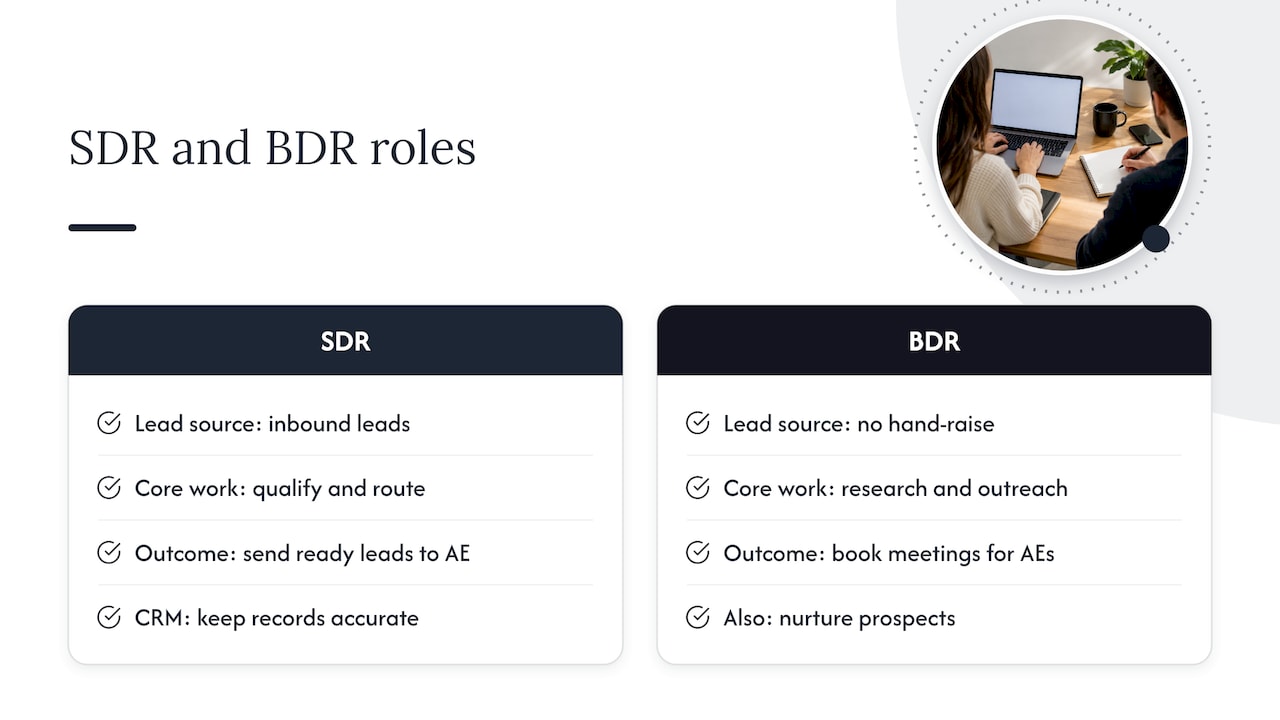
SDR. Marketing generates a lead: someone fills in a form, requests a demo, downloads a guide or registers for a webinar. The SDR responds fast, works out whether the person has real fit and interest, and routes the sales-ready ones to an AE. The SDR also keeps CRM records accurate along the way.
BDR. Nobody has raised a hand yet. The BDR identifies target companies and the right people inside them, researches contact details and reaches out by phone or email. Salesforce’s guide describes the BDR job as prospecting, qualification, nurturing and booking meetings for AEs, including staying in touch when a qualified prospect’s timing is not right yet.
There is a bit of history behind the confusion. The specialized prospecting role was popularized by Aaron Ross and Marylou Tyler’s book Predictable Revenue, based on the outbound team Ross built at Salesforce. In that model, “sales development” originally meant outbound. The inbound-equals-SDR split came later. And there is no official US federal definition of either title: the Bureau of Labor Statistics direct-match title list has no SDR or BDR entry.
SDR vs BDR at a glance
| SDR (typical convention) | BDR (typical convention) | |
|---|---|---|
| Lead source | Marketing-sourced inbound leads | Self-sourced outbound, target accounts |
| Core job | Qualify interest that already exists | Create interest that does not exist yet |
| Main channels | Phone, fast email follow-up | Cold email, LinkedIn, cold calls, multi-threaded sequences |
| Dominant metric | Speed to lead, qualification rate | Pipeline sourced, accounts engaged, meetings booked |
| Key skill | Fast response, high call-volume tolerance | Research, personalization, persistence |
| Typically reports to | Marketing or sales, depending on company | Sales |
| Output | Qualified meeting for an AE | Qualified meeting for an AE |
Treat this table as the convention, not the law. The next section shows how often reality differs.
Why the titles overlap in practice
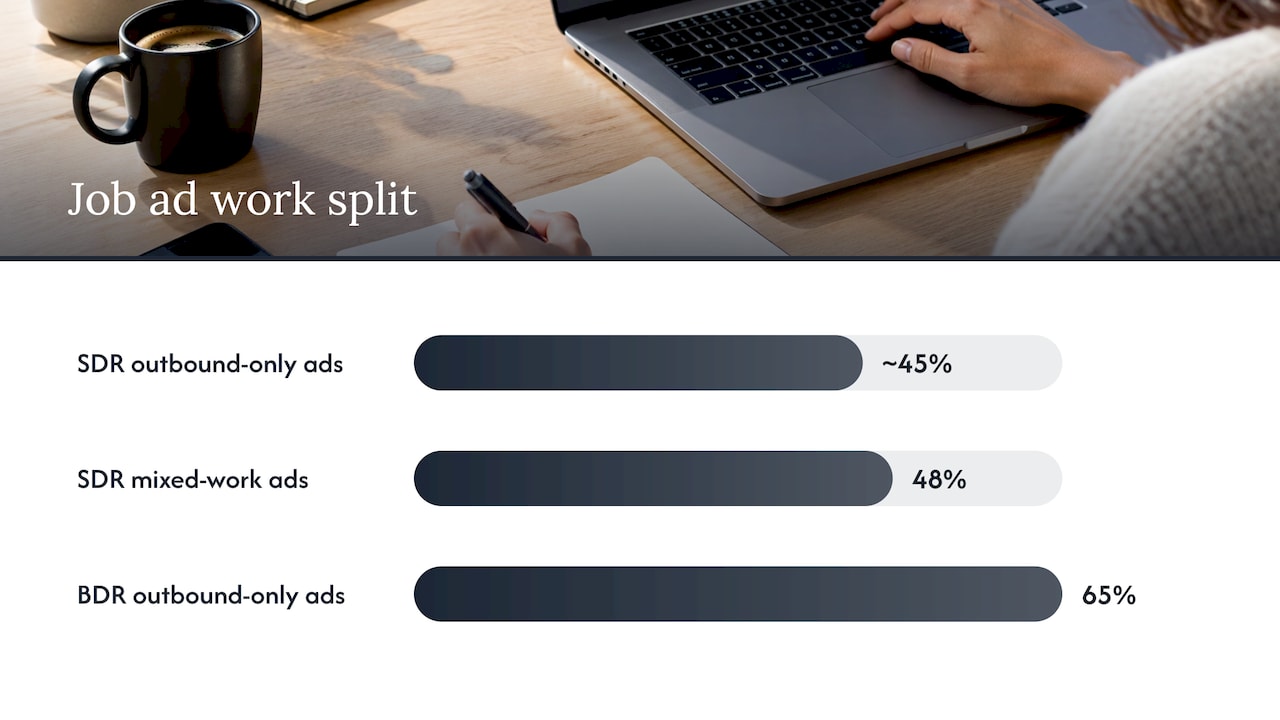
If you have ever read a stack of job ads and felt the definitions did not hold, you were right. ParrotNotes analyzed 154 live job ads and found that only 3 of 91 SDR ads described inbound-only work. Roughly 45% of the SDR ads were outbound-only and 48% mixed both. On the BDR side, 65% of 63 ads were outbound-only. So “BDR = outbound” mostly holds, while “SDR = inbound” barely does.
Why the drift? Titles get borrowed from a previous employer. The work changes and the title stays. Some companies use one title as an entry rung and the other as the next step: Salesforce’s guide notes that some companies treat BDR as entry-level and SDR as the career step after it, and others invert the usual inbound and outbound split entirely. Reporting lines differ too. A Bridge Group survey, as cited in the same ParrotNotes analysis, found 60% of sales development reps report to sales, 26% to marketing and 10% directly to a C-level executive.
So is a BDR higher than an SDR? Nothing in the title says so. Seniority is set by your own career ladder, not by the acronym.
Practitioners say the same thing. Gail Behun, Senior Director of Revenue Enablement at Juniper Square, told Sales Enablement Collective that her company uses “inbound SDRs” and “outbound SDRs”, because the practical question is whether the rep works inbound or outbound leads.
Real talk: pick the vocabulary once, write it into your sales playbook, and use it consistently in job ads, CRM fields and board decks. The label is arbitrary. The inconsistency is expensive.
What each role does day to day
The BDR week
A BDR starts with a list: target accounts that match your ideal customer profile (ICP, the type of company and buyer you sell to best). Then comes research, identifying the people who matter in each account, and outreach by cold call, cold email and LinkedIn. ZoomInfo’s guide lists account research, cold calls, cold email and LinkedIn as the usual tools for opening conversations with prospects who have not engaged. The BDR books a qualified meeting, hands it to an AE and moves to the next account.
This is a research-and-persistence job. It rewards someone who can write a relevant first line and keep going through silence.
The SDR week
An SDR lives in the queue. Leads arrive from demo requests, content downloads and webinar signups, and the clock starts the moment they do. The SDR sorts the genuinely interested from the merely curious, confirms fit, books the meeting and keeps the CRM clean. It is a speed-and-judgment job. It rewards quick reflexes, comfort with high call volume and the ability to ask sharp qualifying questions.
What neither does
According to Revenue.io’s guide, lead-qualification reps at nearly all B2B companies do not close deals. They qualify opportunities for AEs, who run discovery, demo, proposal, negotiation and close. If your SDRs or BDRs are expected to close, you are probably describing an AE role under another name.
How to measure each role
The two roles need different scorecards, because they work different lead sources. Guideflow’s 2026 mid-market SaaS benchmarks give a rough sense of the gap: SDRs book about 20 to 30 meetings a month, BDRs about 12 to 18 qualified meetings, with cold email reply rates of 3% to 8% for outbound and 15% to 25% for warm inbound email. Treat those as one vendor’s mid-market figures, not a target for your team. Your ACV, market and ICP will move them a lot.
What matters more is the shape of the scorecard:
- SDR: speed to lead, lead-to-meeting conversion, demo show rate, qualification accuracy.
- BDR: accounts engaged, meetings booked, pipeline sourced, meeting-to-opportunity rate.
Bessemer Venture Partners’ operating guide recommends tracking dials, connect and hold rates, demo show rate, talk time, meetings booked and pipeline rather than relying on activity totals alone. That is the point. A rep can make 80 calls a day and create nothing. If you want to connect activity to economics, start with calculating cost per lead and then follow the lead through to pipeline.
In our experience building revenue systems, the metric that gets neglected is the meeting-to-opportunity rate. A rep who books many meetings your AEs reject is hurting you twice: wasted AE time and a distorted pipeline forecast. That is why the qualification criteria should be agreed with sales and marketing before anyone is hired. Our guide on B2B qualification criteria walks through seven tests a lead should pass before sales engages, and the sales and marketing SLA piece shows how to formalize the agreement.
Which one should you hire first?
Skip the title debate and ask three questions.
- Do you have inbound volume that goes cold? If demo requests and content leads sit for hours, an SDR function pays back first. Speed to lead is the lever.
- Do you have a named list of accounts you want but nobody is calling? That is a BDR job. Outbound only works when someone owns the research and the sequences.
- Is your AE spending time on both? Then your AE is doing the wrong job. Founders and AEs who prospect on the side tend to drop it whenever a deal gets hot.
For an EU tech company with a small team, a common pattern is one outbound-focused rep first, because inbound volume is often not there yet. Add inbound qualification when marketing starts delivering a steady flow. If you sell into several European markets, language, buying habits and data rules change the outbound playbook. We cover that in European B2B sales differences.
Hiring cost matters here too. In the US, one vendor’s 2026 compilation puts entry-level SDR base salaries at $55,000 to $65,000 and median on-target earnings at $83,000 to $102,000, with average tenure around 1.8 years. Bessemer reports average SDR/BDR tenure of about 14 months in many portfolio companies, sometimes as short as six. In both cases the role is a stepping stone, and your system has to absorb constant turnover. Our SDR hiring benchmarks page goes deeper on what to expect and what to pay.
Build for turnover
Short tenures are normal, so the role cannot depend on one star rep’s memory. That means a written ICP, documented messaging, a clear definition of a qualified meeting and an onboarding path that gets a new rep productive quickly. Structure beats heroics.
Where AI fits
People ask whether AI will replace SDRs. What we see in practice is a split of work, not a swap. Research, list building, first-draft personalization, CRM updates and routing are the repeatable parts that automation handles well. Judgment on a live call, reading a buyer’s real intent and deciding who deserves AE time still need a person who knows your market. Teams that automate a broken process just produce bad outreach faster. Fix the ICP, the qualification rules and the data model first. Then decide which steps to automate. Our piece on the B2B sales tech stack covers what to buy and what to skip.
Perspective
Most SDR vs BDR conversations we get pulled into are not really about SDRs or BDRs. They are about a pipeline that leaks somewhere between the first touch and the AE’s calendar, and a title change was supposed to fix it.
Our view: the role is a component in a revenue system, not a fix on its own. An outbound rep without a sharp ICP burns your market. An inbound rep without an agreed definition of “qualified” floods AEs with meetings they do not want. A handoff nobody wrote down turns into a weekly argument between sales and marketing.
That is why we rebuild the whole chain together: ICP, roles, qualification, pipeline, governance. Isolated fixes are cheap to start and expensive to live with. We come from hands-on operating experience in tech, not theory, so we care about what a rep does on Tuesday morning and how you will know it worked on Friday.
If you are choosing between an SDR and a BDR, ask what has to be true for either one to succeed here. If you cannot answer in two sentences, design that first, then hire.
Antony
Get the system right before the hire
If your SDR and BDR roles overlap, your handoff is vague or your AEs reject half the meetings, we can help you map the problem and rebuild it. Sales Label Consulting offers Sales Role Design, Sales Team Setup, Sales Workflow Audit and Revenue System Diagnostics for B2B tech companies in the EU. These cover the ICP, the roles, the pipeline and the governance around them, delivered as a connected system rather than isolated fixes.
If you want to see where your revenue system stands first, start with the Revenue Diagnostic.
FAQ
Is a BDR higher than an SDR?
Not by definition. Seniority depends on the employer. Some companies treat BDR as the entry-level role and SDR as the next step, and others do the opposite. Look at the company’s career ladder, not the acronym.
Which is better, SDR or BDR?
Neither is better; they solve different problems. SDRs convert existing interest into meetings, and BDRs create interest where there is none. Choose by your lead source: strong inbound volume calls for SDRs, and a target-account list with little inbound calls for BDRs.
What is the difference between a BDR and an AE?
A BDR opens the conversation and books a qualified meeting. An account executive takes that meeting and runs discovery, demo, proposal, negotiation and close. The handoff between them should be defined in writing, including what counts as qualified.
Will SDRs be replaced by AI?
Parts of the job are being automated, especially research, list building, first drafts and CRM upkeep. The conversation-heavy parts, such as live qualification and reading buyer intent, still depend on people. The practical move is to design the process first and then automate the steps that are stable.
Do I need both roles?
Only if you have both motions. Many companies do not separate them at all and simply run inbound and outbound reps under one title. What matters is that every lead source has an owner and a scorecard.
Sources
- SDR vs. BDR: What’s the Difference? (ZoomInfo)
- What is a Business Development Representative? (Salesforce)
- SDR vs BDR: Differences, Metrics and Which to Hire (Bebop)
- SDR vs BDR: What 154 Live Job Ads Show (ParrotNotes)
- SDR vs BDR: What’s the real difference in sales roles? (Sales Enablement Collective)
- Inside Sales Job Titles: SDR, BDR, ISR & AE (Revenue.io)
- SDR vs BDR: The complete guide to sales development roles (Guideflow)
- How to build an SDR / BDR function (Bessemer Venture Partners)
- What Does SDR Mean in Sales? (Sifthub)
- Cost Per Lead: How to Calculate It and What to Aim For
Recommended
More from Insights
 ArticleSales Dashboard Design: A Practical Guide for Revenue Leaders
Sales Label Consulting · 25 Nov 2026 · 13 min read
 ArticlePartner Deal Registration: Rules That Protect Pipeline
Sales Label Consulting · 24 Nov 2026 · 12 min read
 ArticleSandbagging in Sales: How to Spot It and Fix What Causes It
Sales Label Consulting · 23 Nov 2026 · 15 min read